
ARzPaya Fee Calculator
Estimate Your Trading Costs
Your Estimated Costs
Enter values above to see your estimated fees
When a trader in Iran-or anyone curious about the region’s digital‑asset scene-searches for a reliable platform, ARzPaya is often the name that pops up. This review breaks down what the exchange actually offers, how it stacks up against local rivals, and whether its claims hold water for everyday users.
Key Takeaways
- ARzPaya runs both a web portal and a mobile app, focusing on Tether‑centric trading with 24‑hour support.
- Identity verification is only mandatory for Iranian Rial (IRR) deposits and withdrawals; crypto‑only trades can stay anonymous.
- Fees are low on paper, but hidden spreads on the Tether market can raise effective costs.
- Regulatory pressure in Iran and international sanctions mean the platform is blocked on several global P2P services.
- Education is a major selling point-ARzPaya publishes a magazine and a library of step‑by‑step guides.
What is ARzPaya?
ARzPaya is a cryptocurrency exchange based in Iran. Launched in the early 2020s, it markets itself as the country’s largest digital‑currency marketplace, serving “millions of users worldwide.” The platform offers a web interface at arzpaya.com and a mobile app on Google Play. Its core promise is fast Tether (USDT) trading, minimal fees, and a dedicated wallet for each supported coin.
Supported Assets & Wallet Structure
ARzPaya lists a solid lineup of major cryptocurrencies. Each coin gets its own isolated wallet, so users can keep Bitcoin, Ethereum, Binance Coin, Cardano, Chainlink, SHIB, and others separate from their Tether balances.
Bitcoin and Ethereum are the flagship assets, while Binance Coin (BNB) and Cardano (ADA) round out the offering. The platform also supports Chainlink (LINK) and the meme token SHIB.
All wallets are custodial, meaning the exchange holds the private keys. Users can withdraw any amount to an external address 24 hours a day, but the speed of withdrawals depends on network congestion and internal batch processing schedules.
Trading Interfaces & Fee Structure
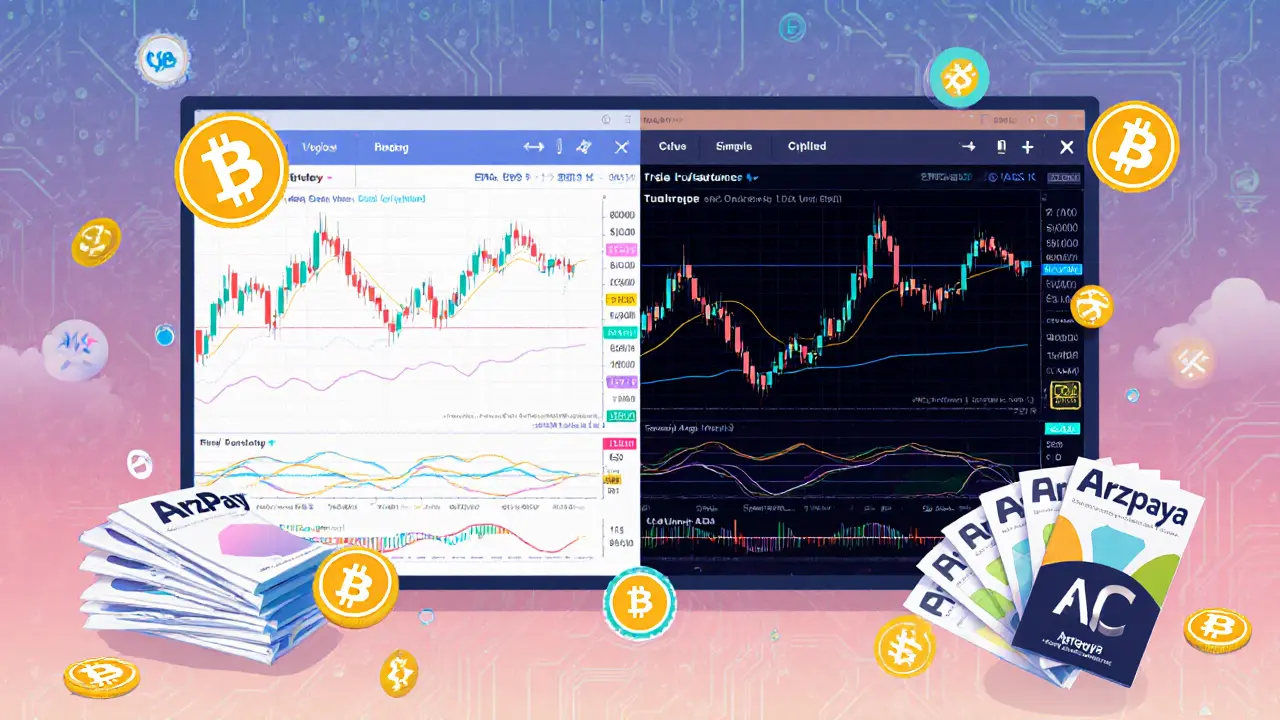
Two UI modes are available: a “Simple” view for beginners and a “Professional” view with advanced charting tools. Both interfaces connect to the same order book, primarily for USDT‑pair markets.
Fees are advertised as a flat 0.2 % per trade, but the spread on the Tether market can vary between 0.1 % and 0.5 % depending on liquidity. Deposits in Iranian Rial via the Shetab network (the domestic banking card system) incur a 1 % processing charge, whereas crypto‑only deposits are free.
Withdrawals to an external wallet are charged 0.0005 BTC for Bitcoin, 0.005 ETH for Ethereum, and a flat 5 USDT for Tether. The platform does not list fees for less common assets, so users must contact support for exact numbers.
Verification, Security, and Compliance
ARzPaya follows a dual‑tier KYC approach. Users who only trade crypto can stay “unverified,” but any IRR deposit or withdrawal triggers a full identity check (national ID, phone number, and selfie). This hybrid model is common among Iranian exchanges because it balances regulatory demands with user privacy expectations.
Security‑wise, the exchange claims “cold‑storage” for the majority of its Tether holdings, yet no third‑party audit reports are publicly available. The platform’s wallet architecture-dedicated per‑coin wallets-helps limit cross‑contamination if one asset is compromised.
Internationally, NoOnes, a major P2P marketplace, lists ARzPaya as a restricted exchange. Users attempting to send crypto from ARzPaya to a NoOnes wallet risk account freezes. This restriction stems from sanctions, AML concerns, and the broader perception that Iranian exchanges carry higher fraud risk.
Educational Resources
One of ARzPaya’s standout features is its content library. The “ARzPaya Magazine” publishes weekly articles covering basics like “What is blockchain?” and deeper dives into topics such as Proof of Stake (PoS) versus Proof of Work (PoW). The site also hosts video tutorials, live webinars, and a glossary of crypto terms-all aimed at helping newcomers avoid costly mistakes.
Competitive Landscape in Iran
Iran’s crypto space is fragmented, with dozens of exchanges vying for market share. To give readers a quick snapshot, the table below compares ARzPaya against three other home‑grown platforms on key dimensions.
| Feature | ARzPaya | ARZICOIN | Bit.mit |
|---|---|---|---|
| Supported assets | 15+ (incl. BTC, ETH, BNB, ADA) | 10+ | 12+ |
| Mobile app | Google Play (Android) | iOS & Android | Android only |
| KYC for crypto‑only trades | Not required | Required | Not required |
| IRR deposit fee | 1 % | 1.5 % | 1 % |
| International restrictions | Listed on NoOnes blocklist | None reported | None reported |
ARzPaya shines with its education focus and low‑fee Tether market, but the international blocklist can be a deal‑breaker for traders who need cross‑border liquidity.

Pros & Cons
- Pros
- Fast USDT trading and 24‑hour support.
- Dual KYC model lets casual traders stay anonymous.
- Extensive educational material reduces entry barriers.
- Integration with Shetab network eases IRR deposits.
- Cons
- International restrictions limit P2P transfers.
- Lack of public security audit or transparency reports.
- Hidden spreads can make effective fees higher than advertised.
- Customer‑service response times vary, especially during peak market volatility.
Is ARzPaya Worth Using?
If you’re based in Iran, need a local exchange that accepts Shetab cards, and your primary focus is USDT trading, ARzPaya is a solid choice-provided you’re comfortable with the limited international connectivity. For traders who value global liquidity or need to move funds to overseas wallets frequently, a platform without the NoOnes blocklist (e.g., a reputable offshore exchange) might be safer.
Frequently Asked Questions
Can I trade on ARzPaya without providing any ID?
Yes. You can create an account and trade crypto‑to‑crypto (e.g., BTC/USDT) without completing KYC. However, any IRR deposit or withdrawal will trigger a full identity verification.
What are the main fees I should watch for?
Trading fee is listed as 0.2 % per transaction, but the spread on the USDT market can add 0.1‑0.5 % depending on liquidity. IRR deposits cost 1 % and withdrawals to external wallets incur network‑specific fees (e.g., 0.0005 BTC for Bitcoin).
Is my crypto safe on ARzPaya?
ARzPaya stores most USDT in cold storage and offers dedicated wallets per coin, which limits cross‑asset risk. However, the exchange does not publish third‑party audit reports, so some users prefer keeping large balances on hardware wallets instead.
Why is ARzPaya blocked on NoOnes?
International platforms view Iranian exchanges as high‑risk due to sanctions, AML concerns, and limited regulatory transparency. NoOnes adds ARzPaya to its blocklist to protect users from potential account freezes.
How does the educational content help new traders?
The ARzPaya Magazine publishes step‑by‑step guides, videos, and webinars covering basics like "What is a blockchain?" and advanced topics such as PoS consensus. This material reduces the learning curve and can prevent costly mistakes for newcomers.
Overall, the ARzPaya review shows an exchange that’s well‑tailored for Iran’s domestic market but hampered by global compliance hurdles. Choose it if you need a local gateway to USDT and are comfortable staying within the country’s regulatory limits.


