
GOHOME (GOHOME) isn’t just another meme coin. It’s a $200+ cryptocurrency born from a glitch on the White House website - and it’s now the most expensive memecoin in history. If you’ve heard whispers about a coin that costs more than Bitcoin per unit, you’re not imagining things. GOHOME is real, wild, and built on Solana. But what exactly is it? And why are people buying it at prices that seem insane?
How GOHOME Started: A White House Glitch That Went Viral
On January 21, 2025 - the day after Donald Trump’s inauguration - the official White House website had a 404 error page. For a few hours, it displayed a button that said "go home." It wasn’t a joke. It wasn’t a hack. It was a technical mistake. Someone typed the wrong code. But the internet didn’t care about the error. It saw a meme.
Within 48 hours, the phrase "go home" was trending on Twitter, TikTok, and Reddit. Memes popped up everywhere: politicians being told to "go home," protesters holding signs with the phrase, even a dog wearing a "go home" hat. Then, a group of anonymous developers launched GOHOME - a token named after the glitch. No whitepaper. No roadmap. Just a community that said: "Let’s turn a political mistake into a joke with value."
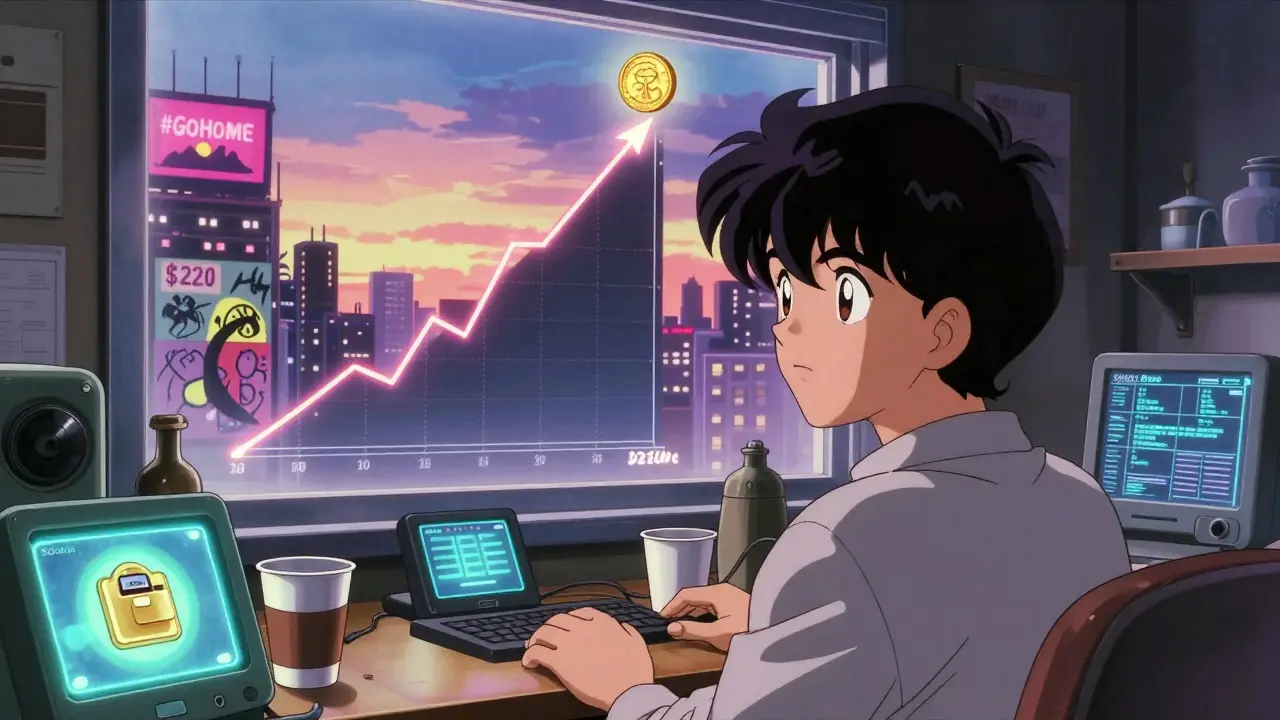
By February 2025, GOHOME was trading. By March, it hit $277.70. Today, it hovers around $220. That’s not a typo. One GOHOME token costs more than a used car in some countries.
Why Is GOHOME So Expensive?
Most meme coins are cheap. Dogecoin? $0.12. Shiba Inu? $0.000007. You can buy millions of them for $10. GOHOME? You need $220 to buy one. And that’s the whole point.
GOHOME’s creators didn’t try to make a coin for mass adoption. They made one for scarcity. Here’s how:
- Total supply: 9,999,619 tokens
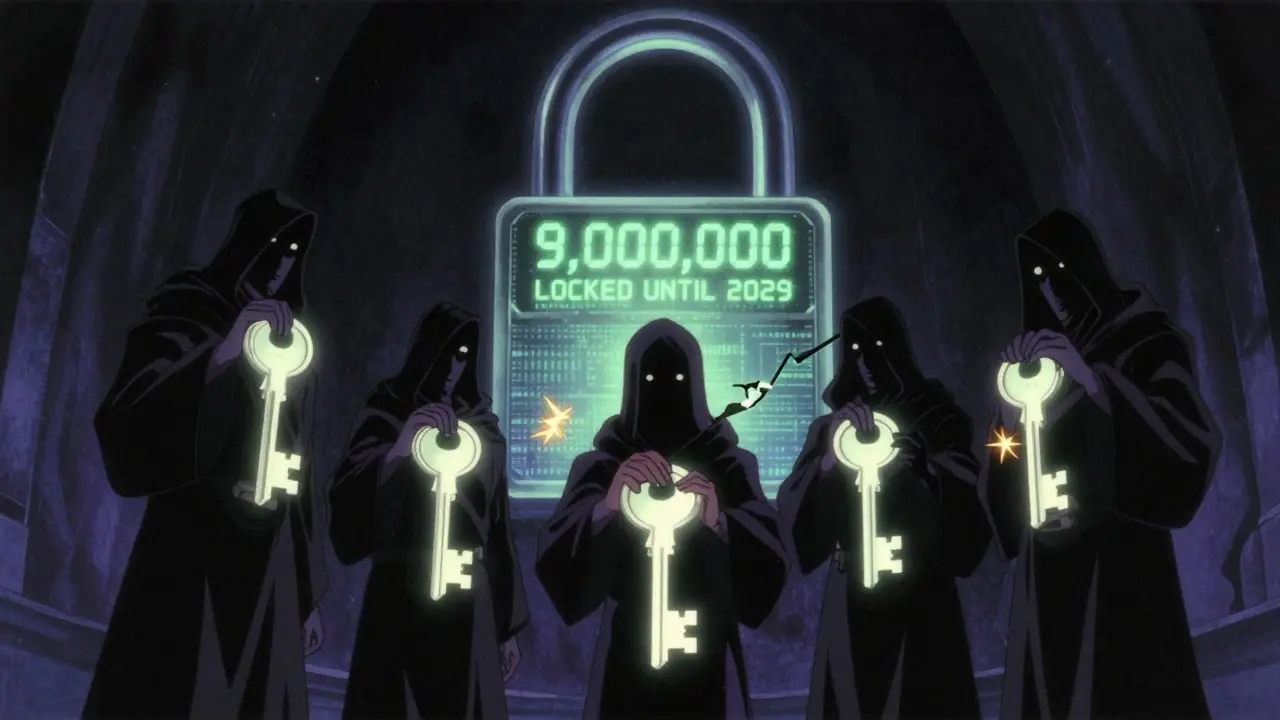
- 9 million tokens are locked until 2029
- Only 500,000 tokens are circulating right now
That means less than 5% of all GOHOME tokens are available to trade. Compare that to Bitcoin, where over 93% of coins are already in circulation. GOHOME is like a limited-edition sneaker with 95% of the stock locked in a vault. The fewer tokens you can buy, the more people are willing to pay.
And then there’s the "Infinite Money Glitch." No one knows exactly what it is. The devs won’t explain it. But traders swear it causes sudden price spikes when certain wallet addresses move tokens. Some call it a secret algorithm. Others think it’s just hype. Either way, it works - for now.
Who Controls GOHOME? The Centralization Problem
Here’s the dark side: 50% of all circulating GOHOME tokens are held by just five wallets. That’s not decentralization. That’s a handful of people holding most of the power.
On October 30, 2025, one wallet dumped 50,000 tokens - worth over $10 million at the time. The price crashed 20% in 15 minutes. The community called it a "rug pull." The devs said it was "a liquidity adjustment."
There’s no proof of malice. But there’s also no proof of safety. Unlike Ethereum or Solana, GOHOME has no public development team. No GitHub. No Twitter account. No official Discord admin. Just a Telegram group with 12,000 members and a Discord server with 8,700. You’re trading based on memes, not code.
Experts are split. CoinCodex warns of "extreme centralization risk." Blockspot.io calls it "a community-driven experiment with smart locking." But both agree: if those 9 million locked tokens unlock in 2029, the price could collapse.
How to Buy GOHOME
You can’t buy GOHOME on Coinbase or Binance. Not yet. Right now, it’s only available on decentralized exchanges (DEXs) that run on Solana. Here’s how:
- Get a Solana wallet: Phantom or Solflare are the easiest.
- Buy SOL (Solana’s native coin) on a centralized exchange like Kraken or Binance.
- Send SOL to your Solana wallet.
- Go to a Solana DEX like Raydium or Jupiter.
- Swap SOL for GOHOME.
Transaction fees? Around $0.00025. That’s cheaper than a cup of coffee. But the real cost is volatility. GOHOME can swing 15% in 10 minutes. One trader on Reddit said they made $5,000 in two days. Another lost $18,000 in one night.
The Community: Meme Culture Meets Financial Speculation
GOHOME’s biggest strength isn’t its tech. It’s its culture. The community treats the coin like a joke - but they’re serious about it.
On Reddit, you’ll find memes of the White House with "go home" buttons. On Discord, people post videos of themselves yelling "go home" at politicians. On Twitter, the hashtag #GoHomeCoin has over 800,000 mentions. It’s not about politics. It’s about absurdity. And that’s what keeps people engaged.
Unlike Dogecoin, which started as a joke and became a payment method, GOHOME has no use case. You can’t buy coffee with it. You can’t tip creators. You can’t use it in games. It’s purely a meme with tokenomics. And that’s why it’s so polarizing.
Is GOHOME a Good Investment?
Let’s be blunt: if you’re looking for a safe, long-term crypto investment, GOHOME is not it.
Here’s what you’re betting on:
- Scarcity: Only 5% of tokens are out there. That could drive prices up.
- Community: The hype is real. More people = more demand.
- Volatility: Big moves mean big profits - or big losses.
Here’s what you’re risking:
- Centralization: A few wallets control half the supply.
- 2029 Unlock: 9 million tokens flood the market. That’s a 2,000% supply increase.
- No utility: It does nothing. Not even pay dividends.
- No roadmap: The devs haven’t said what’s next.
According to Bloomberg Crypto, 92% of meme coins trading above $100 fail within 18 months. GOHOME is at $220. That’s not a good sign.
But here’s the twist: it’s still alive. It’s still trading. People are still buying. And it’s still the most expensive memecoin ever. Maybe that’s enough.
What’s Next for GOHOME?
The community is pushing for a Binance listing. If it happens, GOHOME could explode. But if Binance refuses - or if the devs never release a real update - the coin could fade.
Right now, the only milestone is 2029. That’s when 9 million tokens unlock. If demand has grown by then - if GOHOME has become a cultural staple - maybe the price holds. If not? The market could crash harder than any crypto bubble in history.
For now, GOHOME isn’t a currency. It’s a social experiment. A bet on absurdity. A gamble that the world will keep laughing - and keep paying.
Is GOHOME a real cryptocurrency?
Yes, GOHOME is a real token on the Solana blockchain. It has a public blockchain address, transaction history, and is listed on decentralized exchanges. But it has no utility, no team, and no official documentation - making it a meme coin with extreme speculation, not a traditional cryptocurrency.
Can I buy GOHOME on Binance or Coinbase?
No, GOHOME is not listed on any major centralized exchange as of February 2026. You can only buy it on Solana-based decentralized exchanges like Raydium or Jupiter. You’ll need a Solana wallet (Phantom or Solflare) and SOL to swap for GOHOME.
Why is GOHOME so expensive?
GOHOME’s price is high because only about 5% of its total supply is in circulation. With 9 million tokens locked until 2029, scarcity drives demand. Combined with viral hype from the White House meme, traders are paying premium prices - even though the coin has no real-world use.
Is GOHOME a scam?
It’s not a scam in the traditional sense - there’s no fake website or stolen funds. But it’s extremely risky. A small group controls half the circulating supply, and there’s no transparency. The 2029 token unlock could wipe out its value. Many call it a high-risk gamble, not an investment.
What happens in 2029?
In 2029, 9 million GOHOME tokens will unlock - increasing the circulating supply by over 2,000%. If demand hasn’t grown massively by then, the price could crash. If the community has grown stronger, the price might hold. No one knows. It’s the biggest unknown in the entire project.
GOHOME doesn’t make sense. But then again, neither did Bitcoin in 2009. Maybe that’s why people keep buying it.


