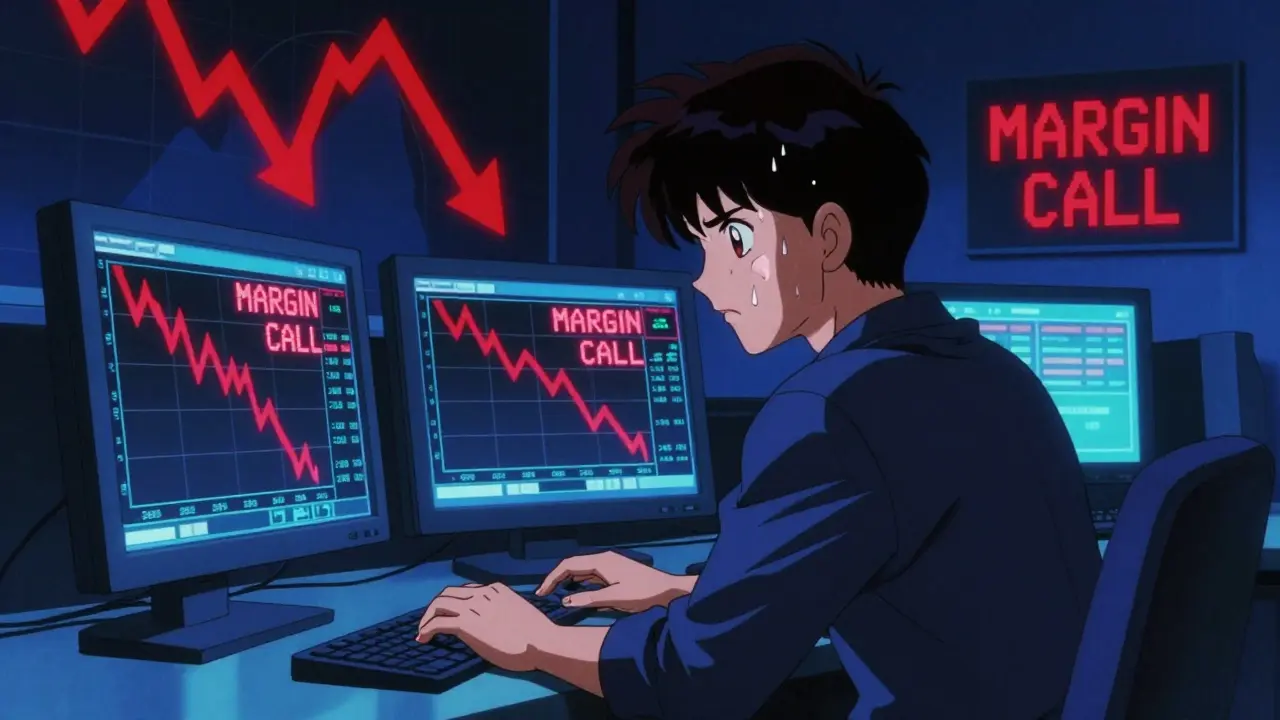
You see the price drop. Your phone buzzes with an alert. Then, suddenly, your position is gone. If you trade with borrowed money-whether on traditional stock exchanges or crypto platforms-you have likely heard the terms margin call and liquidation. They sound technical, but they are actually simple concepts with brutal consequences if you ignore them.
This article breaks down exactly how these mechanisms work, why brokers trigger them, and how you can protect your capital from being wiped out overnight. We will look at the math behind the scenes, the differences between major platforms, and real-world examples of what happens when things go wrong.
What Is a Margin Call?
A margin call is essentially a warning shot. It is a formal demand from your broker or exchange to deposit more funds into your account because your equity has fallen below a required safety level. Think of it as a bank telling you that the value of your house has dropped so much that you no longer qualify for your mortgage without putting down extra cash.
In the world of trading, this concept dates back to 1934, right after the Great Depression crash. The Federal Reserve introduced Regulation T to stop excessive speculation. Today, regulators like FINRA (Financial Industry Regulatory Authority) enforce rules requiring investors to maintain a minimum equity percentage-usually 25%-in their accounts. However, many brokers set even stricter limits, often ranging from 30% to 40%, especially for volatile assets.
The primary purpose of a margin call is not to punish you; it is to protect the lender. When you borrow money to trade, the broker takes on risk. If your trades lose money, the broker still needs to get their loan back. A margin call gives you a chance to fix the problem before the broker has to step in and sell your assets.
- Trigger Point: Your account equity drops below the maintenance margin requirement.
- Action Required: Deposit more cash or collateral immediately.
- Goal: Restore the account to a safe leverage ratio.
Understanding Liquidation: The Final Step
If you ignore the margin call, or if the market moves against you too quickly for you to react, you face liquidation. This is the process where the broker forcibly sells your positions to pay back the borrowed funds. Once liquidation happens, your position is closed, and any remaining equity is yours-but usually, there is little to nothing left.
Liquidation is automatic and ruthless. Algorithms execute these sales at the best available market price, which can be disastrous during high volatility. For example, during the March 2020 market crash, data showed that 68% of retail margin accounts were liquidated at prices 15-25% worse than pre-crash levels due to illiquidity. The broker doesn't care about your long-term investment thesis; they care about recouping their loan.
Different platforms handle liquidation differently. Some, like Kraken, use a first-in-first-out (FIFO) method to close positions. Others, like Fidelity, may target specific assets that caused the deficit. In crypto, exchanges like Binance.US and Coinbase Pro have varying thresholds, making it crucial to read the fine print of your specific platform's agreement.
The Math Behind the Risk
To survive leveraged trading, you need to understand the numbers. The core calculation revolves around the debt-to-collateral ratio. Here is how it works in practice:
- Initial Margin (Regulation T): You must fund at least 50% of the purchase price in cash. The broker lends the other 50%. This means you are trading with 2x leverage.
- Maintenance Margin: This is the minimum equity you must keep in the account. For most equities, it is 25%. For volatile stocks or cryptocurrencies, it can be higher.
- Margin Level Formula: (Account Equity / Total Position Value) x 100.
Let’s say you buy $10,000 worth of Bitcoin using $5,000 of your own money and $5,000 borrowed from the exchange. Your initial equity is 50%. If the price of Bitcoin drops by 10%, your position is now worth $9,000. You still owe $5,000. Your equity is now $4,000 ($9,000 - $5,000). Your new margin level is 40% ($4,000 / $10,000). If the maintenance requirement is 25%, you are still safe. But if Bitcoin drops another 15%, your equity shrinks further, potentially triggering a margin call.
| Platform/Broker | Standard Equity Margin | Volatile Assets/Crypto | Liquidation Trigger |
|---|---|---|---|
| Fidelity | 30% | Higher (varies) | Immediate upon breach |
| Interactive Brokers | 25% | 35-50% | Real-time monitoring |
| Binance.US | N/A | 25% Maintenance | 130% Ratio (76.9% Utilization) |
| Coinbase Pro | N/A | Variable | 125% Ratio (80% Utilization) |
Why Crypto Platforms Are Different
While traditional finance follows strict regulatory frameworks like FINRA Rule 4210, the cryptocurrency space operates with less uniformity. This creates both opportunities and risks. Crypto exchanges often offer much higher leverage ratios-sometimes up to 100x or more. This amplifies gains but also accelerates losses.
For instance, PrimeXBT triggers margin call alerts when available margin falls to 100% of the maintenance requirement, with liquidation occurring at 50% available margin. Compare this to Coinbase Pro, which might trigger calls at a 125% ratio. These subtle differences matter immensely. A trader who understands one platform’s logic might get caught off guard by another’s stricter or looser parameters.
Furthermore, crypto markets never sleep. Unlike stock markets that close at 4 PM EST, crypto trades 24/7. This means a gap down can happen while you are sleeping, eating, or traveling. There is no "after-hours" pause to give you time to react. Real-time alerts via SMS or email are not just nice-to-haves; they are survival tools.
Real-World Scenarios: What Can Go Wrong?
Numbers on a spreadsheet look clean, but human behavior and market chaos complicate everything. Let’s look at two common scenarios.
Scenario 1: The Overnight Gap
Imagine you hold a leveraged position in Tesla stock. During the day, the price is stable. You go to bed. Overnight, bad news hits. The stock opens 10% lower. Because your leverage was 4:1, that 10% drop equals a 40% loss on your equity. Your margin level plummets below the maintenance threshold before you even wake up. By the time you check your phone, the broker has already liquidated your position to cover the debt. You are left with a fraction of your original capital.
Scenario 2: The Crypto Winter Squeeze
During the 2022 crypto downturn, many traders used high leverage to short Bitcoin, expecting it to fall further. Instead, brief rallies triggered cascading liquidations. As shorts were forced to buy back positions to cover debts, the price spiked higher, triggering more liquidations. This "short squeeze" wiped out billions in leveraged positions in hours. Dr. Robert R. Johnson, a finance professor, notes that margin calls crystallize paper losses into real losses at the worst possible moment, often when panic selling drives prices to irrational lows.

How to Protect Yourself
You don’t have to avoid leverage entirely, but you must manage it wisely. Here are practical steps to reduce your risk of liquidation:
- Maintain a Liquidity Buffer: Don’t hover near the minimum margin requirement. Financial Edge Training recommends keeping at least 15% more equity than required. This buffer gave traders in their study a 63% reduction in margin call incidents.
- Use Stop-Loss Orders: Set automatic sell orders at predetermined price levels. This allows you to exit a losing position gracefully before it triggers a full liquidation.
- Monitor Real-Time Data: Use tools like TradingView or your exchange’s dashboard to track your margin utilization percentage constantly. Ignorance is not a defense against algorithms.
- Understand SMA: Special Memorandum Account (SMA) calculations determine how much buying power you have. Misunderstanding SMA led 78% of new margin traders at Fidelity to unexpected violations. Learn how your broker calculates this.
- Diversify Collateral: If your broker allows it, use a mix of stablecoins and less volatile assets as collateral rather than relying solely on the asset you are trading.
Regulatory Changes and Future Trends
The landscape of margin trading is evolving. Regulators are watching closely. The SEC identified margin lending as a high-risk area for broker-dealers in 2022, issuing dozens of deficiency letters for inadequate procedures. In response, FINRA proposed amendments to require real-time display of margin utilization on trading platforms, aiming for compliance by mid-2024.
In Europe, ESMA implemented stricter leverage caps for retail forex traders, reducing margin call incidents by 52%. While this protected consumers, it also reduced participation. We may see similar measures emerge in the crypto sector as the industry matures. Until then, the burden of risk management falls largely on you, the trader.
Technology is also helping. Interactive Brokers launched a "Margin Escape" feature that automatically converts eligible positions to cash upon a margin call for a small fee. This innovation helped users avoid full liquidation in over 90% of cases where it was used. Expect more such protective features to become standard across major platforms.
What is the difference between a margin call and liquidation?
A margin call is a warning that requires you to add funds to your account to meet minimum equity requirements. Liquidation is the forced sale of your assets by the broker if you fail to meet the margin call or if your equity drops below a critical threshold.
How do I calculate my maintenance margin?
Maintenance margin is calculated by dividing your account equity by the total value of your positions. For example, if you have $2,500 in equity and $10,000 in positions, your margin level is 25%. Most brokers require this to stay above 25-30%.
Can I avoid liquidation once a margin call is issued?
Yes, if you act quickly. Depositing additional funds or closing part of your position manually can restore your account equity above the maintenance requirement. However, you must do this within the timeframe specified by your broker, which can be as short as 24 hours.
Is leverage dangerous for beginners?
Highly. Beginners often underestimate the speed at which leveraged losses accumulate. Data shows that retail traders with smaller accounts are significantly more likely to experience liquidation. It is recommended to practice with simulated trading for 3-6 months before using real leverage.
Do all crypto exchanges have the same liquidation rules?
No. Each exchange sets its own maintenance margin requirements and liquidation triggers. For example, Binance.US and Coinbase Pro have different utilization ratios for triggering calls. Always read the specific terms of service for the platform you are using.