
Governance Token Distribution Calculator
Token Allocation Calculator
When a new protocol launches, the biggest question often isn’t how to raise capital-it’s how to hand out the voting power that will steer the project’s future. Governance token distribution is the keystone of any decentralized ecosystem because it decides who gets a say, how incentives line up, and whether the network stays truly community‑run.
Key Takeaways
- Successful distribution balances decentralization, capital raising, and regulatory compliance.
- Allocate tokens across clear buckets: team, investors, community, ecosystem reserves, and advisors.
- Hybrid models that blend paid sales with unpaid incentives tend to deliver the best mix of liquidity and engagement.
- Vesting schedules with cliffs protect against early sell‑offs while rewarding long‑term commitment.
- Delegation, quadratic voting, and vote‑escrowed tokens help mitigate whale dominance.
What Is a Governance Token?
Governance Token is a cryptographic asset that grants voting rights in blockchain protocols and decentralized autonomous organizations (DAOs). Holders can propose changes, vote on fee structures, or approve upgrades. The idea first surfaced with early projects like Dash in 2014 but truly took off when MakerDAO launched MKR in 2017, setting the template for community‑driven finance.
Why Distribution Strategy Matters
If the token ends up in the hands of a few whales, the protocol risks centralization, governance attacks, and loss of credibility. On the flip side, a too‑diffuse spread can stall decision‑making and make it hard to raise funds. Striking the right balance keeps the network secure, attracts investors, and fuels organic growth.
Core Allocation Buckets
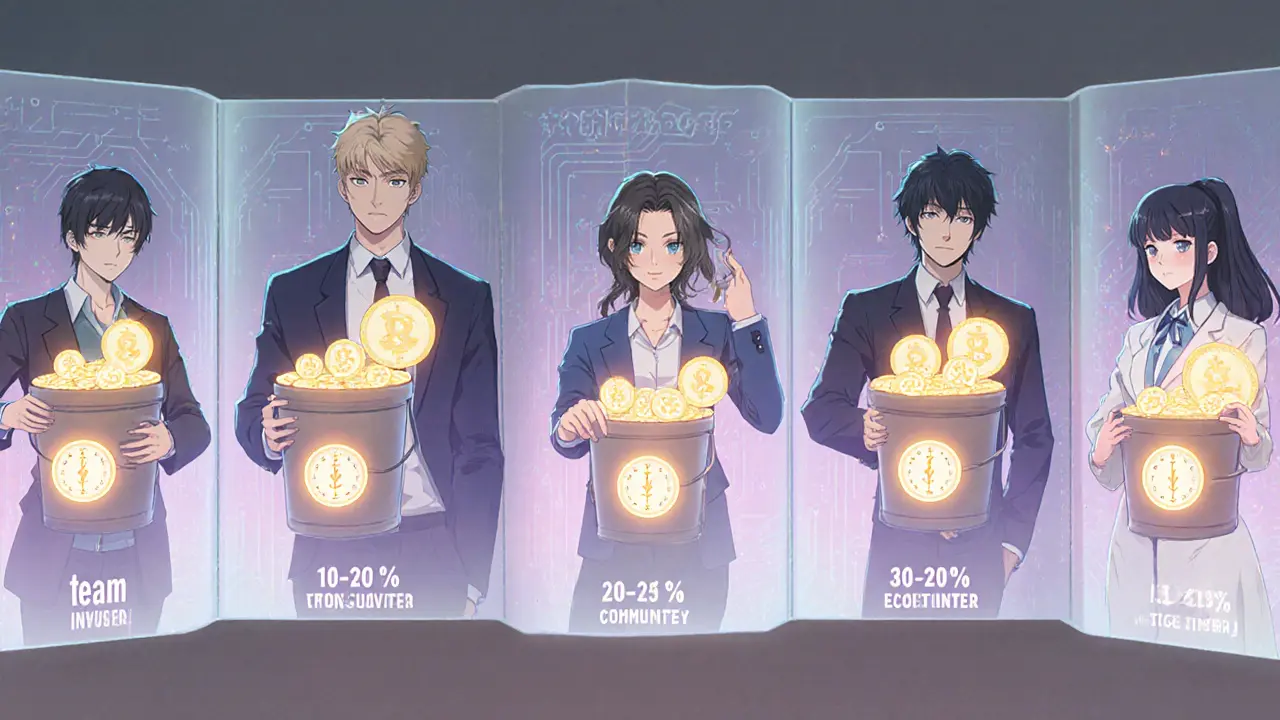
Industry benchmarks, especially from TokenMinds’ 2025 framework, recommend breaking the total supply into five clear categories. Below is a practical range you can adapt based on project size.
| Bucket | Typical % of Supply | Vesting Highlights |
|---|---|---|
| Team | 10‑15% | 4‑year vesting, 12‑month cliff |
| Investors | 15‑20% | Tiered vesting, 6‑12 month cliff |
| Community | 30‑50% | Linear release, no cliff for airdrop‑eligible users |
| Ecosystem / Reserves | 20‑25% | Handled by a treasury, can be re‑allocated |
| Advisors | 2‑5% | 12‑month cliff, 2‑year vesting |
These percentages map directly onto real‑world examples. Uniswap’s UNI token kept 60% for community incentives, while its team and investors together held roughly 20% after a four‑year vesting schedule.
Paid vs. Unpaid Distribution Models
Both approaches have trade‑offs. Paid models-SAFT agreements, private sales, launchpad offerings-provide upfront capital and can be structured to meet SEC guidance (see the 2023 Ripple Labs ruling). However, they often concentrate tokens among accredited investors, as the Terraform Labs case showed, leading to governance friction.
Unpaid models-airdrops, liquidity mining, community rewards-spread tokens more broadly. Uniswap’s 2020 airdrop reached 250,000 unique addresses, with 92% of recipients holding less than 1% of voting power. Yet airdrop farming, where bots claim multiple parcels, can dilute genuine participation. Balancer’s 2020 airdrop suffered a 37% bot capture, according to Reddit reports.
Hybrid strategies combine the best of both worlds. MakerDAO’s rollout started with private sales to strategic partners, later added community mining, and now routes a share of protocol revenue to token holders through a vote‑escrow model.
Designing a Hybrid Distribution Plan
- Define clear objectives. Example: raise $30M, onboard 15k unique token holders, keep any single entity under 25% of voting power.
- Segment the allocation. Follow the bucket table above, but adjust community share upward if you aim for mass participation.
- Launch a private sale. Use a SAFT with accredited investors, enforce KYC/AML per 31CFR§1010.380 for contributions above $1,000.
- Run a public airdrop. Target users who have interacted with the protocol (e.g., performed a swap on Uniswap before a certain date). Use Snapshot for gasless claim verification.
- Introduce liquidity mining. Offer extra rewards that decay over time to encourage early adopters and then taper off.
- Set vesting schedules. Apply 12‑month cliffs for team/investor tokens, no cliff for community airdrop, and linear unlocks for ecosystem reserves.
- Implement delegation. Allow token holders to delegate voting power to trusted delegates, as Uniswap’s delegation model shows 78% of power delegated to active participants.
- Monitor and rebalance. After six months, audit token distribution. If any address holds >5% of supply, consider a token‑swap or lock‑up to dilute concentration.
Following this roadmap typically takes 3‑6months: 4‑6weeks for legal review, 8‑10weeks for tokenomics modeling (tools like TokenSPICE), and 6‑8weeks for smart‑contract development and audit (OpenZeppelin is a common auditor).
Regulatory Safeguards
Governance tokens sit in a gray area. The SEC’s 2024 guidance treats tokens with “meaningful governance rights” as securities unless distribution reaches at least 5,000 unaffiliated holders controlling 75% of voting power. The EU’s MiCA framework, effective Jan2025, demands a “substantial utility assessment” to avoid classification as a financial instrument.
Practical steps:
- Run a Howey Test analysis for every unpaid distribution.
- Integrate KYC/AML for private sales exceeding the $1M threshold.
- Publish a transparent allocation breakdown on the project website.
- Consider a jurisdiction‑agnostic legal counsel (e.g., Perkins Coie) to navigate cross‑border rules.
Mitigating Centralization Risks
Even with a balanced split, whales can accumulate tokens through market purchases. To counter that, many protocols adopt vote‑escrowed tokenomics (veCRV, veAAVE) where locked tokens receive multiplied voting power, encouraging long‑term commitment.
Quadratic voting-tested by Aave in Q32025-weights each vote by the square root of tokens used, making it costly for large holders to dominate proposals.
Delegation also plays a crucial role. By letting small holders delegate to knowledgeable participants, the network avoids low‑turnout voting while preserving decentralization.

Case Studies: Successes and Pitfalls
Uniswap is a decentralized exchange that pioneered a large‑scale governance airdrop. Its 2020 airdrop targeted users who had swapped before September, creating genuine stakeholders. Community participation stayed high, and 78% of voting power is now delegated.
Compound is a money‑market protocol that used daily liquidity mining of COMP tokens. The model attracted active liquidity providers but also saw token price volatility due to constant emission.
MakerDAO is a decentralized lending platform that combines private sales, community incentives, and revenue‑share voting. Its multi‑phase rollout kept early investors engaged while gradually expanding governance to thousands of MKR holders.
On the downside, Balancer is a portfolio manager that suffered an airdrop farming attack in 2020, with bots snapping up 37% of the allocated tokens. The lesson? Use sybil‑resistant claim mechanisms and limit per‑address caps.
EOS’s 2018 token sale concentrated 40% of supply in exchanges and whales within six months, leading to governance paralysis and a steep drop in active participation.
Future Trends in Distribution Mechanics
The 2025 Ethereum upgrade (EIP‑7251) introduced gasless voting, cutting participation barriers. Projects are also integrating decentralized identity to verify unique humans, a move that should curb airdrop farming.
Cross‑chain meta‑governance platforms, like the upcoming DeFi Alliance Governance Layer (Q12026), aim to let DAOs vote on protocol upgrades across multiple blockchains, further expanding the strategic importance of token distribution.
Messari predicts “progressive decentralization” will become the norm: projects start with a concentrated core group, then expand to a broader community over 2‑3years, using lock‑up schedules and delegation to smooth the transition.
Checklist for a Robust Distribution Strategy
- Define objectives (capital, holders count, decentralization metric).
- Draft a clear allocation table with percentages and vesting.
- Choose a hybrid model: private SAFT + public airdrop + liquidity mining.
- Engage legal counsel early to align with SEC and MiCA.
- Build smart contracts using audited libraries (OpenZeppelin).
- Implement gasless voting (Snapshot) and delegation mechanisms.
- Set up monitoring dashboards to track holder distribution in real time.
- Plan periodic rebalancing or token‑swap events to curb concentration.
Frequently Asked Questions
What is the difference between a SAFT and an airdrop?
A SAFT (Simple Agreement for Future Tokens) is a paid, regulated contract where accredited investors commit funds in exchange for future tokens. An airdrop is a free distribution, generally used to seed the community and encourage participation.
How long should a team vesting cliff be?
Industry best practice is a 12‑month cliff, followed by linear vesting over the next 36‑48 months. This prevents immediate sell‑offs and aligns incentives with long‑term protocol health.
Can I use quadratic voting on my DAO?
Yes. Quadratic voting can be implemented via off‑chain tools like Snapshot, then executed on‑chain. It reduces whale influence by making each additional vote costlier, though it adds complexity to the UI.
What legal steps should I take before a public token sale?
Engage a securities lawyer, perform a Howey Test, set up KYC/AML processes, and file any required notices with the SEC or local regulators. Transparency around the token’s utility helps mitigate classification as a security.
How do I prevent airdrop farming?
Use sybil‑resistant claims like decentralized identity verification, limit one claim per verified address, and set activity‑based eligibility (e.g., must have swapped a minimum volume).
Designing a thoughtful governance token distribution isn’t a one‑size‑fits‑all exercise. By aligning incentives, protecting against centralization, and staying on the right side of regulators, you give your protocol the best shot at thriving in the fast‑moving Web3 landscape.


