Crypto Market Cap Manipulation Detector
Check Your Token's Risk
Enter key metrics to assess the risk of market cap manipulation based on the article's red flags.
When you see a tiny token’s market cap explode overnight, the hype can feel exciting-until the price crashes and you wonder what happened. That roller‑coaster is often the result of cryptocurrency market manipulation, where traders exploit the thin liquidity and limited oversight of crypto markets to create false impressions of value. This guide breaks down the most common tricks, shows how experts spot them, and offers practical steps you can take to stay safe.
What Exactly Is Market Cap Manipulation?
Cryptocurrency market cap manipulation refers to coordinated actions that artificially inflate or deflate a digital asset’s reported market capitalization. Market cap-price multiplied by circulating supply-is a quick way investors gauge a coin’s size. By inflating price or circulating supply, manipulators can make a token appear more popular or valuable than it truly is, luring unsuspecting buyers.
Why Crypto Is a Prime Target
The crypto ecosystem differs from traditional stock markets in three key ways:
- 24/7 global trading with no central exchange.
- Anonymous or pseudonymous participants, making it easy for whales individuals or entities that control large holdings of a token to move prices.
- Fragmented liquidity across dozens of exchanges, many of which lack robust surveillance.
These gaps let manipulators pull off schemes that would be caught quickly on regulated exchanges.
Common Manipulation Tactics
The following table summarizes the most prevalent tactics, how they work, typical targets, and red‑flag signals.
| Tactic | How It Works | Typical Targets | Warning Signs |
|---|---|---|---|
| Pump and Dump coordinated buying to inflate price followed by mass selling | Group hype a low‑liquidity token on social media, buy en masse, then dump at the peak. | New ICOs, meme coins, tokens with daily volume < $100k. | Sudden volume spikes, aggressive promotion, price rise without news. |
| Wash Trading trades between linked accounts to create fake volume | Trader A sells to Trader B (same entity) repeatedly, inflating trade count. | Unregulated exchanges, low‑liquidity markets. | Volume far outpacing price movement, identical trade sizes. |
| Spoofing / Sell Wall placing large orders without intent to execute | Large buy/sell orders create false demand/supply, then cancel once price moves. | Mid‑cap tokens on order‑book exchanges. | Large orders appearing then vanishing within seconds. |
| Oracle Manipulation tampering with price feeds that smart contracts rely on | Attack or deceive the price oracle, causing leveraged positions to liquidate in manipulators’ favor. | DeFi platforms that use single‑source oracles. | Unexpected price spikes on one exchange not reflected elsewhere. |
Deep Dive into Each Tactic
Pump and Dump
Pump and dump is the most common manipulation scheme in crypto. A typical cycle starts in a private chat (Telegram, Discord) where a handful of influencers agree to buy a low‑cap token. They flood the market, the price jumps 500‑1,000% in hours, and social media hype spreads. Retail investors rush in, fearing they’ll miss out. Once the price peaks, the original group sells their holdings, causing the price to collapse back to pre‑pump levels. In 2023, over 90,000 tokens were flagged for such activity, netting manipulators an estimated $241 million.
Wash Trading
In wash trading traders generate fake volume by trading with themselves, the goal is to convince others that a market is liquid and active. Blockchain forensics can trace circular fund movements-address A sells to B, B sells back to A, often within seconds. Studies show wash trading makes up >70% of reported volume on unregulated exchanges, misleading investors into thinking a token has genuine demand.
Spoofing and Sell Walls
spoofing involves placing large orders that are never meant to be filled. Traders post a massive sell order (the “wall”) at a price slightly above the market, causing other buyers to think supply is high and hold off. Meanwhile, the spoofer quietly buys at lower prices. When enough tokens are accumulated, they pull the wall, letting the price surge and selling at the new high.
Oracle Manipulation
Decentralized finance (DeFi) platforms rely on price oracles services that provide external market data to smart contracts. If a manipulator can feed false data-by dominating the source exchange or exploiting a vulnerable median calculation-the smart contract may execute trades at manipulated prices. The October 2022 Mango Markets incident, where a trader earned $115 million by tampering with the oracle, exemplifies the risk.
How Manipulators Pull Off Multi‑Exchange Strategies
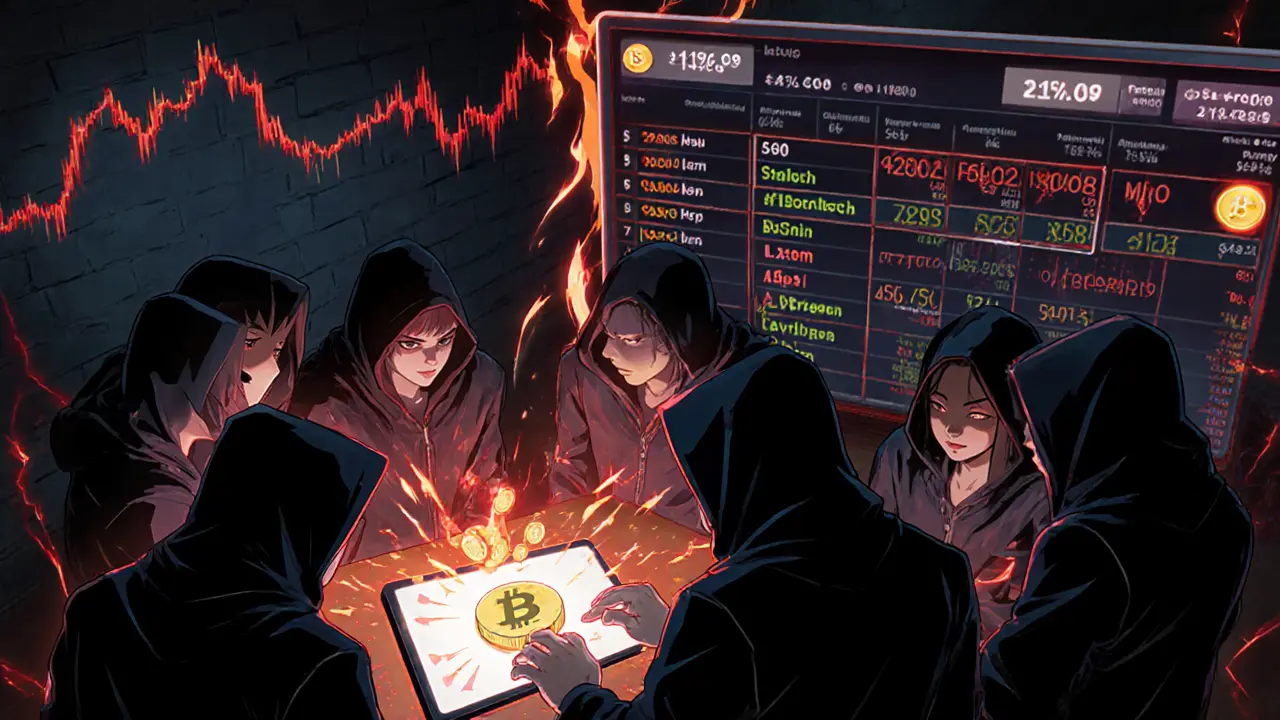
Because no single exchange sees the whole market, sophisticated actors spread their activity across dozens of venues. They might pump a token on a small exchange where they can dominate the order book, then dump simultaneously on larger platforms to maximize profit before the price drops globally. This “cross‑product manipulation” makes detection harder; the price spike looks normal on one exchange, while the dump goes unnoticed on another.
Detecting Manipulation: Red Flags and Tools
Detecting fraudulent moves requires a mix of on‑chain analysis and market monitoring. Here are the top warning signs:
- Sudden, unexplained volume spikes (especially on low‑cap tokens).
- Coordinated social media posts pushing a token with vague promises.
- Large orders appearing and disappearing within seconds (spoofing).
- Price divergence between major exchanges and the token’s declared oracle.
- Repeated circular trades between the same set of addresses (wash trading).
Tools like blockchain explorers web services that let you view transaction data on a blockchain and specialized analytics platforms (e.g., Nansen, Glassnode) can surface these patterns. For retail investors, setting up alerts for volume spikes on reputable exchanges often provides a first line of defense.
Regulatory Landscape: What Authorities Are Doing
Regulators are catching up fast. In the United States, the SEC Securities and Exchange Commission, which enforces securities laws has filed multiple enforcement actions against pump‑and‑dump schemes, labeling many tokens as securities. The 2024 FBI Federal Bureau of Investigation, which runs cyber‑crime operations “Operation Token Mirrors” used a fake coin to sting a $25 million pump‑and‑dump ring, resulting in 18 arrests.
Internationally, the EU’s MiCA framework (Markets in Crypto‑Assets) aims to standardize disclosure and impose stricter AML/KYC obligations on exchanges, which could curb wash trading on regulated platforms.

Protecting Yourself: Best Practices for Investors
- Do your own research (DYOR). Verify the token’s whitepaper, team, and on‑chain activity.
- Check liquidity. Tokens with $10k‑$100k daily volume are high‑risk for manipulation.
- Watch for coordinated hype. If a token is trending on multiple hype channels at once, treat it with suspicion.
- Use reputable exchanges. Regulated platforms have better surveillance and are less likely to host wash‑trading bots.
- Set stop‑loss limits. Protect against sudden dumps by pre‑defining exit points.
Remember, no tool can guarantee safety, but a disciplined approach reduces exposure to manipulators.
Future Outlook: Will Manipulation Fade Away?
As institutional money flows into crypto, market depth will increase and surveillance technologies will improve. Yet, new tokens and decentralized platforms will always create niche markets where manipulators can operate. Expect a shift from blatant pump‑and‑dump attacks to more sophisticated, algorithmic tricks-like manipulating on‑chain governance votes or exploiting cross‑chain bridges. Staying informed and using on‑chain analytics will remain essential.
Quick Checklist to Spot Manipulation
- Is the token’s market cap rising faster than its price?
- Are there large, short‑lived orders on the order book?
- Do you see the same wallet addresses appearing on both buy and sell sides?
- Is there a sudden surge of social media hype with no fundamental news?
- Are multiple exchanges reporting wildly different prices?
If you answer “yes” to several of these, consider staying out or limiting exposure.
What is a "whale" in crypto?
A whale is an individual or organization that holds a large amount of a specific cryptocurrency, enough to influence its price with relatively small trades.
How can I tell if a token is being washed traded?
Look for unusually high transaction volume that isn’t matched by price movement, and check blockchain explorers for repeated trades between the same set of addresses.
Are pump‑and‑dump schemes illegal?
Yes. In many jurisdictions, including the US, pump‑and‑dump is considered securities fraud when the token is deemed a security, and regulators have pursued criminal charges against participants.
What role does the SEC play in crypto manipulation?
The SEC enforces securities laws, and it has brought several enforcement actions against projects and individuals for using deceptive practices that affect market pricing.
Can DeFi oracles be trusted?
Oracles are only as trustworthy as their data sources and aggregation methods. Using decentralized, multi‑source oracles reduces the risk of manipulation compared to a single‑exchange feed.


