Bittrex Withdrawal Fee Calculator
Avoid Monthly Fees on Bittrex Assets
Bittrex charges a 1% monthly fee per asset (minimum $50) for assets held beyond the 30-day grace period. Calculate your potential fees and take action to recover your assets.
Your Monthly Fee Estimate
Withdraw as soon as possible to avoid losing funds.
When it comes to crypto trading platforms, Bittrex is a cryptocurrency exchange founded in 2014 by former Microsoft engineers, known for its military‑grade security and extensive altcoin list. After a rapid rise, the platform entered a steep regulatory decline and has been in liquidation mode since early 2025. This Bittrex review walks you through its history, security model, fee structure, liquidity, user experience, and the current steps you need to take if you still have assets on the exchange.
Key Takeaways
- Bittrex offered over 250 crypto assets and a tiered 0.25%‑0.30% maker/taker fee before shutting down.
- Security was its strongest point - 95% of funds were kept in cold storage with no major hacks.
- Regulatory pressure forced the U.S. arm to close in 2023 and the global arm to become withdrawal‑only in 2025.
- Users now face a 1% monthly fee per asset if they delay withdrawals beyond 30 days.
- Liquidation is managed by ALPS Trust Ltd. (Liechtenstein) and the Bermuda court; most assets are expected to be recovered by Q3 2026.
From Startup to Shutdown: The Timeline
The three founders - Bill Shihara, Rami Kawach, and Richie Lai - launched Bittrex in 2014 with a promise of a “secure, compliant trading environment.” By 2021 the exchange listed 257 cryptocurrencies, from Bitcoin (BTC) and Ethereum (ETH) to niche projects like Grin (GRIN) and Beam (BEAM). The platform ran two legal entities: Bittrex Incorporated (U.S.) and Bittrex Global (Liechtenstein & Bermuda).
Regulators started to tighten the net in 2019 when New Jersey issued a cease‑and‑desist order for unregistered securities. The SEC later fined Bittrex $29 million in 2022 for servicing prohibited jurisdictions. The mounting compliance costs - about $47 million annually for the U.S. arm - eroded profit margins to a negative 18% in 2022 (Fitch Ratings, 2024).
On April 30 2023 Bittrex Incorporated announced the shutdown of all U.S. operations. Less than a year later, on December 4 2023, Bittrex Global halted trading and switched to withdrawal‑only mode. As of February 25 2025 the two entities are in active liquidation, overseen by ALPS Trust Ltd. for the Liechtenstein company and by the Bermuda Monetary Authority for the Bermuda subsidiary.
Security Architecture: Why Bittrex Was Trusted
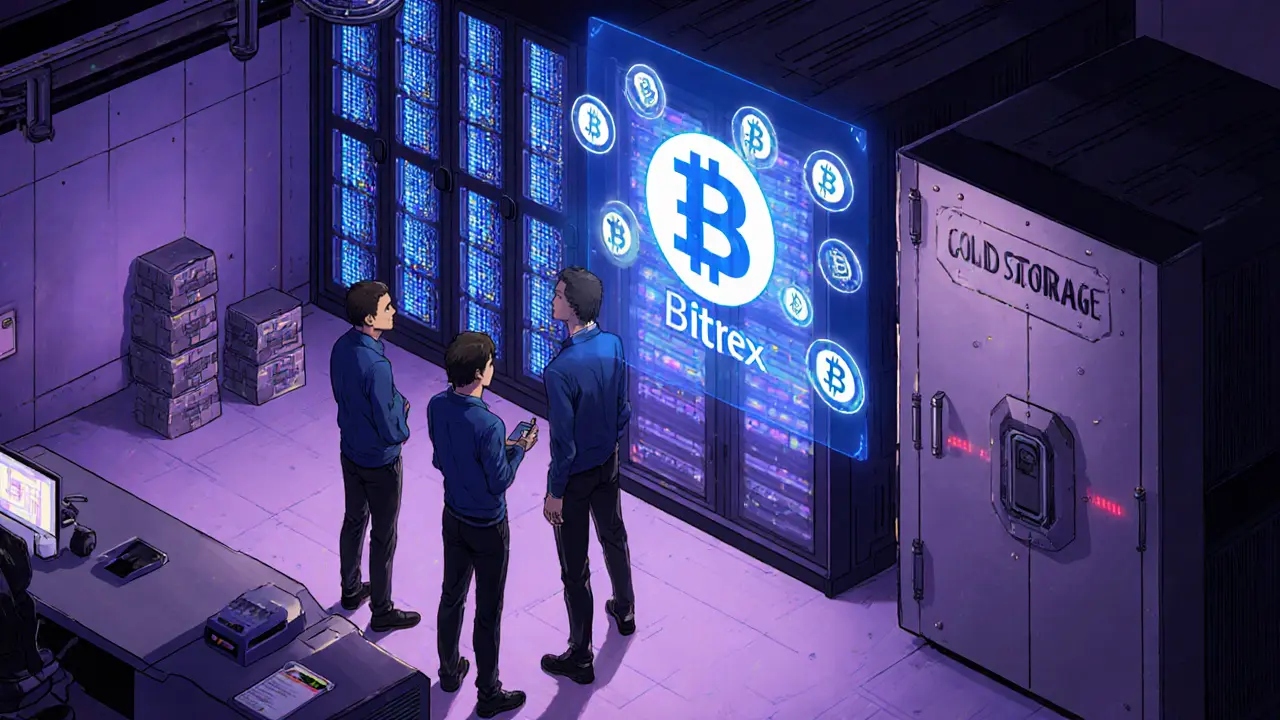
Security is where Bittrex truly shone. The exchange used multi‑signature cold wallets stored in geographically dispersed data centres, keeping roughly 95% of user funds offline. Biometric access controls added a second layer of protection for the hot‑wallet infrastructure. Real‑time transaction monitoring, powered by a partnership with Chainalysis since 2018, flagged suspicious activity before any breach could happen. In fact, no successful hack was recorded during its eight‑year run - a rare feat in an industry where 12% of exchanges suffered breaches in 2022 (Chainalysis).
Even after the shutdown, the custodial assets remain locked in those cold wallets, which is why the liquidation process can safely return funds to users without risking a breach.
Fee Structure and Trading Tools
Before the shutdown, Bittrex ran a tiered maker/taker model:
- Maker: 0.25% (base tier) down to 0.10% for monthly volumes over $500,000.
- Taker: 0.30% (base tier) down to 0.10% for the highest tier.
Trading tools were relatively basic. Bittrex offered a proprietary matching engine capable of handling 350,000 orders per second, WebSocket streams for real‑time market data, and a simple API with a 20‑request‑per‑second limit. The platform lacked futures, options, or leveraged contracts, which put it behind competitors like Bitfinex that offered deep derivatives markets.
Asset Coverage and Liquidity
Bittrex’s biggest advantage was its altcoin diversity. With 257 listed assets in 2021, it outpaced Coinbase (≈50 assets) and matched the breadth of Binance’s early catalog. Early access to projects such as TRON (TRX) and EOS made it a go‑to for traders hunting new tokens.
Liquidity, however, lagged behind. Average daily trading volume hovered around $1.2 billion in Q4 2022, while Bitfinex processed $15.8 billion and Binance topped $200 billion. The thinner order books sometimes caused slippage on larger trades, a pain point for high‑frequency traders.
User Experience, Support, and Common Pain Points
The web and mobile apps were clean but not especially innovative. KYC was required for any deposit above $2,000 per month, a three‑stage process that averaged 48 hours for verification. Support was a recurring complaint - The Block’s 2022 user‑experience report gave Bittrex a 2.8/5 rating, citing 72‑hour average ticket resolution times. Trustpilot’s 3.2/5 rating (1,842 reviews) reflected similar frustrations, especially around fiat withdrawal delays (average 5.2 business days).
Developers also hit limits. The API’s 20‑request‑per‑second ceiling caused bot failures during volatility spikes, and the documentation, while scoring 4.0/5 on Stack Exchange surveys, missed detailed error‑code explanations.
Current Liquidation Status and What You Should Do
As of February 2025, users can still withdraw assets, but only after re‑submitting KYC documents through the Bittrex Global Zendesk portal. ALPS Trust Ltd. reports a 92% processing rate within 72 hours for compliant requests. If you miss the 30‑day window, the 1% monthly fee will start accruing, eroding your balance over time.
Key steps to recover your funds:
- Log in to the Bittrex Global portal (https://bittrexglobal.zendesk.com) and open a ticket titled “Asset Withdrawal Request - [Your Account ID]”.
- Upload a clear photo of a government‑issued ID and a proof‑of‑address document.
- Wait for the confirmation email; most users receive a withdrawal link within 48‑72 hours.
- Initiate the withdrawal to a personal wallet. Avoid keeping assets on the exchange for longer than necessary.
If you encounter a “default fee” notice, withdraw immediately to stop further charges. For users in Bermuda, the court‑approved process is still pending, so keep an eye on official updates from the Bermuda Monetary Authority.

Feature Comparison: Bittrex vs. Major Competitors (2024)
| Feature | Bittrex | Coinbase | Binance | Bitfinex |
|---|---|---|---|---|
| Altcoins Listed | 257 | ≈50 | ≈500 | ≈200 |
| Daily Volume (USD) | $1.2 B | $3.4 B | $200 B | $15.8 B |
| Maker/Taker Fees (Base) | 0.25% / 0.30% | 0.00% / 0.50% | 0.10% / 0.10% | 0.10% / 0.20% |
| Cold Storage Ratio | 95% | 90% | 80% | 78% |
| Regulatory Status (2025) | In liquidation (global) | Active US & EU | Active global, under scrutiny | Active, US‑focused |
| Derivatives | No | Yes (US futures) | Yes (perpetual & options) | Yes (margin & futures) |
| Support Avg. Resp. Time | 68‑72 hrs | 24‑48 hrs | 2‑5 hrs | 12‑24 hrs |
Pros and Cons at a Glance
- Pros
- Industry‑leading security with 95% cold storage.
- Wide altcoin selection for early‑stage projects.
- Transparent fee tiers for high‑volume traders.
- Stable matching engine handling high order flow.
- Cons
- Thin liquidity on many pairs - higher slippage.
- No derivatives or margin products.
- Regulatory rigidity led to shutdown.
- Customer support slower than top rivals.
- Monthly 1% default fee for inactive accounts.
Is Bittrex Worth Considering Today?
For new traders looking for a live platform, the answer is no - the exchange is in liquidation and will not relaunch. However, the review offers valuable lessons. Its security model set a benchmark that newer custodians like BitGo have adopted. If you still have assets on Bittrex, act fast to avoid the 1% monthly fee and follow the withdrawal steps above.
Can I still trade on Bittrex?
No. Bittrex Global switched to withdrawal‑only mode in December 2023 and has been in liquidation since February 2025. Trading functionality is permanently disabled.
How do I withdraw my crypto from Bittrex?
Log into the Bittrex Global portal, open a Zendesk ticket with your ID and proof‑of‑address, wait for the verification email, and then submit a withdrawal request. Most users receive a withdrawal link within 48‑72 hours.
Will I be charged a fee for withdrawing now?
Withdrawal itself is free, but if you wait past the 30‑day grace period, a 1% per‑asset monthly fee (minimum $50) starts accruing. Withdraw as soon as possible to avoid extra costs.
What happened to Bittrex’s U.S. operations?
Bittrex Incorporated ceased all U.S. activities on April 30 2023 after facing multiple state‑level enforcement actions and escalating compliance expenses. The U.S. entity closed permanently and its assets were transferred to the global arm before the global shutdown.
Is there any chance Bittrex will reopen?
No. Both Bittrex Global GmbH and Bittrex Global Ltd. are under liquidation, and the directors have confirmed there are no plans to relaunch the exchange.


