Have you ever tried swapping tokens across different blockchains and felt like you were jumping through hoops? You connect your wallet, pick a bridge, pay gas fees on one chain, wait for confirmation, then pay more gas on another chain just to move your assets. It’s messy, expensive, and slow. That frustration is exactly what Unizen aims to fix.
Unizen isn’t just another decentralized exchange (DEX). It positions itself as an operating system for cross-chain trading. Its native token, ZCX, powers this ecosystem. But what does that actually mean for you as a trader or investor? Is it a solid project with real utility, or just another hype-driven coin from the last bull run? Let’s break down what Unizen is, how its technology works, and where it stands in the crowded DeFi landscape today.
What Exactly Is Unizen?
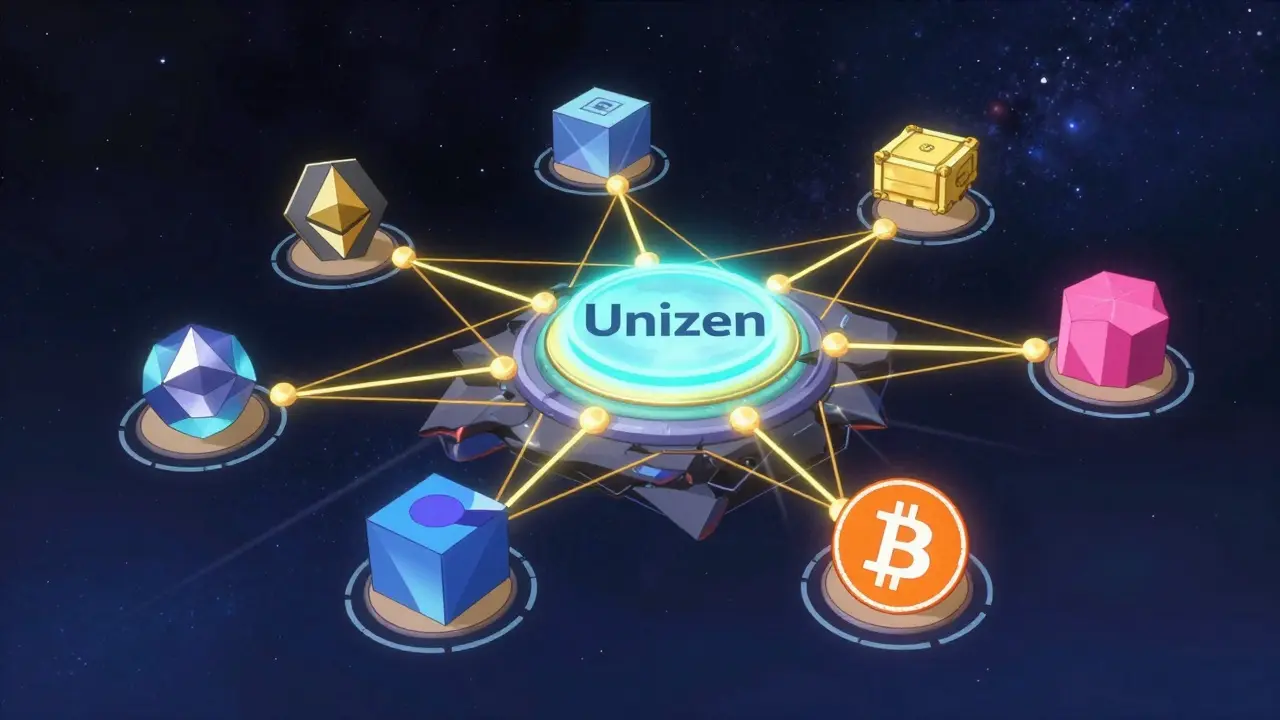
At its core, Unizen is a cross-chain, omni-chain decentralized exchange (DEX) aggregator. In plain English, that means it doesn’t hold your money. Instead, it acts like a smart search engine for liquidity. When you want to trade, Unizen scans hundreds of different exchanges-both centralized (CEXs) and decentralized (DEXs)-across multiple blockchains to find you the best price.
Most aggregators only work within one blockchain family, like Ethereum. Unizen claims to support over 16 chains and more than 200 liquidity sources. This includes not just standard EVM chains but also UTXO-based assets like native Bitcoin and Dogecoin. That’s a big deal because swapping Bitcoin directly without wrapping it into a derivative version has historically been a headache in DeFi.
The platform uses a hybrid model often called "CeDeFi." This combines the ease of centralized exchanges with the security and non-custodial nature of decentralized ones. For retail users, this means no account sign-ups, no KYC (Know Your Customer) checks, and zero manual bridging. For institutions, it offers a unified interface to access fragmented markets efficiently.
How the Technology Works: U-LDM and UIP
So, how does Unizen pull off these complex trades seamlessly? It relies on two proprietary technologies:
- Unizen Liquidity Distribution Mechanism (U-LDM): Think of this as the brain of the operation. It’s a smart-order routing engine. When you enter a trade, U-LDM splits your order across multiple pools and venues instantly. If buying 10,000 USDC would crash the price on one DEX, U-LDM might buy 3,000 there, 4,000 on another, and the rest on a third. This minimizes slippage-the difference between the expected price and the executed price-and ensures you get the best possible rate.
- Unizen Interoperability Protocol (UIP): This is the plumbing that connects everything. UIP is a cross-chain abstraction layer. Normally, if you want to swap an asset on Solana for one on Ethereum, you need a bridge. Bridges are risky and slow. UIP handles this behind the scenes. You click "swap," and Unizen manages the cross-chain communication so you don’t have to manually bridge assets yourself.
This setup allows for what Unizen calls "zero bridging" for the user. You connect your wallet, select your input and output tokens, and execute. The complexity stays hidden in the background.
ZCX Token: Utility and Deflationary Design
The ZCX token is the fuel for this machine. It’s an ERC-20 token deployed on Ethereum. But unlike meme coins that rely solely on speculation, ZCX has several defined utilities within the Unizen ecosystem.
| Utility | Benefit to Holder |
|---|---|
| Exchange Governance | Vote on platform decisions and which new modules or chains get integrated. |
| Fee Discounts | Pay lower trading fees when using ZCX for transactions. |
| Staking Rewards | Stake ZCX to earn rewards in other tokens from the ZenX Labs incubation portfolio. |
| Access to ZenX Labs | Gain early access to projects incubated by Unizen’s venture arm. |
One of the most aggressive features of ZCX is its "hyper-deflationary" model. The total supply started at 1 billion tokens. However, the protocol burns ZCX regularly. Burns happen through trade fees, Pro Membership subscriptions, and even when new assets are listed on the platform. These burned tokens are sent to a dead address, permanently removing them from circulation. Over time, this reduces the circulating supply, which can theoretically increase scarcity if demand remains constant or grows.
Market Performance and Current Status
If you look at the price chart of ZCX, you’ll see a classic crypto rollercoaster. The token hit an all-time high (ATH) of $6.87 in October 2021 during the peak of the DeFi summer frenzy. Since then, like many altcoins, it has faced significant drawdowns.
As of mid-2026, ZCX trades significantly lower, often in the sub-cent range depending on the specific market snapshot. Market capitalization figures vary across data providers due to differences in how they calculate circulating supply versus max supply, but it generally sits in the small-cap category. This volatility is normal for niche DeFi protocols that haven’t yet achieved mass institutional adoption.
Despite the price action, development continues. The platform has expanded from supporting 13 chains to over 16, and liquidity sources have grown past 200. This suggests the team is still actively building infrastructure rather than abandoning ship after the bear market.
Who Is Unizen For?
Unizen targets two distinct groups:
- Retail Traders: If you hate dealing with bridges, hate signing up for KYC-heavy platforms, and want to swap assets across different chains without thinking about the underlying mechanics, Unizen’s interface simplifies that process. You just connect a wallet like MetaMask or Trust Wallet and trade.
- Institutions and Enterprises: Banks, hedge funds, and governments need reliable, high-volume execution. Unizen’s CeDeFi model allows them to access both deep centralized liquidity and decentralized pools through a single API or interface, reducing operational overhead.
Risks and Considerations
No crypto investment is risk-free. Here are the main things to watch out for with Unizen:
- Competition: The DEX aggregator space is crowded. Competitors like 1inch, Matcha, and Jupiter offer similar services. Unizen needs to prove its UTXO support and CeDeFi hybrid model are superior enough to steal market share.
- Smart Contract Risk: As a non-custodial platform interacting with multiple chains, Unizen relies on complex smart contracts. While audits are standard practice, bugs can still exist. Always do your own research on security reports.
- Token Volatility: The hyper-deflationary model sounds great, but if trading volume drops, burn rates decrease, and price pressure can mount. The token’s value is tied closely to the platform’s usage metrics.
- Regulatory Uncertainty: Targeting banks and governments brings regulatory scrutiny. How regulators view hybrid CeDeFi models in 2026 and beyond could impact Unizen’s ability to serve institutional clients.
How to Buy ZCX
You can acquire ZCX through several methods:
Centralized Exchanges (CEXs): Platforms like MEXC list ZCX. To buy here, you create an account, complete KYC verification, deposit fiat or crypto, and place a market or limit order. This is the easiest way for beginners but requires trusting a third party with your identity and funds.
Decentralized Exchanges (DEXs): Since ZCX is an ERC-20 token, you can swap ETH for ZCX on Ethereum-based DEXs like Uniswap. Connect your wallet, approve the transaction, and swap. This keeps you in control of your keys but requires managing gas fees and wallet security.
P2P Markets: Some platforms allow peer-to-peer trading of ZCX, though liquidity may be lower compared to major pairs like BTC/USDT.
Final Thoughts
Unizen tries to solve a real problem: the fragmentation of crypto liquidity. By acting as an aggregator that spans both centralized and decentralized worlds across multiple chains, it offers a compelling vision for smoother trading. The ZCX token backs this up with governance, staking, and deflationary mechanics.
However, the crypto market is ruthless. High-tech solutions fail if users don’t adopt them. Watch for growth in daily active users, total value locked (TVL), and successful integrations with major institutions. If those metrics rise, ZCX could regain relevance. If not, it risks becoming another forgotten project from the 2021 boom.
Is Unizen safe to use?
Unizen is non-custodial, meaning you retain control of your private keys and funds until the moment of trade execution. However, like any DeFi platform, it carries smart contract risks. Always verify the official website URL and ensure your wallet is secure before connecting.
What is the difference between Unizen and 1inch?
Both are DEX aggregators. 1inch primarily focuses on EVM-compatible chains and decentralized liquidity. Unizen distinguishes itself by supporting UTXO assets like native Bitcoin and integrating centralized exchange liquidity (CeDeFi model), aiming for broader cross-chain coverage including non-EVM networks.
Does Unizen require KYC?
No, the Unizen aggregator interface does not require KYC. You simply connect your Web3 wallet. However, if you buy ZCX on a centralized exchange like MEXC, that exchange will likely require KYC verification.
Can I stake ZCX?
Yes, ZCX holders can stake their tokens to earn rewards. These rewards often come in the form of other tokens from projects incubated by ZenX Labs, Unizen’s venture arm, providing diversified yield opportunities.
Why did ZCX price drop so much from its ATH?
The drop reflects broader market cycles. Many DeFi tokens peaked in 2021 and corrected sharply during subsequent bear markets. Additionally, changes in circulating supply due to burns and vesting schedules can impact price dynamics. It’s essential to look at long-term utility rather than short-term price action.