
You’ve probably seen the ticker GALEON pop up on a chart or heard it mentioned in niche crypto circles. But what actually is it? Unlike Bitcoin, which aims to be digital gold, or Ethereum, which powers smart contracts for everything from games to finance, Galeon has a very specific job: fixing how hospitals handle patient data.
Galeon is a cryptocurrency project built around a next-generation Electronic Health Record (EHR) system. It uses blockchain technology and artificial intelligence to connect hospitals, doctors, patients, and researchers. The goal? To create the world’s largest high-quality medical database without compromising patient privacy. If you’re wondering if this is just another speculative coin or a serious tech play, you need to understand how its unique "Blockchain Swarm Learning" works and where it stands in the market today.
The Core Problem: Siloed Medical Data
Think about your last doctor’s visit. Did your specialist have instant access to the X-rays taken by your general practitioner three years ago? Probably not. In most countries, hospital data is locked in silos. Each clinic uses different software, making it nearly impossible to share information securely. This fragmentation slows down research, leads to duplicate tests, and frustrates patients.
Galeon was initiated in 2016 to solve this exact problem. A co-founder realized that linking hospitals at a national scale could revolutionize care. They started by working with hundreds of caregivers to design a platform that could structure and secure this data. Over time, this evolved into a blockchain project launched publicly in 2022, introducing the GALEON token to incentivize participation.
How Blockchain Swarm Learning Works
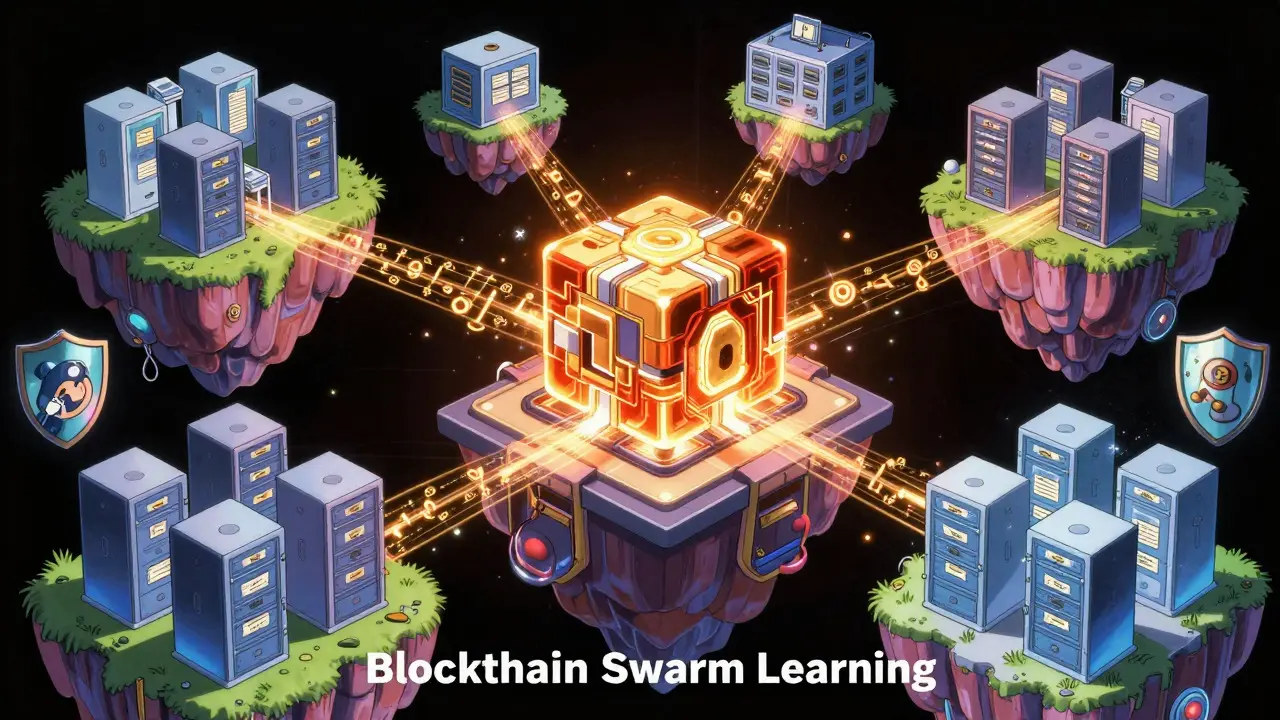
The technical heart of Galeon is a concept called Blockchain Swarm Learning. This sounds complex, but the idea is straightforward. Traditionally, to train an AI to detect diseases from X-rays, you’d need to gather millions of images into one central server. That’s a privacy nightmare. Who owns that data? What if it gets hacked?
Galeon flips this model. Instead of moving the data, they move the algorithm. Here’s how it plays out:
- Data Stays Local: Patient records remain within the hospital’s secure servers. No raw personal data leaves the building.
- AI Learns Decentralizedly: An AI model travels to each hospital. It learns from the local data-identifying patterns in pneumonia cases, for example-and then sends only the *learnings* (the updated math) back to the network.
- Global Improvement: The global AI model improves because it has learned from thousands of hospitals worldwide, but no single hospital ever exposed their patients’ identities.
This approach allows Galeon to build a powerful medical AI while keeping patient privacy intact. Hospitals are rewarded with GALEON tokens for contributing their computational power and data insights, aligning financial incentives with better healthcare outcomes.
Tokenomics and Market Reality
Understanding the GALEON token requires looking at both its utility and its market performance. As of mid-2026, Galeon is classified as a micro-cap cryptocurrency. It doesn’t rank in the top 100 coins; instead, it hovers between #1100 and #1500 on major trackers like CoinMarketCap and CoinGecko.
| Metric | Value / Detail |
|---|---|
| Total Supply | 4,000,000,000 GALEON |
| Circulating Supply | ~940 Million GALEON |
| All-Time High (ATH) | $0.04271 (Dec 4, 2024) |
| Current Price Range | $0.005 - $0.02 (Highly Volatile) |
| Market Cap | $4M - $16M (Varies by exchange) |
| Primary Use Case | Healthcare EHR & DeSci Incentives |
The price history tells a story typical of small-cap altcoins. Galeon hit its peak in December 2024 before dropping roughly 84% from its highs. This volatility means it’s a high-risk asset. Liquidity is also modest, with daily trading volumes often ranging between $20,000 and $300,000 across exchanges like PancakeSwap and AscendEX. You won’t find massive institutional orders here; this is largely driven by retail traders and early believers in the healthcare-tech narrative.
Who Uses Galeon?
The ecosystem isn’t just for speculators. It’s designed for three main groups:
- Hospitals and Clinics: They integrate Galeon’s EHR system to modernize their records. In return, they earn tokens for participating in the swarm learning network.
- Researchers and Pharma Companies: They gain access to anonymized, high-quality medical datasets to train diagnostic AI models faster than ever before.
- Patients: While still emerging, the vision includes patients owning their data and potentially earning rewards when researchers use their anonymized health information for breakthroughs.
Galeon positions itself as a "DeSci" (Decentralized Science) layer. This is a growing sector in crypto where funding and data sharing for scientific research are handled via blockchain rather than traditional grants or corporate monopolies. Galeon claims partnerships with major entities, including mentions of collaboration with Samsung, suggesting they are aiming for enterprise-level integration.

Risks and Considerations
Before buying or integrating, keep these factors in mind. First, adoption is slow. Healthcare is heavily regulated. Getting hospitals to switch from legacy systems to a blockchain-based EHR takes years, not months. There is no public data confirming exactly how many hospitals are currently live on the Galeon network, which makes valuation difficult.
Second, competition is fierce. Traditional giants like Epic Systems and Cerner dominate the EHR space. While they aren’t blockchain-native, they have deep pockets and entrenched relationships. Galeon must prove that its decentralized model is not just cooler, but actually more efficient and cost-effective.
Finally, regulatory uncertainty looms. Handling medical data means dealing with HIPAA in the US or GDPR in Europe. Galeon’s architecture aims to comply by keeping data local, but legal frameworks for blockchain in healthcare are still evolving. Any regulatory crackdown on data handling could impact the token’s utility.
Is Galeon Worth Your Attention?
If you believe that AI will transform medicine and that current data silos are the biggest bottleneck, Galeon offers a compelling thesis. It’s one of the few crypto projects with a tangible real-world application outside of finance. The Blockchain Swarm Learning concept is technically sound and addresses a genuine pain point.
However, as an investment, it remains highly speculative. The low liquidity and significant drawdown from its all-time high mean you could lose value quickly. It’s best suited for investors who understand the long timeline of healthcare IT adoption and are willing to bet on the infrastructure of future medical AI rather than short-term price pumps.
Where can I buy GALEON tokens?
You can trade GALEON on several exchanges. For decentralized trading, PancakeSwap (v2) is the most popular venue, using the GALEON/WBNB pair. For centralized exchanges, AscendEX (BitMax) is a key provider, offering the GALEON/USDT pair. Always check current listings on aggregators like CoinGecko or CoinMarketCap, as availability changes frequently.
What is the maximum supply of GALEON?
The total maximum supply of GALEON is capped at 4 billion tokens. As of mid-2026, approximately 940 million tokens are in circulation. The rest are likely allocated for future development, team vesting, or ecosystem rewards.
How does Galeon protect patient privacy?
Galeon uses Blockchain Swarm Learning. Raw patient data never leaves the hospital's local servers. Only the mathematical improvements (the AI learnings) are shared on the blockchain. This ensures that individual identities remain anonymous while the global AI model still benefits from diverse data sets.
Is Galeon a good investment in 2026?
Galeon is a high-risk, high-reward micro-cap asset. It has dropped significantly from its 2024 highs and has low liquidity. It may be suitable for speculative portfolios focused on healthcare tech and DeSci, but it lacks the stability of larger cryptocurrencies. Do thorough research before investing.
What is DeSci?
DeSci stands for Decentralized Science. It’s a movement using blockchain tools to fund, share, and verify scientific research. Galeon fits into this by creating a decentralized marketplace for medical data and AI training, removing intermediaries and rewarding contributors directly with tokens.