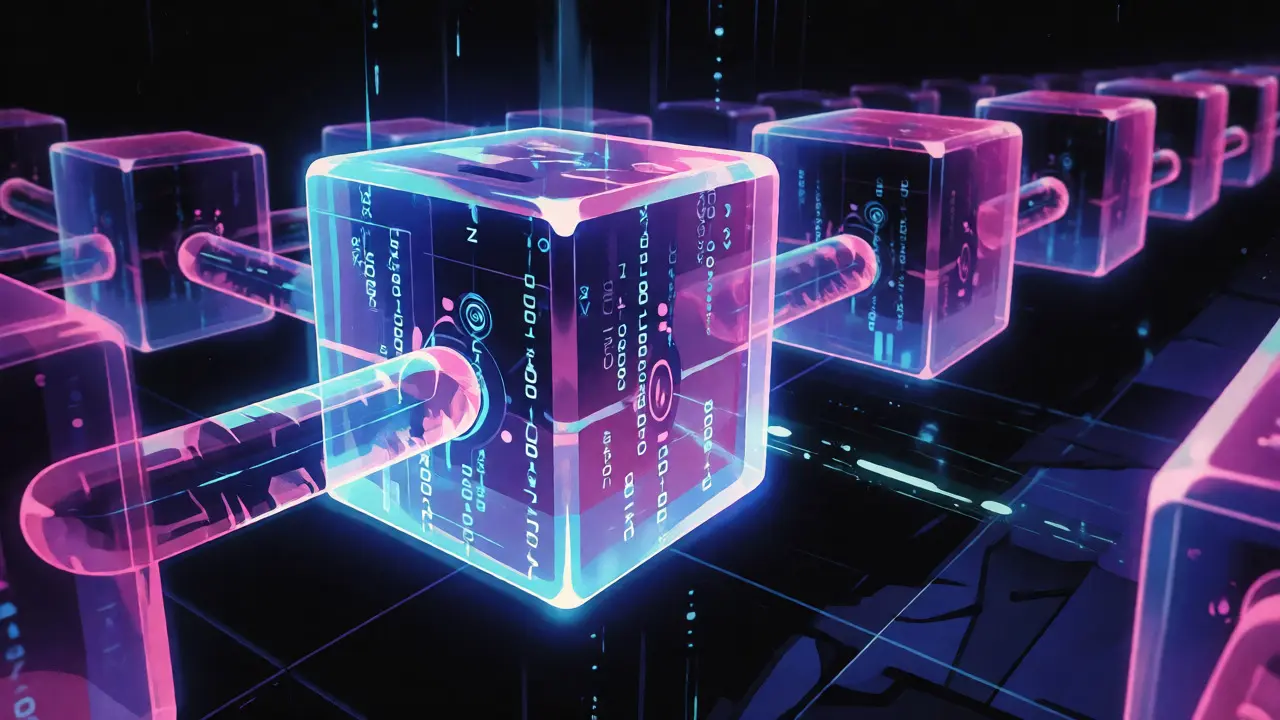
Imagine you’re trying to prove you paid someone for coffee, but no bank exists to keep the receipt. You need a way to record that transaction so everyone agrees it happened and no one can change it later. This is where a block comes in. It’s not just a chunk of code; it’s the digital brick that builds the entire blockchain. If you’ve ever wondered how Bitcoin or Ethereum keeps track of millions of transactions without a central boss, understanding what sits inside a block is your first step.
The Digital Ledger Page
Think of a blockchain as a massive, shared notebook. Each page in this notebook is a block. Just like a physical ledger records who bought what and when, a block contains a batch of verified transactions. But unlike a paper notebook, these pages are glued together with super-strong digital glue called cryptography. Once a page (block) is filled and glued into the book (chain), you can’t tear it out or scribble over it without everyone noticing. This structure ensures that history stays honest.
The very first page in any blockchain is special. It’s called the Genesis Block, or Block 0. Created by Satoshi Nakamoto in 2009 for Bitcoin, this block didn’t have a previous block to link to, so it started the chain from scratch. Every other block since then has been added on top of it, creating an unbroken line of history back to that first moment.
Inside the Box: Key Components
So, what actually goes into one of these blocks? It’s more than just a list of names and numbers. Each block has three critical parts that make the system work securely.
- Transaction Data: This is the meat of the block. It holds batches of valid transactions waiting to be confirmed. For example, if Alice sends 1 BTC to Bob, that detail lives here. To keep things efficient, these transactions aren’t just listed randomly; they’re organized into a Merkle Tree. This data structure allows computers to quickly verify if a specific transaction is part of the block without checking every single entry.
- Cryptographic Hash: This is the block’s unique fingerprint. It’s a string of letters and numbers generated by running the block’s data through a mathematical function. If you change even one comma in the transaction data, the hash changes completely. This makes tampering obvious.
- Previous Block’s Hash: Here’s the magic trick. Each block doesn’t just contain its own hash; it also stores the hash of the block before it. This creates a chain. If someone tries to alter Block 5, its hash changes. Because Block 6 contains the old hash of Block 5, the link breaks. The network instantly knows something is wrong.
You might also see a timestamp included, which records exactly when the block was created. This helps maintain chronological order, ensuring we know which transaction happened first.
How Blocks Get Made and Linked
Creating a block isn’t automatic. It requires agreement from the network participants, often called nodes. In public networks like Bitcoin, this process is known as mining. Miners compete to solve complex math puzzles. The first one to solve it gets to bundle pending transactions into a new block and add it to the chain. As a reward, they get cryptocurrency.
Once a miner proposes a block, other nodes check it. They verify that the transactions are valid (e.g., did Alice actually have the money?) and that the puzzle solution is correct. If most nodes agree, the block is accepted. This consensus mechanism prevents anyone from adding fake transactions. If you tried to sneak in a block claiming you had a million dollars when you only had ten, the network would reject it immediately.
| Feature | Blockchain Block | Traditional Database Row |
|---|---|---|
| Immutability | Permanent once added; cannot be edited | Can be updated or deleted by admins |
| Verification | Distributed consensus among many nodes | Centralized server validation |
| Security | Cryptographic hashing links blocks | Passwords and access controls |
| Transparency | Publicly visible (in public chains) | Private to authorized users |

Why Linking Matters More Than Storing
You might ask, "Why bother linking them? Why not just store all transactions in one giant file?" The answer lies in security. Linking creates dependency. Because each block relies on the previous one’s hash, altering history becomes exponentially harder. To hack the Bitcoin blockchain, you wouldn’t just change one block; you’d have to recalculate the hashes for that block and every single block after it, while simultaneously racing against the rest of the network to catch up. With thousands of computers working globally, this is practically impossible.
This design resembles stacking wooden blocks. You can easily add a block to the top. But try pulling a block from the middle, and the whole tower collapses. In blockchain terms, removing or changing a past block invalidates all subsequent blocks, breaking the chain’s integrity.
Limitations You Should Know
Blocks are powerful, but they aren’t perfect. Their immutability is a double-edged sword. If you send money to the wrong address, you can’t simply edit the block to fix it. Instead, you must create a new transaction to reverse or compensate for the error. This leaves a permanent record of both the mistake and the fix.
Also, adding blocks takes time and energy. In Proof-of-Work systems like Bitcoin, miners use massive amounts of electricity to secure the network. This leads to debates about sustainability. Newer systems like Ethereum’s Proof-of-Stake aim to reduce this energy cost by selecting validators based on stake rather than computing power, but the core concept of the block remains the same.

Real-World Applications Beyond Crypto
While blocks started with Bitcoin, their use cases have exploded. Supply chain companies use them to track goods. Imagine a block recording when a shipment left a factory, another when it cleared customs, and another when it arrived at the store. Each step is immutable and transparent. This reduces fraud and improves trust between partners.
Digital identity is another growing area. Instead of storing your personal data on a company’s server (which can be hacked), you could control your identity via blockchain blocks. Only you hold the keys to share specific details, and the verification happens directly on the chain.
Next Steps for Learners
If you want to dig deeper, start by exploring how different consensus mechanisms affect block creation speed. Look into Proof-of-Stake versus Proof-of-Work to understand why some chains process transactions faster than others. Understanding the block is the foundation; everything else in blockchain tech builds upon this simple yet profound structure.
Can a block be deleted from the blockchain?
In most public blockchains, no. Once a block is added and confirmed by enough network participants, it is considered permanent. Deleting it would require re-mining all subsequent blocks, which is computationally impractical and economically prohibitive.
What happens if two blocks are mined at the same time?
This creates a temporary fork in the chain. Nodes may accept either block initially. Eventually, one branch will grow longer (more cumulative proof of work). The network agrees to follow the longest valid chain, and the orphaned block’s transactions are usually moved to the winning branch.
Does every block contain transactions?
Not necessarily. While most blocks contain multiple transactions, a block can be empty of user transactions but still exist because a miner claimed the block reward. However, in practice, blocks are rarely empty because there are almost always pending transactions waiting to be processed.
Is the size of a block fixed?
It depends on the blockchain. Bitcoin has a limit of 4 megabytes per block (post-SegWit), which restricts how many transactions fit. Other chains like Solana or Avalanche have different limits or dynamic sizing strategies to handle higher throughput.
Why is the previous block's hash important?
The previous block's hash acts as a digital seal. It proves that the current block follows the correct predecessor. If you change data in an older block, its hash changes. Since the next block references the old hash, the link breaks, alerting the network to tampering.