Imagine trying to buy Bitcoin in Moscow today. You open your browser, type in a familiar exchange name, and hit a wall. Maybe it's a blocked page from Roskomnadzor, or maybe the platform just doesn't let you deposit rubles anymore. It’s confusing because Russia didn’t outright ban cryptocurrency. They actually legalized holding and trading it back in 2021. So, why does it feel like half the market is off-limits?
The reality is messier than a simple "ban." The Russian government, led by the Bank of Russia, takes a selective approach. They aren't banning all crypto; they are banning specific platforms that don't play by their rules or those caught up in international sanctions. As of September 2026, the landscape has shifted from total uncertainty to a structured, state-controlled environment. If you’re an investor or trader looking at the Russian market, you need to know exactly which exchanges are blocked, which are restricted, and why.
The Big One: Why Garantex Was Shut Down
If you follow crypto news, you’ve heard of Garantex. For years, it was the go-to hub for moving money in and out of sanctioned regions. But in spring 2025, its reign effectively ended. This wasn’t just a Russian decision; it was a global enforcement action.
In March 2025, the U.S. Secret Service, working with authorities in Germany and Finland, seized Garantex’s web domain. They froze over $26 million in cryptocurrency. The reason? Authorities claimed Garantex facilitated sanctions evasion. Essentially, it helped move money around restrictions that Western countries had placed on Russia.
| Aspect | Detail |
|---|---|
| Seizure Date | March 6, 2025 |
| Assets Frozen | $26+ Million USD equivalent |
| Primary Accusation | Sanctions Evasion / Money Laundering |
| Successor Platform | Grinex (and later Exved) |
You might think this means Garantex users lost everything. Not exactly. Transparency International found that the network behind Garantex simply evolved. Operations moved to decentralized structures in places like the UAE, Brazil, and Kyrgyzstan. Within Russia, a service called Exved took over many of these flows. Founded by Sergey Mendeleev, who was key to building Garantex, Exved markets itself as the first exchange specifically for importers and exporters. So, while the Garantex brand is dead, the infrastructure lives on under new names.
Grinex: The Sanctioned Successor
When Garantex got hit, its customers needed somewhere to go. That’s where Grinex came in. Created by former Garantex employees, Grinex absorbed much of the customer base and funds after the March 2025 disruptions.
But if you thought escaping Garantex meant escaping trouble, think again. The U.S. Treasury’s Office of Foreign Assets Control (OFAC) quickly designated Grinex as part of the same sanctions net. They argued that Grinex was just a shell continuing Garantex’s work. Consequently, Grinex faces similar restrictions. While you might still find it accessible through certain Russian interfaces, using it exposes you to significant compliance risks, especially if you have any ties to the US financial system.
Western Giants: Binance, Coinbase, and Kraken
Here is a common misconception: Is Binance banned in Russia? Technically, no. There is no law explicitly saying "Binance is illegal." However, practical barriers make it nearly impossible to use for average Russians.
The issue stems from two sides:
- International Sanctions: Western exchanges must comply with US and EU sanctions. This often means freezing accounts linked to sanctioned entities or restricting services for Russian residents to avoid secondary sanctions.
- Russian Compliance: The Bank of Russia requires strict Anti-Money Laundering (AML) checks. Many international platforms struggle to meet these specific local requirements or choose not to operate there due to the complexity.
Coinbase and Kraken face similar hurdles. They aren't "banned" by decree, but they are effectively excluded from the mainstream Russian market. Payment processing is limited, banking connections are severed, and user verification processes often fail for Russian citizens. If you try to sign up today, you’ll likely find that deposits via Russian banks are unsupported or heavily restricted.
BestChange: A Temporary Ban Lifted
Not every restriction is permanent. Take BestChange, a popular aggregator for crypto exchanges. In recent years, it faced a temporary ban by Roskomnadzor, the Russian federal agency responsible for media oversight and internet censorship.
The problem wasn't BestChange itself, but how it displayed data. The Central Bank of Russia objected to listings involving foreign payment systems and certain currencies like the Kazakhstani tenge. To fix this, BestChange worked closely with legal experts. They removed problematic ruble-based exchange info and adjusted their listings. By 2025, the ban was lifted. This case shows that if a platform complies with Russian regulatory demands, it can return to the market. It’s a game of cat and mouse, but one that favors those willing to adapt.
The Regulatory Framework: What’s Actually Legal?
To understand what’s banned, you need to know what’s allowed. Russia passed legislation in July 2020 that legalized crypto transactions but banned their use for domestic payments starting January 2021. You can buy and hold Bitcoin, but you can’t buy coffee with it.
Things changed in summer 2024. New laws permitted digital currency payments in international trade. This created a loophole for companies doing business abroad. Now, Deputy Finance Minister Ivan Chebeskov announced in October 2025 that Russia is building dedicated national infrastructure for crypto activities. This isn't about prohibition; it's about control. The goal is a state-controlled ecosystem, similar to China’s digital yuan strategy.
Key restrictions currently in place include:
- No Domestic Payments: You cannot use crypto to pay for goods and services inside Russia.
- Qualified Investors Only: Proposed experimental regimes restrict complex crypto trading to "especially qualified" investors with high financial thresholds.
- Bank Prohibitions: Russian financial institutions are largely prohibited from investing directly in cryptocurrencies.
How Roskomnadzor Enforces the Bans
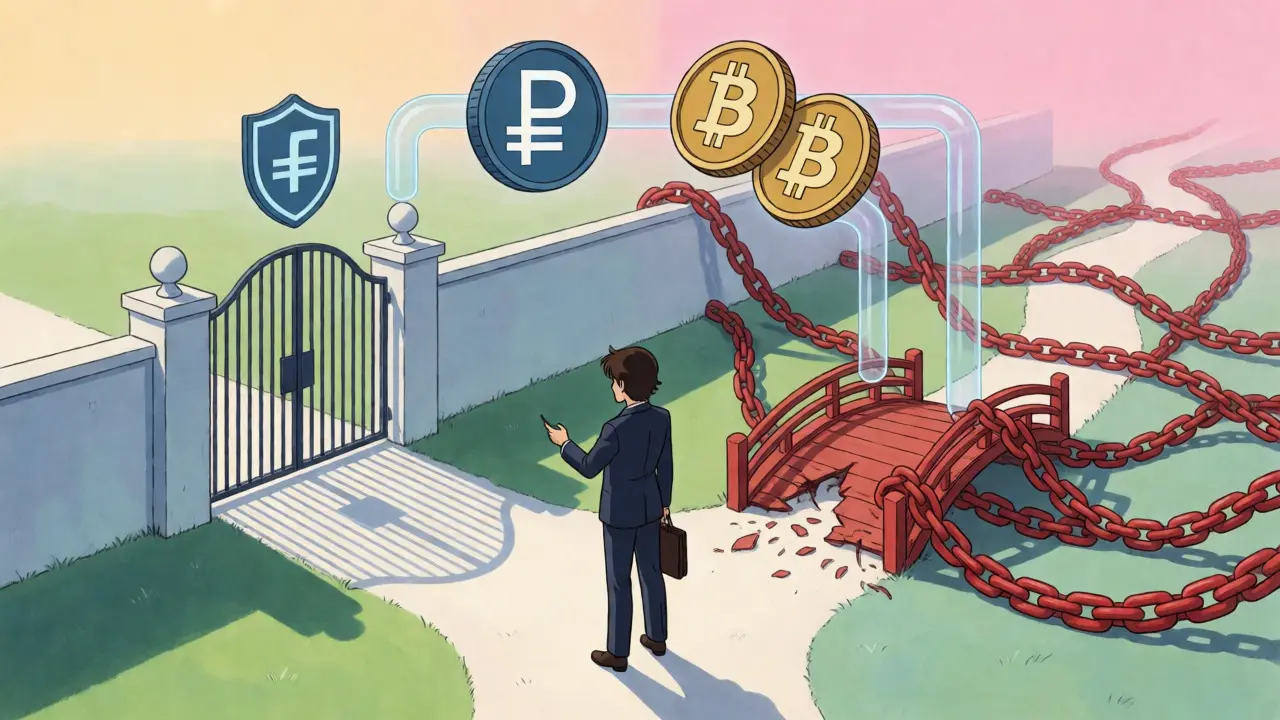
Who actually blocks these websites? It’s Roskomnadzor. They maintain a list of restricted sites. If an exchange fails to meet AML standards or gets involved in sanctions evasion, Roskomnadzor adds its URL to the blacklist. Internet service providers then block access.
This system allows for rapid response. Unlike legislative bans, which take months, a Roskomnadzor block can happen quickly. This is why some exchanges disappear overnight only to reappear weeks later after making adjustments. Monitoring is tight, with enhanced information exchange between tax and financial authorities to track suspicious P2P transactions.
What Should You Do If You Trade in Russia?
If you are active in the Russian crypto market, here is your checklist:
- Check the Domain: Ensure the exchange URL isn't on the current Roskomnadzor restricted list.
- Avoid Sanctioned Entities: Steer clear of Garantex, Grinex, and their direct successors if you want to minimize international compliance risk.
- Use Compliant Local Platforms: Look for exchanges registered in Russia that adhere to Bank of Russia AML guidelines.
- Be Careful with P2P: Peer-to-peer transactions are under heavy scrutiny. Keep records of all trades.
- Monitor News: Regulations change fast. What’s blocked today might be unblocked tomorrow if compliance issues are resolved.
The trend is clear: Russia is moving toward sovereign digital asset control. Blanket bans are out; targeted restrictions on non-compliant or sanctioned platforms are in. For traders, this means more friction but also a clearer set of rules. Stick to platforms that cooperate with local regulators, and you’ll stay on the right side of the line.
Is Binance completely banned in Russia?
No, Binance is not explicitly banned by Russian law. However, it faces severe operational restrictions due to international sanctions and local compliance requirements. Many users find it difficult to deposit rubles or withdraw fiat currency, making it practically inaccessible for many Russian residents compared to local compliant exchanges.
Why was Garantex shut down?
Garantex was shut down following a joint operation by the U.S. Secret Service and European authorities in March 2025. It was accused of facilitating sanctions evasion and money laundering. Its domain was seized, and over $26 million in assets were frozen.
Can I still buy Bitcoin in Russia?
Yes, buying and holding Bitcoin is legal in Russia. However, you cannot use it for domestic payments. Trading is restricted to qualified investors in some contexts, and you must use exchanges that comply with Russian anti-money laundering laws.
What is Grinex?
Grinex is a cryptocurrency exchange created by former Garantex employees to continue operations after Garantex was sanctioned. Like Garantex, it has been designated by the U.S. Treasury for sanctions evasion, meaning it carries significant compliance risks for international users.
Which agency blocks crypto websites in Russia?
Roskomnadzor, the Federal Service for Supervision of Communications, Information Technology and Mass Media, maintains the list of restricted sites and enforces website blocks for non-compliant crypto exchanges.