
Imagine trying to pay for a coffee with Bitcoin on the main network. You might wait minutes, pay high fees, and still wonder if it went through. That’s the problem Blockchain rollups are here to fix. They are not just a buzzword; they are the most practical solution we have right now for making blockchains fast and cheap without sacrificing security.
If you’ve heard about Ethereum getting congested or gas prices spiking during busy times, you’ve felt the pain that rollups solve. But what exactly are they? Simply put, rollups take transactions off the main blockchain (Layer 1), process them elsewhere, and then send a compressed summary back to the main chain. This keeps the security of the main network while drastically increasing speed and lowering costs.
The Core Problem: Why We Need Rollups
To understand why rollups matter, you first need to see the bottleneck. Blockchains like Ethereum are designed to be secure and decentralized. Every node in the network verifies every transaction. This is great for security but terrible for speed. If everyone tries to use the network at once, it clogs up. Transactions slow down, and fees skyrocket because users bid against each other to get their transaction included in the next block.
Vitalik Buterin, the co-founder of Ethereum, has long argued that the main chain should handle settlement and security, not every single transaction detail. He projected that while traditional scaling might hit 50,000 to 100,000 transactions per second (TPS), Ethereum rollups could potentially deliver between 300,000 and 500,000 TPS. That’s a massive jump. The analogy often used is a cheque. Whether you write $10 or $10 million on a cheque, the paper weighs the same. Similarly, the data resulting from thousands of transactions can be compressed into a small package that the main chain can easily store.
How Rollups Work: The Mechanics
Rollups operate as Layer 2 solutions. They sit on top of Layer 1 blockchains. Here is the step-by-step process:
- Off-Chain Processing: Users send their transactions to the rollup network instead of the main chain. These transactions are processed quickly and cheaply off-chain.
- Bundling: The rollup collects these transactions and bundles them together. Instead of sending 1,000 separate transactions to Ethereum, it sends one batch.
- Data Submission: The rollup submits this batch data to the Layer 1 blockchain. This acts as a record that these transactions happened.
- State Update: Smart contracts on Layer 1 verify the batch and update the overall state of the rollup. This ensures that the rollup remains honest and secure.
The key insight here is that the main chain doesn’t need to execute every transaction. It only needs to store the data and ensure the rules were followed. By moving the heavy lifting off-chain, the network can handle far more activity.

Two Main Types: ZK-Rollups vs. Optimistic Rollups
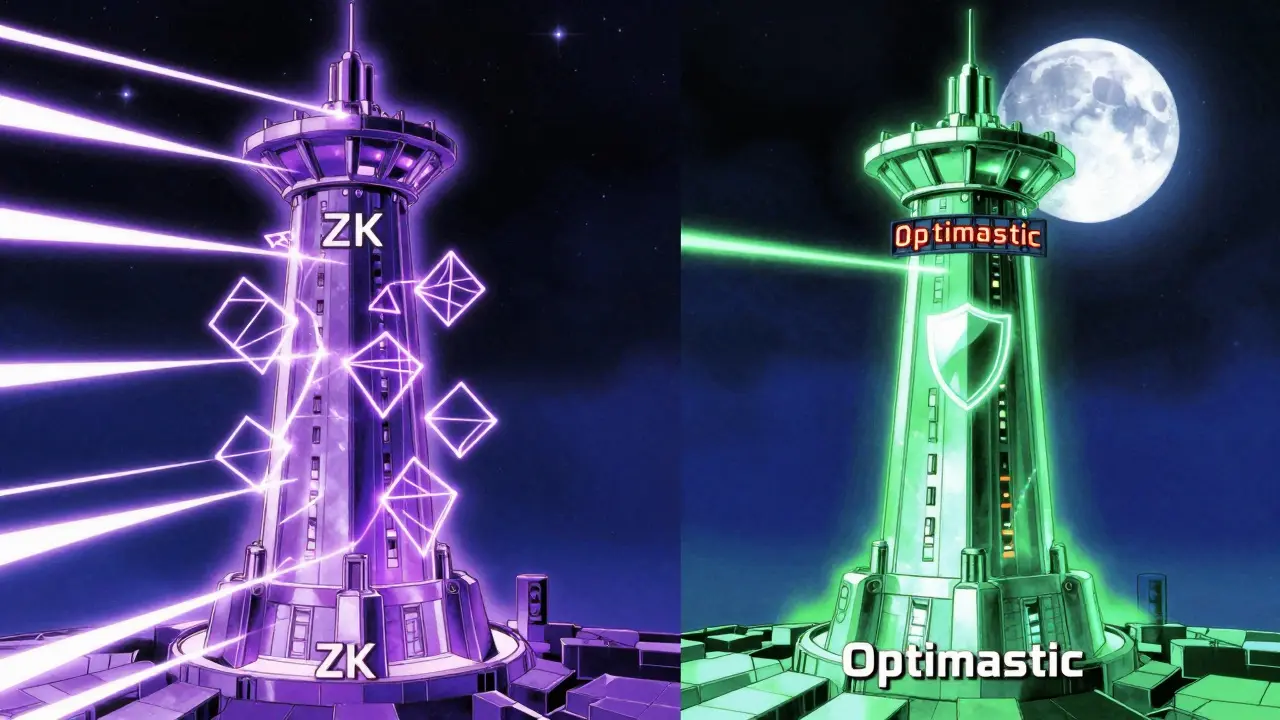
Not all rollups are created equal. There are two dominant types, and they differ significantly in how they prove their transactions are valid. Understanding this difference is crucial for choosing which platform to use.
| Feature | ZK-Rollups | Optimistic Rollups |
|---|---|---|
| Verification Method | Cryptographic proofs (Zero-Knowledge) | Fraud proofs (Challenge period) |
| Finality Speed | Fast (minutes) | Slow (days, typically 7 days) |
| Complexity | High (requires specialized hardware) | Lower (compatible with EVM) |
| Examples | StarkNet, zkSync, Loopring | Optimism, Arbitrum |
| Privacy | High (transaction details hidden) | Low (data is public until challenged) |
Optimistic Rollups
Optimistic rollups assume that transactions are valid unless someone proves otherwise. This is why they’re called “optimistic.” When a batch of transactions is submitted to the main chain, there is a challenge period-usually seven days. During this time, anyone can look at the data and submit a “fraud proof” if they find an error. If no fraud is found, the transactions are finalized.
This approach is easier to implement because it uses standard Ethereum Virtual Machine (EVM) code. Platforms like Optimism and Arbitrum are leading examples. They are popular because developers can port existing dApps with minimal changes. However, the withdrawal time is slow because you must wait for the challenge period to end.
ZK-Rollups
ZK-rollups use zero-knowledge cryptography to prove that transactions are valid. Instead of waiting for someone to challenge a transaction, the rollup generates a mathematical proof that guarantees correctness. This proof is sent to the main chain, which verifies it instantly. This means faster finality-often just minutes.
However, generating these proofs is computationally expensive and requires specialized hardware. Not all smart contracts can be easily converted to work with ZK-proofs. Projects like zkSync and StarkNet are pushing this technology forward. As hardware improves and tooling becomes better, ZK-rollups are expected to become more dominant due to their speed and privacy benefits.
Why Enterprises Are Betting on Rollups
It’s not just crypto enthusiasts using rollups anymore. Major corporations are building their own Layer 2 networks. Companies like Sony, Flipkart, Visa, and Mastercard are exploring or already deploying rollup technology. Why?
Because scale matters. For a global payment processor like Visa, handling millions of transactions per day on a congested mainnet is impossible. Rollups allow them to inherit the security of Ethereum while achieving the throughput needed for commercial applications. This enterprise adoption signals that rollups are maturing from experimental tech to production-ready infrastructure.
Decentralized applications (dApps) also benefit. Gaming, for instance, requires fast, cheap transactions. Imagine playing a blockchain game where every sword swing costs $5 in gas fees. It wouldn’t work. Rollups make micro-transactions feasible, enabling new business models in DeFi, gaming, and social media.
Security and Decentralization: The Trilemma Solved?
The blockchain trilemma states that you can only have two of three: security, decentralization, and scalability. Rollups aim to break this rule. By posting data to Layer 1, rollups inherit its security. To attack a rollup, you would need to attack the underlying blockchain, which is prohibitively expensive.
At the same time, they improve scalability by processing transactions off-chain. And because the data is still available on Layer 1, users can always exit the rollup if the operators act maliciously. This preserves decentralization. While no system is perfect, rollups offer the best compromise we currently have for balancing these three factors.
Getting Started with Rollups
If you want to use rollups, you don’t need to change your wallet. Most modern wallets like MetaMask support Layer 2 networks out of the box. You simply add the network (e.g., Arbitrum One or Optimism Mainnet) and bridge your assets from Ethereum Mainnet to the L2. Bridging involves locking your ETH on Layer 1 and receiving equivalent tokens on Layer 2. Once there, you can trade, lend, or play games with near-zero fees and instant confirmations.
Just remember: when you move funds back to Layer 1, the time depends on the type of rollup. With Optimistic rollups, expect to wait up to seven days. With ZK-rollups, it’s usually much faster. Always check the specific platform’s documentation before bridging large amounts.
Are rollups safer than Layer 1?
Rollups inherit the security of Layer 1 because they post data to the main chain. However, they introduce new risks related to the rollup operator and smart contract bugs. While the base layer is secure, you must trust the integrity of the rollup’s code and its dispute resolution mechanism.
Which rollup is best for beginners?
Optimistic rollups like Arbitrum and Optimism are generally more beginner-friendly because they are compatible with existing Ethereum tools and dApps. You can use familiar interfaces and wallets without needing to learn new programming languages or complex cryptographic concepts.
Do rollups cost money to use?
Yes, but significantly less than Layer 1. You still pay gas fees on the rollup, but they are a fraction of the cost on Ethereum Mainnet. Additionally, you may pay a small fee to bridge assets between layers. The savings come from sharing the data posting costs across many users in a single batch.
Can rollups be hacked?
Any software can have vulnerabilities. Rollups rely on smart contracts and cryptographic proofs. If a bug exists in the rollup’s code or the proof generation, it could be exploited. However, the economic incentives and audit processes in major rollup projects make successful hacks rare compared to centralized exchanges.
What is the difference between a sidechain and a rollup?
Sidechains are independent blockchains with their own security mechanisms. They do not post data to the main chain in the same way rollups do. Rollups are considered more secure because they rely on the main chain for finality and data availability, whereas sidechains require you to trust their own validators.