
Swapping tokens used to be a simple act. You picked your pair, clicked swap, and paid the fee. Now, with Uniswap v4 deployed on Arbitrum, the landscape has shifted dramatically. It is no longer just about moving assets; it is about programmable liquidity, near-instant execution, and costs that are a fraction of what they were even two years ago.
If you have been sitting on the sidelines watching Uniswap evolve from v2 to v3, v4 might feel like a different animal entirely. Especially when paired with Arbitrum a high-performance Layer 2 scaling solution for Ethereum, the combination offers something rare in decentralized finance (DeFi): institutional-grade efficiency wrapped in a user-friendly interface. But does it actually work better for you? Let's break down what this means for your wallet, your trades, and your security.
The Core Shift: From Factory to Singleton
To understand why Uniswap v4 on Arbitrum feels faster and cheaper, you need to look under the hood. Previous versions, like v2 and v3, relied on a "factory" pattern. Every time a new trading pool was created, a brand-new smart contract was deployed to the blockchain. This worked, but it was expensive and fragmented. Each pool lived at its own address, creating a sprawl of contracts that increased gas costs and attack surfaces.
v4 changes this completely by introducing a Singleton Architecture centered around a single PoolManager contract. Think of it as moving from a thousand separate bank branches to one massive, highly efficient central hub. The PoolManager contract holds all the logic and accounting for every pool under one address. When you swap tokens on Arbitrum using v4, the transaction doesn't hop between dozens of separate contracts. It stays within the manager, reducing the number of external token transfers required.
This architectural shift enables Flash Accounting a mechanism where token balances are tracked internally during a transaction and settled only at the end. In practical terms, this means multi-hop swaps-where your trade routes through several pools to get the best price-are significantly cheaper. On Ethereum mainnet, these savings are huge. On Arbitrum, where base fees are already low, the difference might seem small in absolute dollars, but it translates to smoother, more predictable execution without sudden gas spikes.
Hooks: The Game Changer for Custom Pools
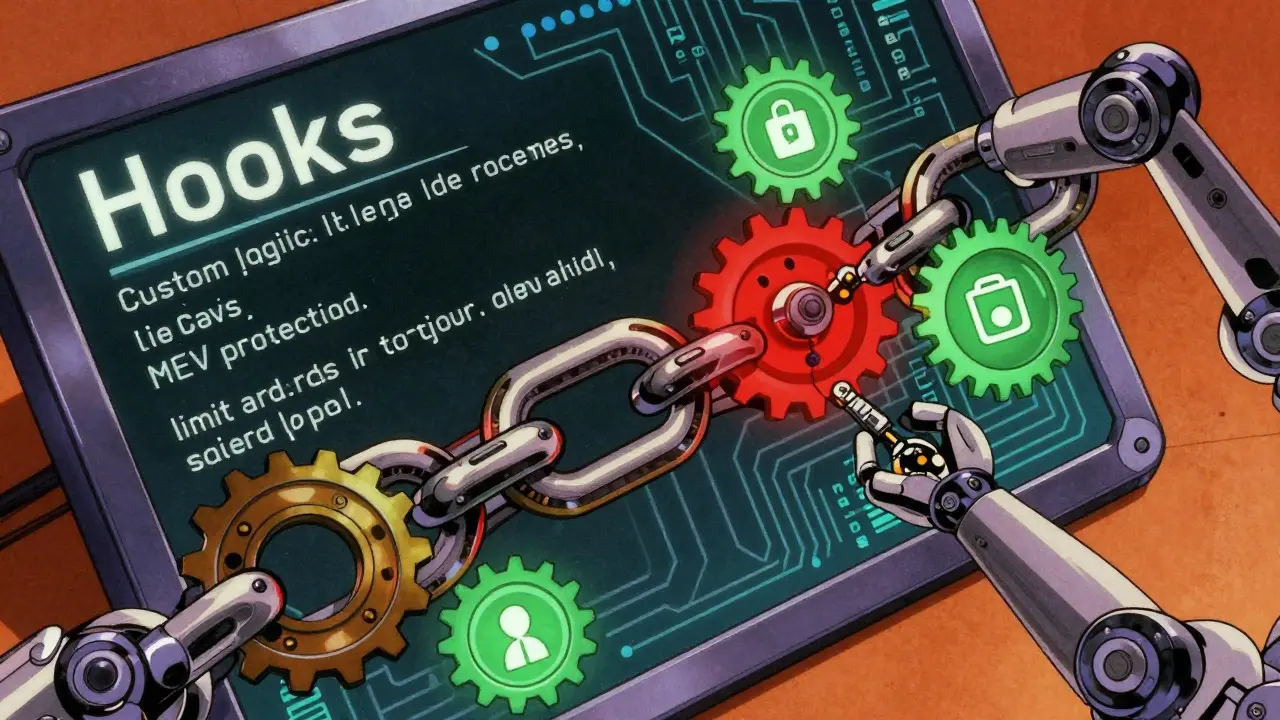
If the singleton architecture is the engine, Hooks external smart contracts attached to pools that execute custom logic at specific lifecycle points are the steering wheel. This is the defining feature of v4. Hooks allow developers to attach custom code to a pool, triggering actions before or after swaps, during initialization, or when positions are modified.
Why does this matter to you as a trader or liquidity provider? Because it unlocks features that were previously impossible or prohibitively expensive to build. For example:
- On-Chain Limit Orders: Instead of relying on off-chain bots, hooks can automatically execute your order when the price hits a certain tick.
- MEV Protection: New hooks can identify if a trade is being front-run and rebate those losses back to the victim, effectively neutralizing predatory bots.
- Dynamic Fees: Pool creators can adjust fees based on volatility or time of day, offering better rates when markets are calm.
However, there is a catch. Hooks add complexity. A hook is essentially a piece of code running inside your trade. If that code has a bug, or if the permissions are encoded incorrectly, your transaction could revert-or worse, funds could be lost. Security firms like OpenZeppelin found over 100 issues during pre-launch audits of v4 core contracts. While the core protocol is robust, the safety of a specific pool depends heavily on the quality of its hooks. Always check if a pool’s hooks have been audited before providing liquidity.
Native ETH Support and Gas Efficiency
One of the most frustrating quirks of earlier Uniswap versions was the handling of native Ether (ETH). To trade ETH against other tokens, you first had to wrap it into WETH (Wrapped Ether), then trade, then unwrap it. This extra step cost gas and added friction.
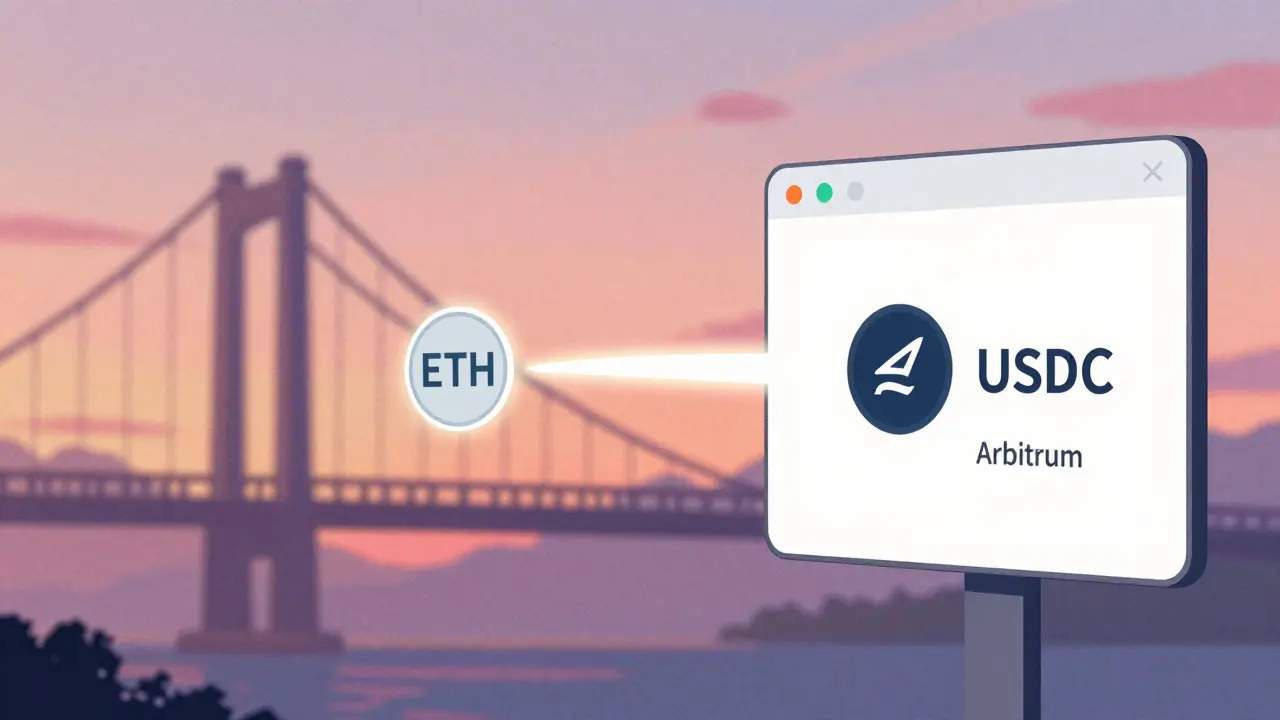
Uniswap v4 brings back Native ETH Trading Pairs allowing direct trading of ETH without wrapping. On Arbitrum, this means you can swap ETH for USDC directly. No wrapping, no unwrapping. Just a clean, single-step transaction. Combined with the singleton architecture, this reduces the computational load on the network.
While Arbitrum’s fees are already a fraction of Ethereum’s, every bit counts. Native ETH pairs eliminate the overhead of interaction with the WETH contract. For high-frequency traders or large-volume market makers, these micro-savings compound quickly. For the average user, it simply makes the experience feel snappier and more intuitive.
Security and Trust: Is Your Money Safe?
Security is the bedrock of any crypto exchange review. Uniswap v4 has undergone some of the most rigorous scrutiny in DeFi history. Before launching in January 2025, the protocol went through nine security reviews by six independent firms. There was also a $2.35 million security competition with over 500 participants and a record-breaking bug bounty program offering up to $15.5 million for critical bugs.
As of mid-2026, v4 has processed over $160 billion in cumulative volume across all chains with zero recorded security incidents in the core protocol. This is a strong signal of stability. However, remember that DeFi is self-custodial. There is no customer support team to call if you send funds to the wrong address or approve a malicious contract. The risk shifts from platform insolvency (like FTX) to user error and smart contract vulnerabilities in third-party integrations.
When using v4 on Arbitrum, ensure you are interacting with the official Uniswap interface or trusted aggregators. The ecosystem is maturing, but phishing sites targeting new features like hooks are common. Always double-check URLs and contract addresses.
| Feature | Uniswap v3 | Uniswap v4 |
|---|---|---|
| Architecture | Factory Pattern (separate contracts per pool) | Singleton (single PoolManager contract) |
| Customization | Limited (concentrated liquidity only) | High (via programmable Hooks) |
| Native ETH | No (requires WETH wrapping) | Yes (direct ETH pairs) |
| Gas Efficiency | Standard L2 costs | Significantly lower due to flash accounting |
| Complexity | Moderate (familiar to most users) | High (requires understanding of hook risks) |
| MEV Mitigation | External solutions only | Built-in via specialized hooks |
User Experience: Still Familiar, But Powerful
Despite the technical overhaul, the user interface remains surprisingly familiar. If you have used Uniswap v2 or v3, you will feel right at home. You connect your wallet, select the Arbitrum network, choose your tokens, and click swap. The complex routing through the PoolManager and potential hook executions happen in the background.
However, there are subtle differences. You might notice new options for fee tiers or specific pool types that indicate hook usage. For instance, a pool might advertise "MEV Protected" or "Limit Order Enabled." These are signals that custom logic is active. As a casual user, you can largely ignore these unless you want to optimize for specific conditions. For advanced users, these labels are goldmines for strategy.
One area of friction remains: liquidity fragmentation. Since v4 launched in early 2025, liquidity has been migrating from v3 to v4. On Arbitrum, both versions coexist. Sometimes, a v3 pool might have deeper liquidity than its v4 counterpart, leading to slightly worse prices on v4 despite the lower gas costs. The Uniswap DAO is actively incentivizing migration, but until then, always compare quotes between v3 and v4 interfaces before executing large trades.
Who Should Use Uniswap v4 on Arbitrum?
This setup isn't for everyone, but it is ideal for specific groups:
- Active Traders: Those who make multiple swaps daily will benefit from the reduced gas costs and native ETH support.
- Liquidity Providers: Advanced LPs can use hooks to create customized strategies, such as auto-compounding rewards or dynamic fee adjustments, maximizing returns.
- Developers: Builders looking to create novel financial products can leverage the SDK and hook framework to innovate on top of a secure, established protocol.
If you are a beginner who rarely trades and prefers simplicity, sticking to standard v3 pools or centralized exchanges might still be less confusing. The power of v4 comes with responsibility. Understanding what a hook does-and trusting its auditor-is part of the job.
Future Outlook: Where Does This Go?
The trajectory is clear. Uniswap v4 is designed to be the backbone of next-generation DeFi. With ongoing governance proposals aiming to unify liquidity and further reduce fees, we expect v4 to dominate on Arbitrum within the next year. The introduction of UNI burn mechanisms tied to protocol fees could also align incentives more closely between users and token holders.
For now, Uniswap v4 on Arbitrum represents a mature, secure, and highly efficient environment for decentralized trading. It strips away the inefficiencies of the past while opening doors to customization that was previously unimaginable. Just remember: with great power comes great caution. Always do your own research, especially when interacting with new hook-enabled pools.
Is Uniswap v4 safe to use on Arbitrum?
Yes, the core Uniswap v4 protocol has undergone extensive auditing and has zero critical security incidents since launch. However, safety depends on the specific pools you use. Pools with custom hooks carry additional risk if those hooks are not properly audited. Stick to well-known pools and verify hook credentials.
How much cheaper are gas fees on Uniswap v4 compared to v3?
Pool creation costs are up to 99% cheaper. For swaps, savings vary based on complexity. Simple swaps may see modest reductions, but multi-hop trades can save significant amounts due to flash accounting and the singleton architecture. On Arbitrum, where base fees are low, the absolute dollar saving is smaller but still meaningful for frequent traders.
What are Hooks in Uniswap v4?
Hooks are customizable smart contracts that can be attached to a pool to modify its behavior. They can trigger actions before or after swaps, adjust fees dynamically, or implement features like limit orders and MEV protection. They allow developers to tailor pools to specific needs.
Can I trade native ETH on Uniswap v4?
Yes. Unlike v2 and v3, which required wrapping ETH into WETH, v4 supports native ETH trading pairs. This eliminates the extra steps and gas costs associated with wrapping and unwrapping, making transactions faster and cheaper.
Should I migrate my liquidity from v3 to v4?
It depends on your strategy. v4 offers better capital efficiency and lower costs, but liquidity is currently fragmented. If you provide liquidity, ensure the v4 pool has sufficient depth to avoid slippage. The Uniswap DAO is offering incentives to encourage migration, so watch for active campaigns on Arbitrum.
Does Uniswap v4 have customer support?
No. Like most DeFi protocols, Uniswap is non-custodial and decentralized. There is no central customer service team. Users must manage their own wallets and transactions. Help is available through community forums, documentation, and Discord channels, but there are no transaction reversals.