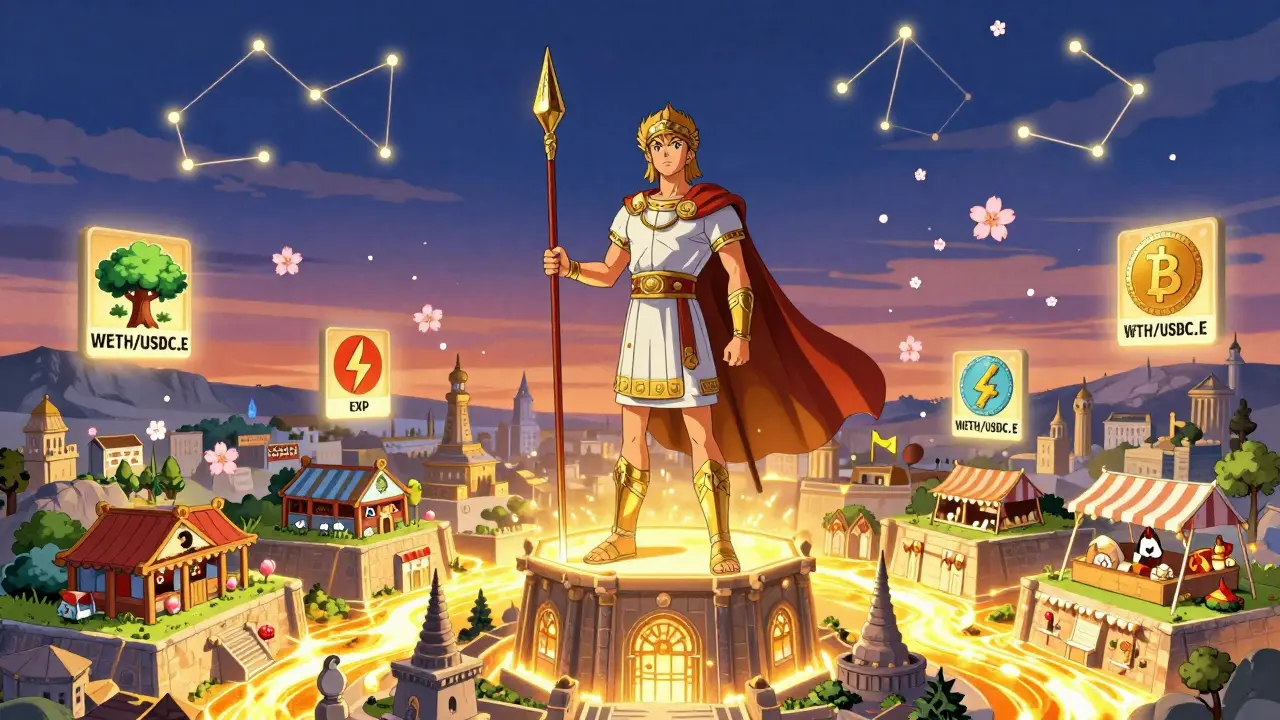
Most crypto exchanges are boring. You deposit, trade, stake, and hope the price goes up. SpartaDEX isn’t like that. It turns liquidity provision into a real-time strategy game set in ancient Greece. If you’ve ever felt DeFi was too dry or too complicated, SpartaDEX might be the twist you didn’t know you needed. But is it a clever innovation or just a flashy distraction? Let’s break it down.
What Is SpartaDEX?
SpartaDEX, often called just "Sparta," is a hybrid crypto exchange built on the Arbitrum blockchain. Launched in 2023, it’s the first DEX to combine decentralized trading with a full-blown strategy game. Instead of just swapping tokens, you become a city-state ruler. You mint a free NFT called a Polis-your personal ancient Greek city-and then grow it by providing liquidity to trading pools.
Every time you add funds to a liquidity pool, you earn EXP. More EXP unlocks higher Senate levels, which boost your staking rewards by up to 33.3%. That’s not a gimmick-it’s baked into the protocol. The more you play, the more you earn. And the game isn’t just for fun: your city’s military strength affects security against "raids" from other players, while economic development directly impacts how much yield you pull in.
The whole system runs on two tokens: SAS for governance and SPARTA as the reward token. SPARTA has a max supply of 1 billion, with around 5.3 million circulating as of late 2023. To get started, you need at least $100 in liquidity deposited into one of the whitelisted pools. That’s steep for beginners, but it filters out casual users and keeps the ecosystem focused.
How SpartaDEX Works
Here’s how the system connects gameplay to finance:
- You connect your wallet (MetaMask, WalletConnect) to SpartaDEX.
- You pick a liquidity pool-like WETH/USDC.E-and deposit at least $100.
- You receive a Polis NFT, which tracks your progress: liquidity provided, EXP earned, Senate level, and city upgrades.
- You spend resources to build your city: farms for food, barracks for defense, markets for trade.
- Your city’s level determines your APR on staked LP tokens. Level 1? 5% APR. Level 7? Up to 6.67% APR on base yield, plus bonuses.
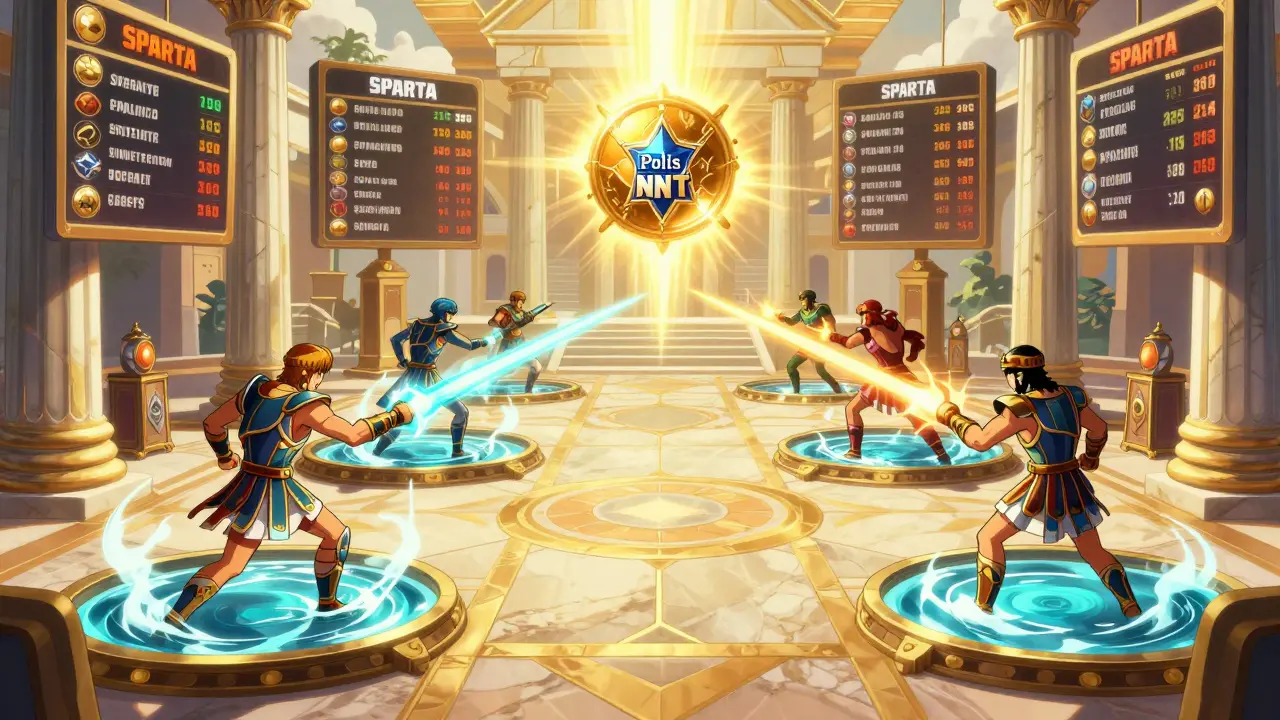
- You compete in weekly tournaments (Olympiad events) to win SPARTA token prizes.
The magic isn’t just in the rewards-it’s in the feedback loop. When you provide liquidity, you’re not just helping the exchange. You’re feeding your own city’s economy. When you upgrade your marketplace, your trading fees go down. When you strengthen your walls, you reduce the chance of losing assets to "raids." It’s DeFi with skin, bones, and ambition.
Trading Pairs and Liquidity
SpartaDEX doesn’t have thousands of tokens. It has eight. That’s intentional. The platform only lists projects that have been community-vetted and whitelisted. As of September 2023, the top trading pair was WETH/USDC.E, which accounted for over $178,000 in daily volume. Total 24-hour volume hovered around $488,000-tiny compared to Uniswap’s $1 billion+, but not bad for a niche platform.
Because liquidity is concentrated in fewer pools, slippage can be an issue on larger trades. If you’re trying to swap $10,000 worth of a lesser-known token, you might get a worse price than on a bigger DEX. But for smaller traders-people who are staking $500 or $2,000-the experience is smooth. The bid-ask spread averages 0.615%, which is competitive for a small DEX.
Unlike Uniswap or PancakeSwap, SpartaDEX doesn’t use automated market makers alone. It layers on behavioral incentives. Users stay longer because they’re not just earning yield-they’re building something. That’s why, despite low volume, user retention is higher than average. Weekly active wallets hit 8,342 in late 2023, and most users log in daily to manage their cities.
Gameplay vs. Finance: The Double Learning Curve
SpartaDEX isn’t for everyone. If you’re new to crypto, you’ll need to learn three things at once:
- How DEXs work (liquidity pools, impermanent loss, slippage)
- How to manage a city-state (resource allocation, upgrades, defense)
- How the tokenomics tie together (SAS, SPARTA, staking, governance)
Most users report spending 3 to 5 hours just to get comfortable. The onboarding isn’t broken-it’s just dense. The official guide walks you through the seven Senate levels, but it doesn’t teach advanced tactics. Reddit and Discord are where real strategy lives. One user on r/DeFi said they earned $127 in ETH rewards in a month by managing their Polis for 20-30 minutes a day. Another lost 15% of their stake to impermanent loss because they didn’t understand how price volatility affects their pool.
The game adds complexity, but it also adds depth. You can’t just "stack and forget" here. You need to adapt. During a bear market, you might shift from military expansion to economic upgrades. During a bull run, you might flood a new pool for maximum EXP. It’s DeFi, but it’s also a living system.
Pros and Cons
| Pros | Cons |
|---|---|
| Unique gamified DeFi model that boosts retention | High entry barrier ($100 minimum liquidity) |
| Up to 33.3% higher APR through city-state progression | Only 8 trading pairs-limited token selection |
| Active community (12,500+ Discord members) | No advanced charting or order book tools |
| Weekly tournaments with $50K prize pools | Slow customer support (72-hour average response) |
| Built on Arbitrum-low fees, fast transactions | Contract audit status not publicly confirmed |
The platform shines for people who want to engage with DeFi, not just use it. If you’re the type who reads whitepapers, joins Discord threads, and likes to optimize systems, SpartaDEX is a playground. But if you just want to swap ETH for USDT quickly, stick with Uniswap.
Security and Regulation
SpartaDEX is incorporated in Estonia, a country with clear crypto regulations. That gives it a legal footing most DeFi projects lack. But here’s the catch: the team is anonymous. No names, no LinkedIn profiles. That’s common in crypto, but it raises red flags for some.
The biggest concern? Contract security. As of late 2023, SpartaDEX hadn’t released a full audit report from a top-tier firm like CertiK or SlowMist. Security researcher Alexei Volkov from CertiK warned that "integrating game mechanics with DeFi increases attack surface." That’s not a scare tactic-it’s math. More code = more bugs. And while the platform hasn’t been hacked, there’s no public proof it’s bulletproof.
On the regulatory side, SPARTA tokens could be classified as securities by the SEC. The agency has been cracking down on token rewards tied to participation. If that happens, SpartaDEX could be forced to restrict U.S. users or restructure its reward system.
Future Roadmap
SpartaDEX isn’t standing still. In Q4 2023, they announced plans to expand to Optimism and Base in early 2024. That means more chains, more users, more liquidity. They’re also rolling out AI-powered strategy advisors-bots that give personalized tips based on your city’s status. Think of it like a coach for your Polis.
Their goal? 50,000 daily active users by Q2 2024. Right now, they’re at about 8,300. That’s a big jump. If they hit it, liquidity depth will improve, trading volume will climb, and the token could gain real momentum. If they don’t? The novelty might fade, and users could drift back to simpler DEXs.
Who Is SpartaDEX For?
Use SpartaDEX if:
- You’re already comfortable with DeFi and want something more engaging
- You enjoy strategy games and don’t mind spending time managing assets
- You believe in long-term community-driven DeFi over short-term yield farming
- You’re okay with limited trading options for deeper rewards
Avoid SpartaDEX if:
- You’re new to crypto and still learning how wallets or liquidity pools work
- You need to trade dozens of altcoins daily
- You want fast customer service or a polished UI
- You’re risk-averse and don’t want to risk impermanent loss
SpartaDEX isn’t trying to beat Uniswap. It’s trying to replace the boredom of staking with a reason to come back every day. It’s not the biggest exchange. But it might be the most interesting.
Is SpartaDEX a scam?
No, SpartaDEX isn’t a scam. It’s a real platform with working smart contracts, a transparent roadmap, and a growing user base. But it’s not risk-free. The team is anonymous, audits aren’t public, and the tokenomics are complex. Treat it like any high-risk DeFi project: only invest what you can afford to lose.
Can I use SpartaDEX on mobile?
Yes, but not through a native app. SpartaDEX works through web wallets like MetaMask on mobile browsers. The interface is responsive, so you can manage your Polis from your phone. But for serious gameplay, a desktop is better-especially for tracking multiple cities or checking tournament rankings.
How do I earn SPARTA tokens?
You earn SPARTA by providing liquidity to whitelisted pools, leveling up your Polis, and winning weekly Olympiad tournaments. The more active you are, the more you earn. There’s no airdrop or free claim-you have to participate. The platform rewards consistency, not luck.
What’s the difference between SAS and SPARTA?
SAS is the governance token. You use it to vote on proposals like which new tokens to list or how to adjust reward rates. SPARTA is the reward token. You earn it through gameplay and staking. You can’t vote with SPARTA, and you can’t stake SAS for yield. They serve different roles.
Is SpartaDEX better than Uniswap?
It’s not better-it’s different. Uniswap is the Swiss Army knife of DeFi: massive liquidity, 8,000+ tokens, instant swaps. SpartaDEX is a specialized tool: deep rewards, community focus, game mechanics. If you want to trade, use Uniswap. If you want to engage, grow, and earn more over time, SpartaDEX is worth your attention.


