
Imagine writing code that locks away millions of dollars. In the world of blockchain, this isn't a hypothetical scenario; it's daily reality. Smart contracts are self-executing agreements with the terms directly written into code. Once deployed, they run exactly as programmed, without the possibility of downtime, censorship, or third-party interference. But what happens when that code has a flaw? The answer is often catastrophic financial loss.
In recent years, the decentralized finance (DeFi) ecosystem has grown exponentially, attracting billions in total value locked. However, this growth has come with a steep price tag. According to data from Immunefi, cumulative losses from smart contract exploits reached $3.2 billion between January 2020 and mid-2025. These aren't just small errors; they are critical vulnerabilities that allow attackers to drain funds, manipulate prices, or seize control of protocols. Understanding these common vulnerabilities is not just for developers-it's essential for anyone interacting with Web3 applications.
The Most Costly Mistake: Access Control Failures
If you ask security experts what causes the most damage, the answer is consistently the same: Access Control Vulnerabilities. This category topped the OWASP Smart Contract Top 10 list in 2025, responsible for over $953 million in damages in 2024 alone. It sounds simple-ensuring only authorized people can change settings-but it’s surprisingly easy to get wrong.
Think of a smart contract like a bank vault. If the lock is broken, or if the key is left under the mat, anyone can walk in. A classic example occurred in September 2023 with the 88mph protocol. Attackers exploited a function initialization bug, reinitializing the contract to gain administrative privileges. They essentially reset the admin keys, allowing them to freeze assets and steal funds. Another incident involved Yearn Finance in early 2025, where an access control flaw allowed unauthorized strategy migration, resulting in temporary losses of $4.2 million.
The root cause is often poor implementation of modifiers like onlyOwner. Developers might forget to restrict sensitive functions, or they might implement role-based access control incorrectly. Dr. Christian Reitwießner, Solidity Language Lead at Ethereum Foundation, noted in his March 2025 keynote that "poorly implemented onlyOwner modifiers remain the biggest threat." The fix is straightforward but requires discipline: use established libraries like OpenZeppelin’s AccessControl, which provides robust, audited patterns for managing roles and permissions.
Manipulating Truth: Price Oracle Exploits
Smart contracts don't have eyes or ears; they rely on external data sources called Oracles to know real-world information, like the price of Bitcoin or ETH. When these oracles are manipulated, the contract makes decisions based on false information. This is known as Price Oracle Manipulation.
In 2024, Chainlink documented 37 successful oracle attacks causing $412.7 million in losses. How does it work? Imagine a lending protocol that uses the current market price of a token to determine how much collateral you need. An attacker might buy a large amount of that token on a low-liquidity exchange, spiking its price artificially. The oracle sees this spike and reports a high price. The attacker then deposits their inflated tokens as collateral and borrows massive amounts of stablecoins. Once they withdraw, the price crashes, leaving the protocol holding worthless collateral.
A user on Reddit’s r/ethfinance community shared their experience after losing 12.7 ETH in the Hundred Finance exploit, caused precisely by this mechanism. To prevent this, developers should avoid relying on single-point data feeds. Instead, use time-weighted average prices (TWAP) from multiple decentralized exchanges, or integrate professional oracle services like Chainlink, which aggregate data from numerous sources to resist manipulation.
The Classic Threat: Reentrancy Attacks
You’ve probably heard of the DAO hack in 2016, which resulted in a $60 million loss and led to the creation of Ethereum Classic. That attack used a technique called Reentrancy. While less frequent today due to better developer awareness, it still caused $187.3 million in damages in 2024.
Here’s the logic: A contract sends Ether to another address. If that receiving address is also a contract, it can execute code before the original transaction finishes. It can call back into the sending contract again, withdrawing more funds before the balance is updated. It’s like taking money out of your bank account, but before the teller updates your balance, you demand another withdrawal because the ledger hasn’t caught up yet.
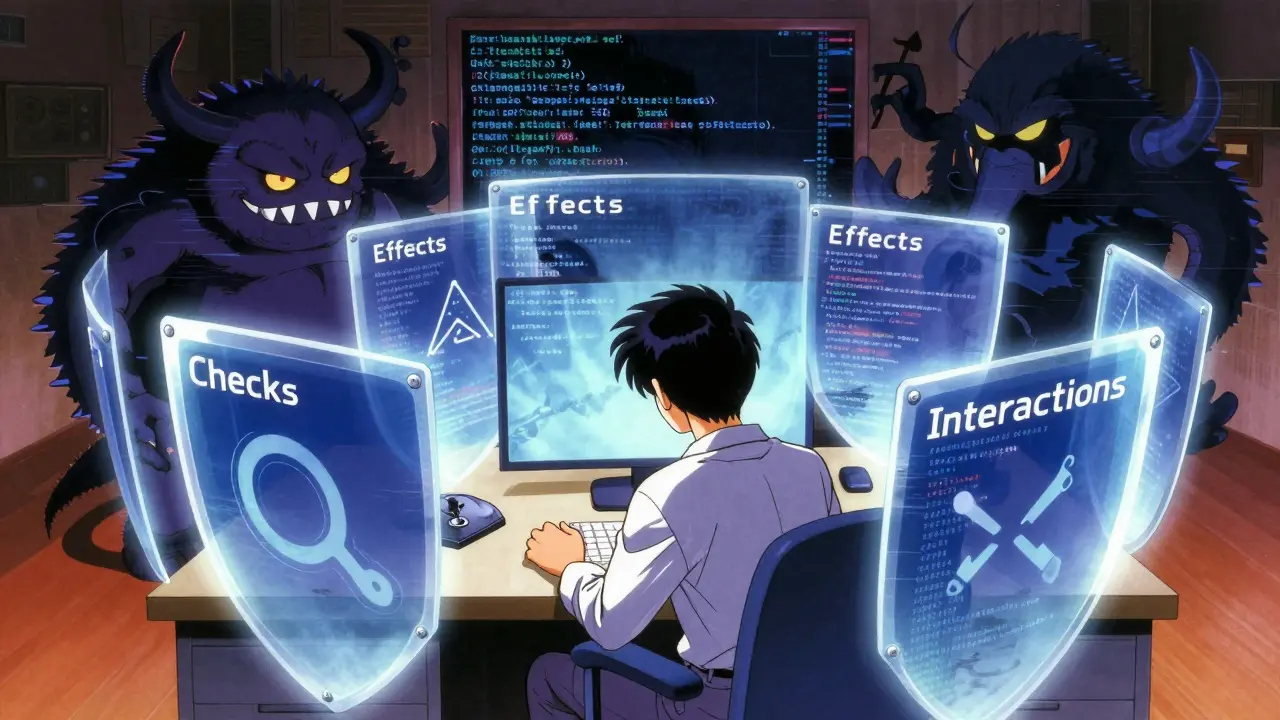
Modern Solidity compilers and linters help catch these issues, but they don’t eliminate them entirely. The best defense is the "Checks-Effects-Interactions" pattern. First, check if the user is eligible for a withdrawal. Second, update the internal state (reduce their balance). Third, interact with the external address by sending funds. By updating the state before the external call, you ensure that even if the recipient tries to reenter, the checks will fail because the balance is already zero.

Flash Loans: Power Without Permission
Flash Loans are unique to DeFi. They allow you to borrow millions of dollars without any collateral, provided you return the loan within the same transaction block. If you don’t, the entire transaction reverts as if it never happened. Flash loans themselves are not vulnerabilities; they are powerful tools for arbitrage and refinancing. However, they become weapons when combined with other flaws.
In 2024, there were 42 incidents involving flash loan abuse, causing $382.1 million in damages. Attackers use flash loans to amplify their capital instantly. For example, they might borrow $100 million via a flash loan, use it to manipulate the price of a token on a small exchange (as mentioned in the Oracle section), and then exploit a lending protocol that relies on that manipulated price. Because the entire sequence happens atomically, it’s incredibly difficult to stop once initiated.
Preventing flash loan attacks isn't about blocking the loans themselves, but about securing the underlying logic. Ensure your contracts don't rely on instantaneous price snapshots for critical decisions. Use TWAPs and implement circuit breakers that pause trading if volatility exceeds certain thresholds.
Silent Killers: Unchecked External Calls
In the 2025 OWASP report, Unchecked External Calls climbed significantly in ranking. This happens when a contract calls another contract but doesn't handle the response properly. If the called contract fails or runs out of gas, the calling contract might continue executing, leading to inconsistent states.
For instance, if Contract A transfers funds to Contract B and expects B to confirm receipt, but A ignores the return value, B might fail silently. Contract A thinks the transfer succeeded and updates its records, while the funds are stuck or lost. Resonance Security reported 19 successful exploits of this type in 2024. Always use safe transfer methods like SafeERC20 from OpenZeppelin, which wraps standard ERC20 transfers and ensures that failures are caught and handled correctly.
Other Critical Vulnerabilities to Watch
Beyond the big hitters, several other vulnerabilities pose significant risks:
- Integer Overflow/Underflow: Older versions of Solidity (<0.8.0) didn't automatically check for arithmetic errors. If a number gets too big, it wraps around to zero. While newer versions handle this, legacy contracts remain vulnerable. QuillAudit reported $28.4 million in losses from this in 2024.
- Lack of Input Validation: Assuming users will always send valid data is dangerous. If a contract doesn't check for zero addresses or negative numbers, attackers can exploit these gaps. This caused $14.6 million in losses in 2024.
- Logic Errors: Sometimes the code works as written, but the business logic is flawed. Incorrect reward distributions or rounding errors can be exploited. OpenZeppelin found these accounted for 12% of all identified vulnerabilities in 2025.
| Vulnerability Type | Estimated Losses (2024) | Primary Cause | Mitigation Strategy |
|---|---|---|---|
| Access Control | $953.2M | Improper permission checks | Use OpenZeppelin AccessControl |
| Flash Loan Abuse | $382.1M | Atomic manipulation of liquidity | Use TWAPs, circuit breakers |
| Oracle Manipulation | $412.7M | Single-source price feeds | Aggregate multiple data sources |
| Reentrancy | $187.3M | External calls before state updates | Checks-Effects-Interactions pattern |
| Unchecked External Calls | $93.5M | Igoring return values | Use SafeERC20 library |
How to Secure Your Smart Contracts
Securing smart contracts isn't a one-time task; it's a continuous process. Here are practical steps to reduce risk:
- Static Analysis Tools: Use tools like Slither, Mythril, or Echidna during development. Slither detects 83% of common vulnerabilities according to Trail of Bits. Integrate them into your CI/CD pipeline so every commit is checked.
- Formal Verification: For critical protocols, consider formal verification. This mathematically proves that the code behaves as intended. The Optimism Collective’s pilot program showed a 92% detection rate for vulnerabilities using this method.
- Professional Audits: Don't skip audits. Firms like OpenZeppelin, Quantstamp, and Trail of Bits provide expert reviews. In 2024, 89% of new DeFi protocols conducted audits before launch, up from 63% in 2023.
- Bug Bounties: Launch a bug bounty program on platforms like Immunefi. In 2024, the average payout was $28,745, incentivizing researchers to find flaws before hackers do.
- Keep Dependencies Updated: Regularly update your Solidity version and libraries. Solidity 0.8.30, released in May 2025, introduced automatic runtime checks for unchecked external calls, reducing SC06 vulnerabilities by an estimated 75%.
The landscape of smart contract security is evolving rapidly. As regulations tighten-with the SEC taking enforcement actions against protocols with inadequate controls-the cost of negligence is rising. But with the right knowledge and tools, you can build secure, resilient applications that stand the test of time.
What is the most common smart contract vulnerability?
According to the OWASP Smart Contract Top 10 (2025), Access Control Vulnerabilities are the most common and damaging, responsible for over $953 million in losses in 2024. This occurs when contracts fail to properly restrict who can execute certain functions.
How can I prevent reentrancy attacks?
The best way to prevent reentrancy is to follow the Checks-Effects-Interactions pattern. Update internal state variables (like user balances) before making any external calls to other contracts. Additionally, using reentrancy guards from libraries like OpenZeppelin adds an extra layer of protection.
Are flash loans inherently insecure?
No, flash loans are not vulnerabilities themselves; they are a feature of DeFi that allows uncollateralized borrowing within a single transaction. However, they can be abused to exploit other vulnerabilities, such as oracle manipulation, because they provide attackers with massive capital instantly.
Which tools should I use to audit my smart contracts?
Popular static analysis tools include Slither, Mythril, and Echidna. Slither is widely adopted, detecting 83% of common vulnerabilities. For comprehensive security, combine automated tools with professional audits from firms like OpenZeppelin or Trail of Bits.
Why are price oracles important for security?
Smart contracts rely on oracles for external data like asset prices. If an oracle is manipulated, the contract may make incorrect decisions, such as lending against undervalued collateral. Using time-weighted average prices (TWAP) and aggregating data from multiple sources helps mitigate this risk.