
Imagine sending a letter in a crowded room. You drop it into a mailbox, but there are ten other people doing the exact same thing at the same time, wearing identical coats. Who sent which letter? It’s impossible to tell without stopping everyone and checking their pockets. That is the basic idea behind ring signatures, a cryptographic technique that lets you prove you signed a message without revealing which key among a group actually did the signing.
In the world of transparent blockchains like Bitcoin, every transaction is visible. Anyone can trace where money came from and where it went. Ring signatures change that dynamic entirely. They create plausible deniability, making it computationally infeasible to distinguish the real sender from a group of decoys. This technology is the backbone of privacy-focused cryptocurrencies, most notably Monero (XMR), a cryptocurrency launched in 2014 that prioritizes untraceability by default.
How Ring Signatures Actually Work
To understand ring signatures, you need to look past the marketing and see the math. In traditional digital signatures, your private key signs a transaction, and the network verifies it against your public key. It’s like signing a check with your unique signature; the bank knows it’s you.
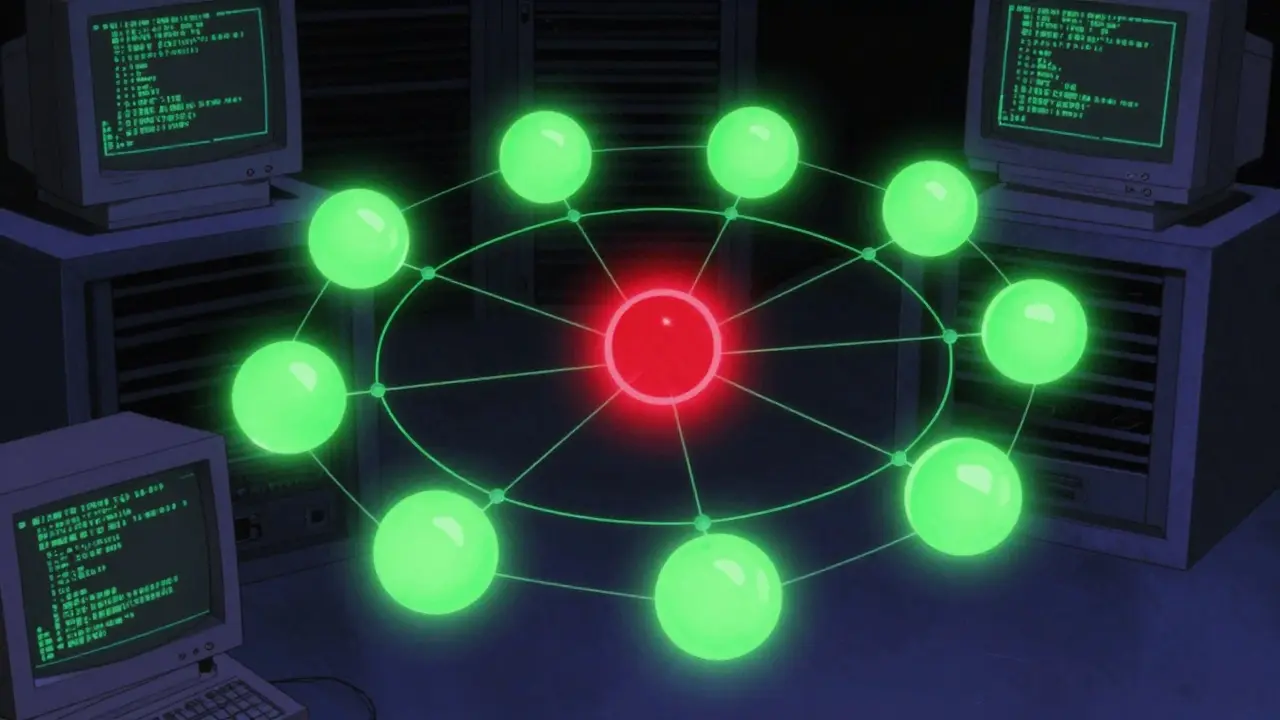
Ring signatures mix your private key with several other public keys pulled randomly from the blockchain. These extra keys act as "decoys." When the transaction is broadcast, the network sees a valid signature coming from a "ring" of possible signers. However, the cryptographic proof is constructed so that while anyone can verify the signature is valid, no one can determine which specific key within the ring generated it.
- The Real Signer: The actual sender who holds the private key.
- The Decoys: Randomly selected public keys from previous transactions on the blockchain.
- The Ring: The combined group of the real signer and the decoys.
This creates a scenario where all members of the ring appear equally likely to have authorized the transaction. As Dr. Andrew Miller, a blockchain professor at the University of Illinois, noted in his 2019 IEEE Security & Privacy paper, this provides robust privacy against network-level adversaries. The beauty, as Monero lead researcher Riccardo Spagni explained in a 2020 MIT lecture, is that these signatures are improvisational-they require no prior setup or coordination between users, unlike older group signature schemes.
Evolution of Ring Sizes in Monero
Privacy isn’t static; it evolves. The strength of a ring signature depends heavily on the size of the ring-the number of decoys included. A small ring makes it easier for analysts to guess the real sender through statistical analysis. Over time, Monero has increased its default ring size to stay ahead of blockchain analysis techniques.
| Year | Default Ring Size | Context / Reason for Change |
|---|---|---|
| 2014-2015 | 3 | Early implementation; low computational cost but weak privacy. |
| 2015-2017 | 5 | Balanced approach to improve anonymity sets. |
| 2017-2020 | 7 | Further hardening against heuristic attacks. |
| 2020-Present | 11 | Current standard; significantly raises the barrier for de-anonymization. |
Currently, Monero uses a gamma distribution method to select these decoys, ensuring they come from a wide variety of ages and amounts on the blockchain. This prevents patterns from emerging that could link transactions. However, even with larger rings, experts warn about limitations. LocalMonero’s technical team highlighted in May 2021 that ring signatures remain the "weakest link" in the privacy scheme when subjected to sophisticated chain analysis across multiple blocks.
RingCT: Hiding Amounts Alongside Identities
Hiding the sender is only half the battle. If the amount being sent is visible, metadata analysis can still compromise privacy. For example, if you send exactly $500, and there is only one unspent output of $500 on the blockchain, you’ve just revealed yourself.
To solve this, Monero introduced Ring Confidential Transactions (RingCT) on January 10, 2017. This upgrade added a layer of privacy that hides the transaction amounts using Pedersen commitments. This cryptographic technique allows the network to verify that inputs equal outputs (preventing inflation) without ever revealing the actual values.
Together, ring signatures and RingCT form two-thirds of Monero’s "three-prong approach" to privacy. The third component is stealth addresses, which hide the recipient’s identity. Unlike Zcash, which offers optional shielded transactions, or Dash’s PrivateSend feature, Monero applies these protections by default. According to Monero Research Lab data, 100% of Monero transactions use these privacy features, compared to an estimated 15-20% adoption rate for Dash’s PrivateSend in 2022.
Trade-offs: Privacy vs. Performance
Nothing comes for free. Implementing ring signatures introduces significant overhead to the blockchain. Because each transaction must include the public keys of all decoys and complex cryptographic proofs, Monero transactions are much larger than those on transparent chains.
As of 2022 metrics from Ledger Academy, a typical Monero transaction ranges from 13 KB to 15 KB. Compare that to Bitcoin’s average transaction size of roughly 250 bytes. This size difference leads to what some call "blockchain bloat," requiring more storage space for nodes and increasing bandwidth usage.
There is also a computational cost. Research from the University of Edinburgh in 2021 indicated that verifying ring signatures increases computational load by approximately 30% compared to non-private transactions. Users have noticed this too. On the MoneroTalk forum, user 'SlowTransacts' complained in August 2024 about confirmation times during network congestion, noting that ring signatures make transactions feel slower than Bitcoin’s 5-10 second processing times. While Monero’s block time is 2 minutes, the verification complexity means finality can take longer under heavy load.
Comparing Privacy Technologies
Ring signatures aren’t the only way to achieve privacy on a blockchain. Different projects choose different tools based on their priorities. Here is how ring signatures stack up against other major privacy technologies.
| Technology | Used By | Privacy Mechanism | Transaction Size | Key Advantage |
|---|---|---|---|---|
| Ring Signatures + RingCT | Monero | Mixes sender with decoys; hides amounts via commitments. | 13-15 KB | No trusted setup required; privacy by default. |
| zk-SNARKs | Zcash | Zero-knowledge proofs verify validity without revealing data. | ~1.4 KB (shielded) | Smaller transaction sizes; theoretically strong proofs. |
| PrivateSend (CoinJoin) | Dash | Mixes coins from multiple users in pools before spending. | Variable | Simpler concept; optional for users. |
Zcash’s zk-SNARKs offer smaller transaction sizes and strong theoretical security, but they required a "trusted setup" ceremony in 2016. If the random data generated during that ceremony was leaked, the entire system’s integrity could be compromised. Ring signatures avoid this risk entirely because they rely on open mathematical problems rather than secret parameters. However, Zcash transactions are smaller, which helps with scalability. Dash’s mixing protocol is easier to understand but suffers from low adoption, meaning the anonymity set is often small and predictable.

Regulatory Scrutiny and Future Developments
As privacy coins gain popularity, regulators pay closer attention. In August 2020, the U.S. Internal Revenue Service awarded a $625,000 contract to Chainalysis to develop software capable of analyzing Monero transactions. While Chainalysis CEO Michael Gronager stated in 2022 that breaking ring signatures at scale remains computationally prohibitive, the pressure is mounting.
In May 2024, FinCEN issued guidance requiring enhanced due diligence for transactions involving privacy coins utilizing ring signatures. This has affected 78% of U.S.-based exchanges, according to CipherTrace’s 2025 Compliance Report. Some exchanges have delisted Monero, pushing users toward decentralized exchanges (DEXs). Trading volume for Monero on THORChain increased 300% year-over-year through 2025, showing a shift in how users access these assets.
Despite regulatory headwinds, the technology is advancing. The Monero Research Lab is working on next-generation protocols to address scalability. The Triptych protocol, detailed in 2020 and implemented in 2022, enables logarithmic scaling. This means you can add 100 decoys to a ring without increasing the transaction size proportionally-reducing size by approximately 80% compared to traditional methods. Additionally, the Arcturus protocol aims to improve verification speed by 400%, and the Lelantus protocol, scheduled for mainnet activation in Q2 2026, seeks to eliminate fixed ring sizes entirely through dynamic anonymity sets.
Practical Implementation for Users and Developers
For the average user, ring signatures are invisible. Wallets like Cake Wallet and the official Monero GUI abstract away the complexity. You don’t need to know about elliptic curve cryptography or EdDSA on Curve25519 to send a payment. LocalMonero’s 2024 user study found that the learning curve for end-users is just 2-3 hours, focusing mainly on wallet security rather than cryptographic mechanics.
Developers, however, face a steeper challenge. Integrating custom ring signature verification requires deep knowledge of the underlying math. The Monero Research Lab reported an average 80-hour development cycle for businesses building custom integrations in 2025. Common pitfalls include incorrect decoy selection, which can reduce privacy effectiveness. If you’re building a service that handles Monero, ensure your implementation correctly adjusts gamma distribution parameters for optimal decoy selection, as documented in numerous solutions on Monero Stack Exchange.
Are ring signatures completely unbreakable?
No cryptographic system is immune to future advances. While ring signatures are currently considered secure against classical computers, quantum computing poses a long-term theoretical threat. More immediately, they are vulnerable to heuristic analysis if ring sizes are small or if users reuse addresses. Current implementations with large rings (size 11+) are highly resistant to de-anonymization.
Why does Monero use ring signatures instead of zk-SNARKs?
Monero chose ring signatures primarily to avoid the "trusted setup" requirement of zk-SNARKs. A trusted setup relies on a one-time ceremony to generate parameters; if those parameters are compromised, the entire system fails. Ring signatures rely on open mathematical assumptions, making them trustless and easier to audit for decentralization purists.
Do ring signatures slow down transactions?
Yes, they increase computational load. Verifying a ring signature requires checking multiple potential signers, which takes more CPU power than a standard ECDSA signature. This results in larger transaction sizes (13-15 KB vs. 250 bytes for Bitcoin) and slightly longer confirmation times during network congestion.
Can banks or governments track Monero transactions?
While governments like the U.S. have funded research into tracking privacy coins, Chainalysis has stated that breaking Monero’s ring signatures at scale remains computationally prohibitive with current technology. However, off-chain metadata (like IP addresses or exchange KYC data) can still expose users if proper operational security is not maintained.
What is the Triptych protocol?
Triptych is a newer ring signature protocol designed to solve the scalability issue of traditional ring signatures. It allows for much larger anonymity sets (e.g., 100 decoys) without a proportional increase in transaction size, achieving logarithmic scaling. This enhances privacy while keeping blockchain bloat manageable.


