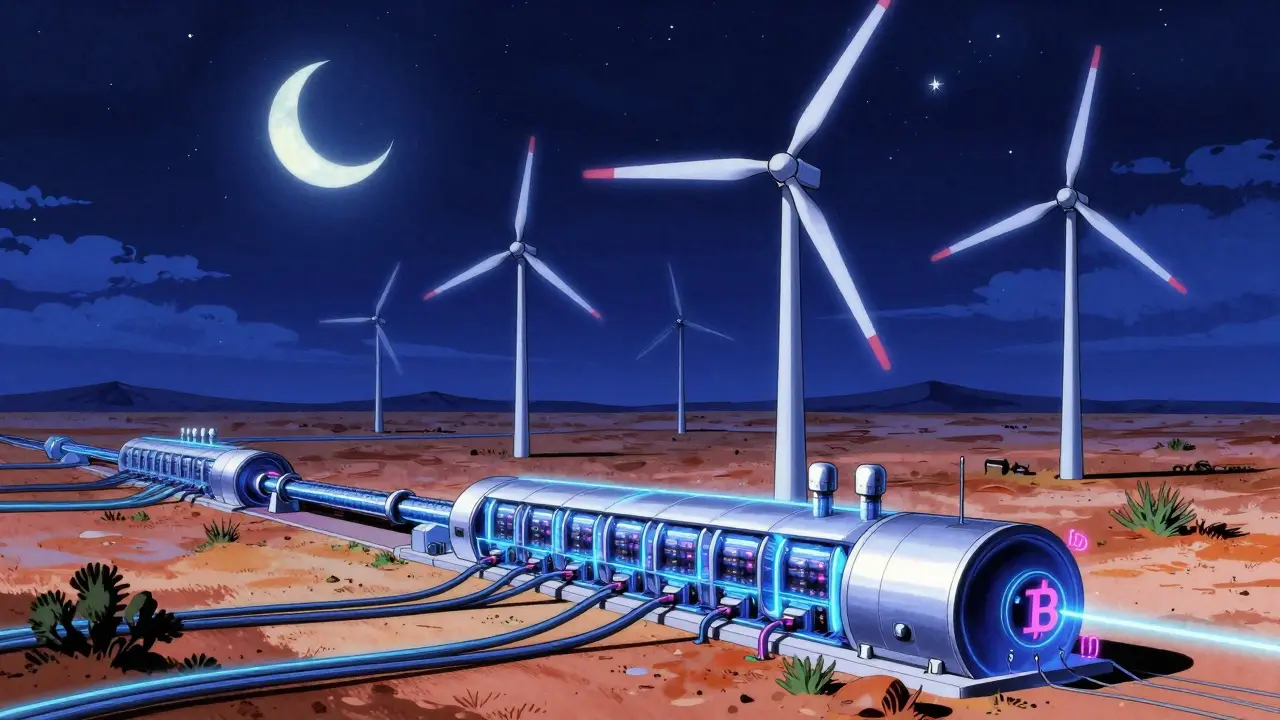
Picture this: it’s midnight in Texas. The wind is howling across the plains, spinning turbines so fast that the grid can’t handle the surplus. Normally, that clean energy would go to waste-curtailed because there’s nowhere to put it. But now? A massive Bitcoin mining facility next door kicks into overdrive. It absorbs that excess power, turns it into digital gold, and shuts down when the sun rises and demand spikes. This isn’t a sci-fi scenario; it’s the new reality of renewable energy for crypto mining.
The narrative around cryptocurrency has shifted dramatically. We’ve moved past the "crypto destroys the planet" headlines. Today, miners are becoming essential partners in the global energy transition. They act as virtual batteries, stabilizing grids and driving investment in solar, wind, hydro, and even nuclear power. If you’re looking at the blockchain industry in 2026, understanding this energy dynamic is no longer optional-it’s the difference between profit and obsolescence.
The Shift from Coal to Clean: By the Numbers
Let’s look at the hard data. For years, critics pointed to coal-powered mines in regions with lax environmental regulations. That model is dying. According to the Cambridge Centre for Alternative Finance’s 2025 Digital Mining Industry Report, sustainable energy sources now account for 52.4% of total Bitcoin mining energy usage. That number includes renewables like wind, solar, and hydro, plus nuclear power.
Natural gas still holds a significant share at 38.2%, largely due to its flexibility in peaking operations, but the trend line is clear. The industry is moving away from static, fossil-fuel-dependent setups toward dynamic, renewable-integrated systems. Why? Because after the Bitcoin halving in April 2024, which cut block rewards from 6.25 BTC to 3.125 BTC, margins got thinner. Miners had to get smarter about their biggest expense: electricity.
| Energy Source | Percentage Share | Trend Direction |
|---|---|---|
| Renewables (Wind/Solar/Hydro) | 42.6% | Increasing ↗ |
| Nuclear Power | 9.8% | Stable/Steady → |
| Natural Gas | 38.2% | Decreasing ↘ |
| Coal & Other | 9.4% | Decreasing ↘ |
How Miners Act as Virtual Batteries
The magic of renewable crypto mining lies in flexibility. Solar panels don’t produce power at night. Wind turbines stall on calm days. Traditional industries need constant power, making them poor partners for intermittent renewables. Miners, however, can ramp up or shut down in seconds.
In Texas, home to some of the world’s largest mining hubs, operators consume roughly 32% of the state’s curtailed wind energy. Here’s how it works: when the grid is overloaded with cheap, surplus wind power, miners sign contracts to buy it at near-zero cost. When the grid needs stability, they throttle back. This demand response integration helps grid operators like the Electric Reliability Council of Texas (ERCOT) avoid turning on expensive, polluting "peaker" plants. Miners aren’t just consuming energy; they’re providing a service that keeps the lights on for everyone else.
Leading the Charge: Who Is Doing It Right?
Not all miners are equal. Some are still burning diesel generators in remote locations. Others have built sophisticated, carbon-negative ecosystems. Let’s look at the players setting the standard in 2026.
- Gryphon Digital Mining: They’ve gone beyond renewables by utilizing flare gas. Instead of letting methane burn off at oil fields-a major greenhouse gas-they capture it and use it to power their ASICs. This makes their operations carbon-negative, meaning they remove more carbon than they emit.
- CleanSpark: With an operating hash rate nearing 12.8 EH/s, CleanSpark focuses on multi-source portfolios. They’re also expanding into high-performance computing (HPC) and AI, diversifying revenue streams while leveraging their existing energy infrastructure in places like Pennsylvania.
- TeraWulf: Specializing in nuclear and hydroelectric power, TeraWulf prioritizes baseload reliability. Nuclear provides consistent, low-carbon energy regardless of weather, which is crucial for maintaining steady hashing power during winter months when solar output drops.
- Iris Energy: Operating exclusively on 100% renewable energy, Iris uses modular facility designs. Their strategy includes pivoting toward AI computing services, showing how green mining infrastructure can serve broader tech demands.

The Debate: Does Crypto Really Help the Grid?
It’s not all praise. There’s a legitimate debate happening in policy circles. Proponents argue that mining drives renewable development. Studies suggest that by investing in solar farms, miners prevent tens of thousands of tons of CO2 emissions annually while lowering their own costs.
However, critics like Earthjustice and the Sierra Club argue that mining often relies on existing grid infrastructure rather than creating new clean capacity. Steven Ferrey, an energy law expert, points out that if miners consume all the cheap hydroelectric power in a region, local residents and small businesses might be forced to rely on more expensive, fossil-fuel-based alternatives. In the Pacific Northwest, for example, less than half of mining operations actually utilize direct renewable sources, despite the region’s clean reputation.
This tension highlights a key challenge: ensuring that mining complements, rather than competes with, community energy needs. The solution lies in transparent reporting and strict regulatory frameworks that prioritize local access.
Real-World Successes and Pitfalls
Implementation varies wildly by location. In Chile’s Atacama Desert, a 2.5 MW solar farm was built primarily for a Bitcoin mine. The surplus energy now powers approximately 1,200 homes, proving that mining can coexist with community benefits. Similarly, in Sub-Saharan Africa, companies like Gridless Compute deploy solar-powered mining rigs paired with battery storage. These microgrids reduce diesel dependence and lower energy costs for households by up to 40%.
But there are pitfalls. Community opposition is rising. In Texas, residents near mining sites have filed lawsuits citing noise pollution from cooling fans. This has led to local ordinances threatening operations. The fix? Immersion cooling technology, which is quieter and more efficient, or relocating to industrial zones far from residential areas. Ignoring community concerns is a business risk that can shut you down faster than any market crash.
Regulatory Headwinds and Hardware Realities
The regulatory landscape is tightening. Kuwait recently banned mining entirely due to grid strain. In the U.S., while federal policies may vary, local and state-level scrutiny is intensifying. Environmental groups are pushing for moratoria and customer protection mechanisms to prevent energy price hikes.
On the hardware side, the supply chain remains centralized. Manufacturers like Bitmain, MicroBT, and Canaan dominate the ASIC market. Recent seizures of equipment by U.S. Customs highlight geopolitical risks. For miners, this means diversifying suppliers and investing in long-term Power Purchase Agreements (PPAs). Smaller operations struggle here; the barrier to entry for building dedicated renewable infrastructure is high. We’re seeing consolidation toward larger, well-capitalized firms that can negotiate favorable terms with energy developers.
Future Outlook: Beyond Bitcoin
The future of renewable mining isn’t just about Bitcoin. It’s about convergence. As AI and high-performance computing demand surge, mining facilities are evolving into multi-purpose data centers. The same solar arrays powering ASICs can also run AI training clusters. This diversification stabilizes revenue and justifies the heavy upfront capital required for green infrastructure.
Technological advancements in smart grid integration and immersion cooling will continue to drive efficiency. The goal for 2027 and beyond is clear: every major mining operation must demonstrate net-positive environmental impact. Whether through carbon offsets, direct renewable generation, or grid stabilization services, sustainability is no longer a marketing buzzword-it’s a license to operate.
What percentage of Bitcoin mining uses renewable energy in 2026?
According to the Cambridge Centre for Alternative Finance's 2025 report, approximately 52.4% of Bitcoin mining energy comes from sustainable sources, including 42.6% from renewables like wind, solar, and hydro, and 9.8% from nuclear power.
How do crypto miners help stabilize the electrical grid?
Miners act as flexible load consumers. They can rapidly increase consumption when there is excess renewable energy (like wind or solar) to prevent curtailment, and quickly shut down during peak demand periods to relieve stress on the grid, effectively functioning as virtual batteries.
Is nuclear power used in cryptocurrency mining?
Yes, nuclear power accounts for about 9.8% of Bitcoin mining energy. Companies like TeraWulf specialize in using nuclear and hydroelectric sources to ensure consistent, low-carbon baseload power that is independent of weather conditions.
What are the main challenges facing renewable crypto mining?
Key challenges include high upfront capital costs for renewable infrastructure, community opposition due to noise and land use, regulatory uncertainty in various jurisdictions, and the centralization of ASIC hardware supply chains among a few manufacturers.
Why did the 2024 Bitcoin halving accelerate the shift to green energy?
The halving reduced block rewards from 6.25 to 3.125 BTC, significantly squeezing profit margins. To remain profitable, miners were forced to optimize their largest operational cost-electricity-by securing cheaper, long-term renewable energy contracts and improving operational efficiency.


