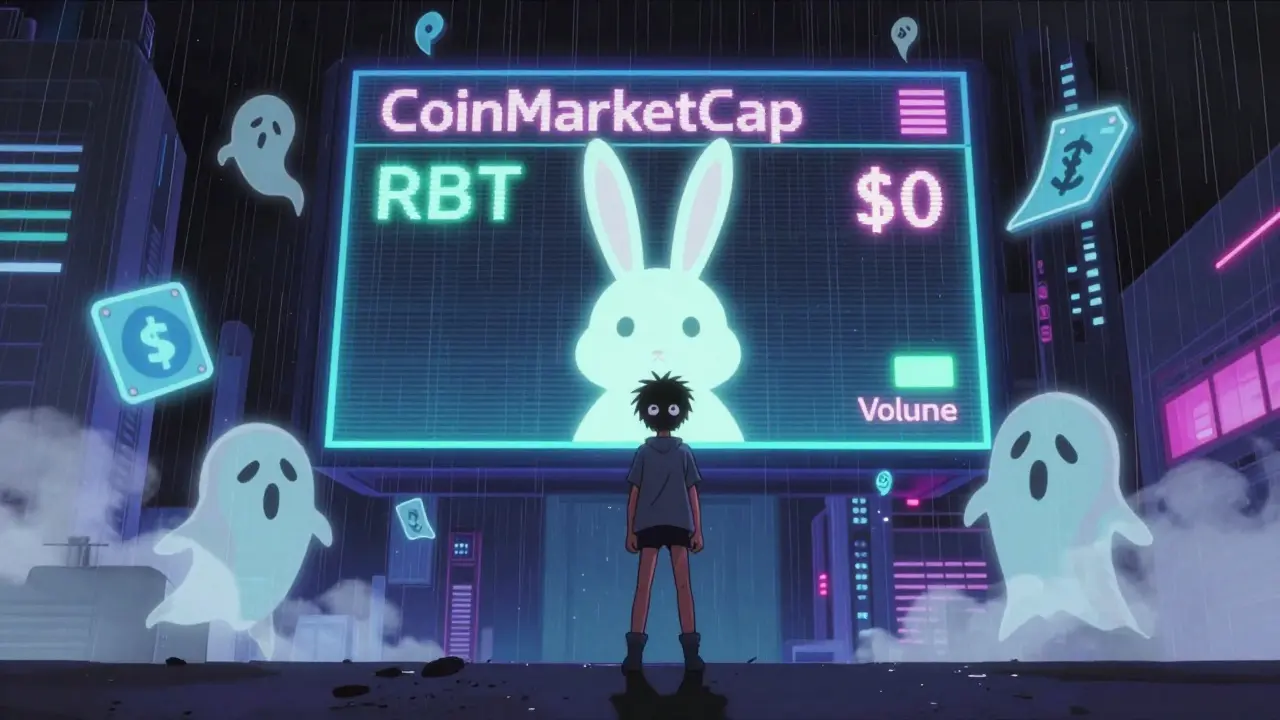
The RBT Rabbit token listing on CoinMarketCap shows a price of $0 and zero trading volume. That’s not a glitch. It’s a red flag. If you’re looking for an airdrop tied to this token, you’re chasing a ghost. There’s no official website, no active social media, no community, and no verifiable team behind it. The CoinMarketCap page is stuck in preview mode - a digital placeholder with no real data. This isn’t a project waiting to launch. It’s a dead listing.
People are still asking about RBT airdrops because they saw the token name pop up in a Telegram group or a shady crypto newsletter. They think, "Free tokens!" But here’s the truth: if a token has no market activity, no exchange listings, and no transparent roadmap, any "airdrop" tied to it is either fake, expired, or a scam designed to harvest your wallet address. You won’t get tokens. You’ll get spam, phishing links, or worse - a drained wallet.
Let’s be clear: CoinMarketCap doesn’t run airdrops. It’s a price tracker. It doesn’t create tokens, distribute them, or manage distributions. When you see "RBT Rabbit CoinMarketCap airdrop," that’s not a real event. It’s a misleading phrase used by clickbait sites to pull in searches. Real airdrops come from projects with websites, whitepapers, and active Telegram or Discord communities. RBT has none of those.
So why does this listing still exist? Because CoinMarketCap allows anyone to submit a token. No verification. No proof of legitimacy. Just a contract address and a name. That’s how hundreds of dead tokens pile up on the site - all with zero volume, zero price, and zero chance of ever being usable. The RBT token is one of them. It’s not a hidden gem. It’s a digital graveyard.
Confused? You’re Not Alone - Here Are the Real Rabbit Tokens
There are several rabbit-themed crypto projects out there, and they’re not the same. Mixing them up is how people lose money.
- Rocky Rabbit (RBTC) - This was a real Telegram tap-to-earn game that exploded in 2024. Over 25 million users joined. It had an airdrop on September 23, 2024, on The Open Network (TON). Tokens were distributed to players who completed daily tasks. The initial price was predicted between $0.001 and $0.005. It had a working app, a team, and a community. That’s a real airdrop.
- Rabbit (RAB) - A multi-utility wallet app that’s done past airdrops to reward early users. It has a website, a wallet, and a roadmap. But as of early 2026, there’s no announced upcoming airdrop. Don’t trust any site claiming otherwise.
- Little Rabbit v2 (LTRBT) - A Binance Smart Chain token focused on yield farming. It trades at around $0.0000000003431. No airdrop. Just a low-liquidity token with minimal use. Don’t confuse it with RBT.
None of these are RBT. But scammers use the "rabbit" name and CoinMarketCap’s name together to make fake airdrops sound legit. If you’re told to connect your wallet to claim RBT tokens, don’t do it. Even if the site looks professional, it’s designed to steal your private keys.
How to Spot a Fake Airdrop (Even If It Looks Real)
Real airdrops don’t ask for your private key. They don’t ask you to send crypto to "unlock" your free tokens. They don’t pressure you with countdown timers. Here’s how to tell the difference:
- Check the official source - If the project has a website, go there directly. Type it into your browser. Don’t click links from Telegram or Twitter. Look for a whitepaper, team bios, and a clear airdrop announcement.
- Verify the token contract - If you’re told to claim RBT, find the contract address on CoinMarketCap or Etherscan. Does it match the one on the official site? If not, it’s fake.
- Look at trading activity - RBT shows $0 price and zero volume. That means no one is buying, selling, or using it. A real token with an airdrop has liquidity. It’s traded on at least one exchange.
- Search for community chatter - Go to Reddit, Twitter, or Telegram. Are people talking about claiming RBT? Or is the conversation empty? Dead communities mean dead projects.
- Never connect your wallet - If a site asks you to connect MetaMask or Trust Wallet to "claim" tokens, walk away. Real airdrops send tokens to your wallet automatically if you qualify.
If you’ve already connected your wallet to a site claiming to give you RBT, check your balance immediately. If you see a strange token with a long string of numbers as its name, it’s likely a scam token. Remove its permission in your wallet settings right away.
What to Do Instead of Chasing RBT
Stop wasting time on RBT. It’s not coming back. Instead, focus on real opportunities.
Keep an eye on projects with:
- Active development teams
- Published roadmaps with deadlines
- Verified social media accounts
- Partnerships with established platforms
- Real trading volume on at least one exchange
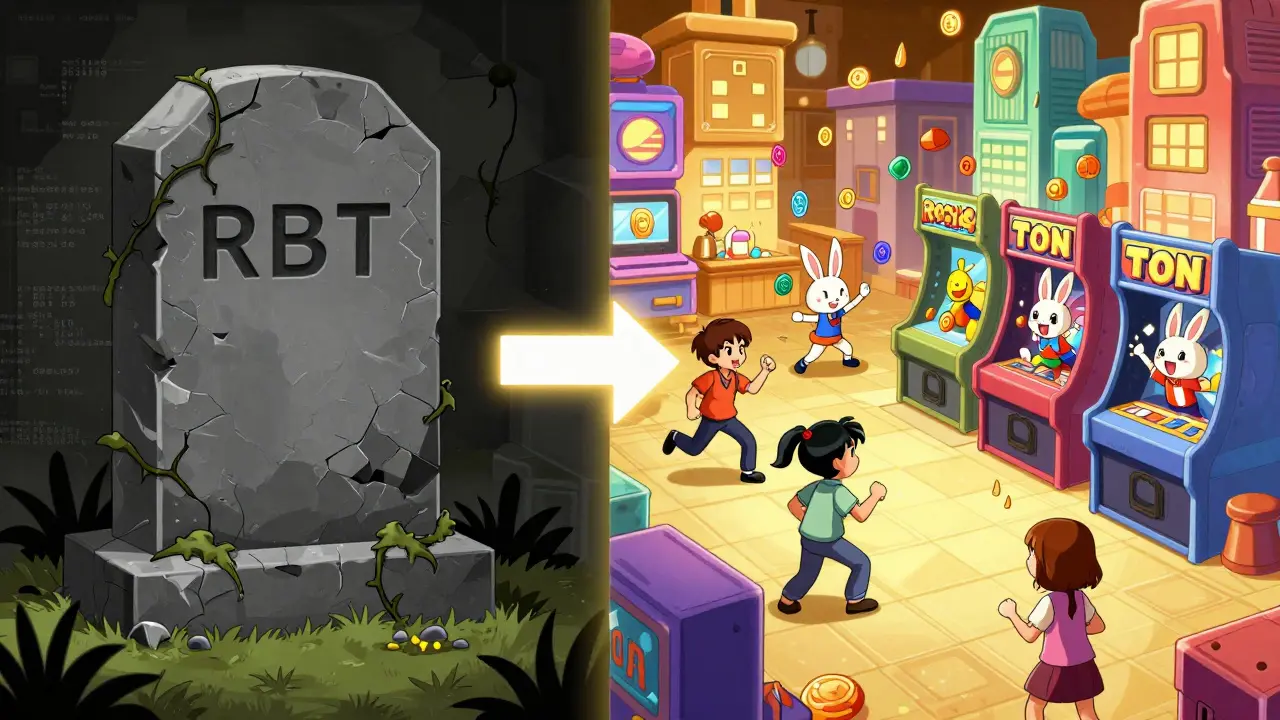
For example, Rocky Rabbit had all of that. Its airdrop was transparent, timed, and tied to user actions. You earned it by playing, not by guessing.
If you want to find real airdrops in 2026, use trusted platforms like AirdropAlert, CoinGecko’s airdrop section, or official project blogs. Don’t rely on CoinMarketCap listings for airdrop info - they’re not designed for that.
Also, remember: most airdrops are for early adopters. If you’re joining now, you’re late. That’s okay. The market is full of new projects every week. Find one with substance, not a rabbit logo and a $0 price tag.
Why This Matters Beyond Just Losing Money
Chasing fake airdrops like RBT doesn’t just cost you time. It trains you to ignore warning signs. That’s dangerous. In crypto, one wrong click can wipe out your entire portfolio. The RBT listing is a low-risk trap - but it’s a training ground for bigger scams.
Scammers know people want free tokens. They use familiar names, fake CoinMarketCap links, and urgency to trick you. The more you fall for this, the more likely you are to fall for a phishing site that steals your Bitcoin or Ethereum.
Protect yourself by learning to recognize empty listings. If a token has no volume, no price, and no website - it’s not a project. It’s a ghost. And ghosts don’t give away free money.
Final Verdict: Is There an RBT Airdrop?
No. There is no active RBT Rabbit token airdrop. The listing on CoinMarketCap is inactive. No one is distributing tokens. No one is claiming them. The project doesn’t exist in any meaningful way.
If you see a website, Telegram bot, or YouTube video promising RBT tokens - it’s a scam. Block it. Report it. Walk away.
Real crypto airdrops don’t hide. They announce. They verify. They have a team. They have a history. RBT has none of that. Don’t waste your energy on it. Focus on real projects with real activity. Your wallet will thank you.
Is RBT Rabbit token real?
RBT is a token with a listing on CoinMarketCap, but it has a $0 price, zero trading volume, and no official website or team. It’s not a functioning project. It’s a placeholder listing with no real activity behind it.
Was there ever an RBT airdrop?
There is no verified record of an RBT airdrop. No official announcement, no distribution records, and no community claims. Any site claiming to offer RBT tokens is not legitimate.
Why does CoinMarketCap list RBT if it’s worthless?
CoinMarketCap allows anyone to submit a token with minimal verification. It doesn’t check if a project is active or real. Many dead tokens sit on the site with $0 prices. RBT is one of them. The listing doesn’t mean the token is valid.
Can I still claim RBT tokens?
No. There is no active claim process. Even if you find a site offering to send RBT, it’s a scam. Connecting your wallet could lead to theft. Do not interact with any RBT claiming site.
What’s the difference between RBT and Rocky Rabbit (RBTC)?
RBT is a dead token with no activity. Rocky Rabbit (RBTC) was a real Telegram game that had a verified airdrop on TON in September 2024 with over 25 million participants. They are completely different projects, but scammers mix their names to confuse people.
How do I find real crypto airdrops in 2026?
Use trusted sources like CoinGecko’s airdrop section, AirdropAlert, or official project blogs. Look for projects with active websites, social media, and clear rules. Avoid anything that asks for your private key, wallet connection, or upfront payment.


