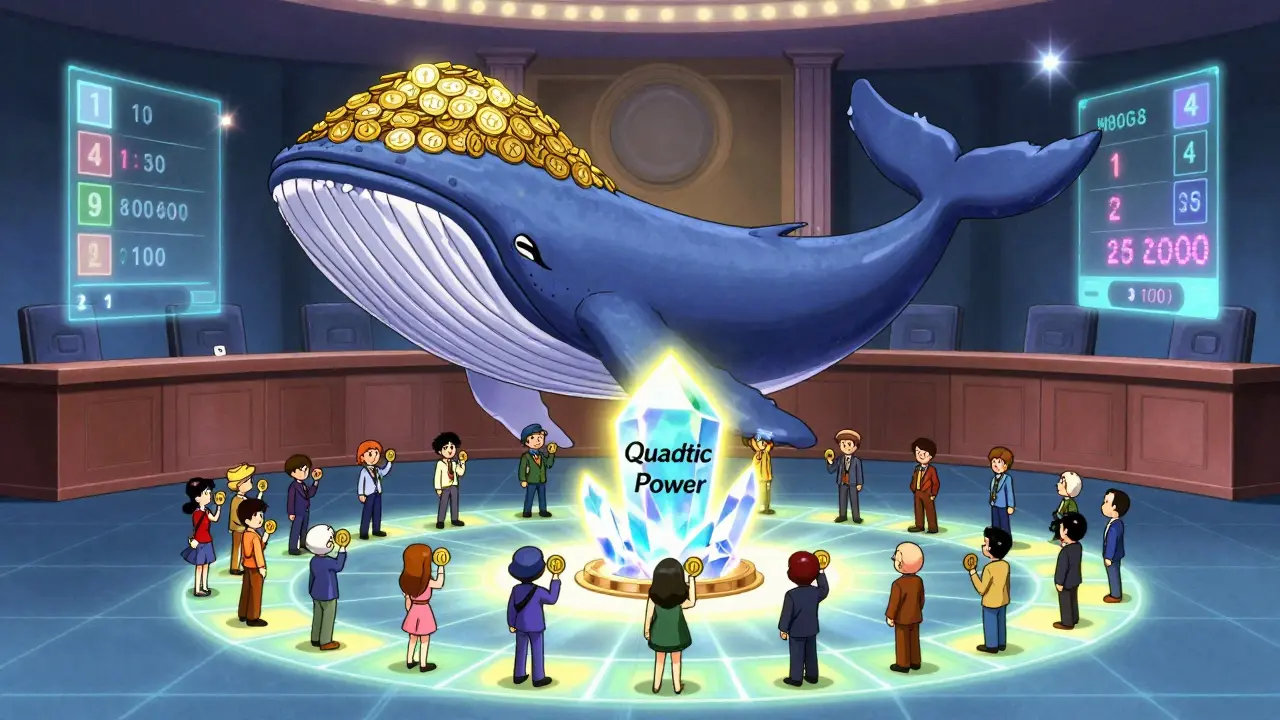
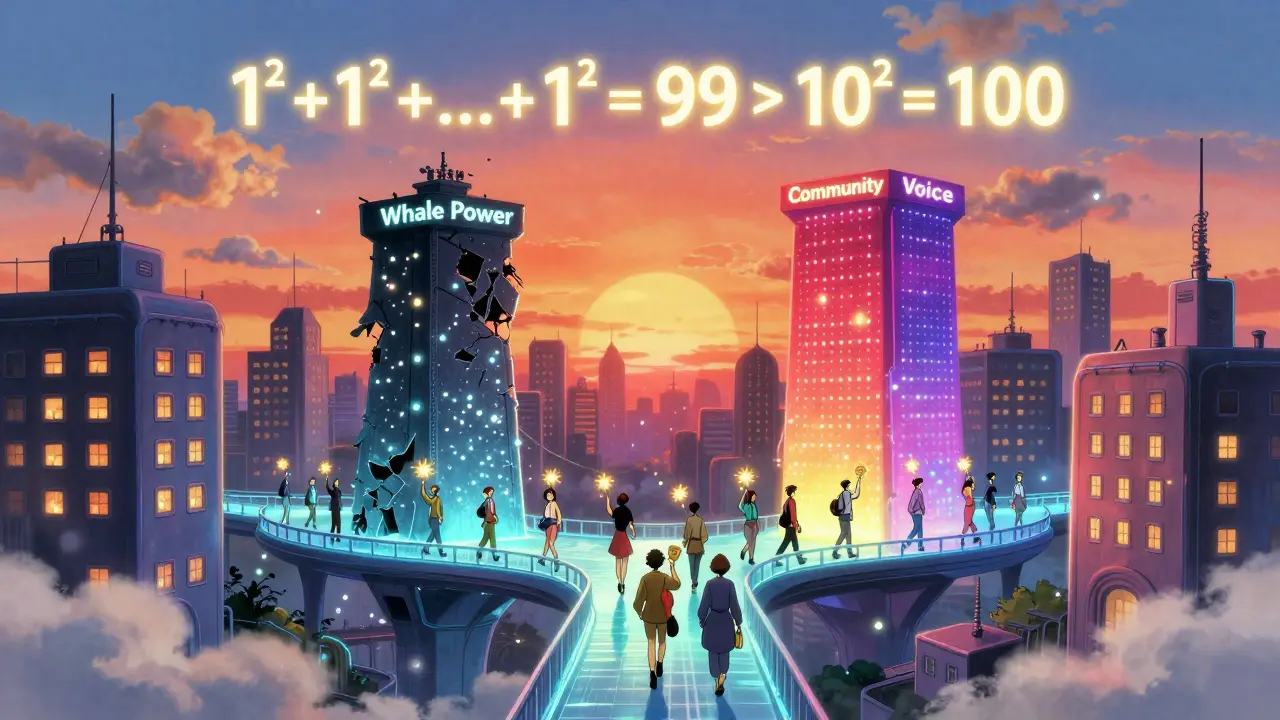
Imagine a DAO where one person holds 100 tokens and 99 others hold just 1 token each. In a normal vote, the person with 100 tokens controls everything. That’s not democracy. That’s plutocracy. Quadratic voting changes that. It doesn’t remove tokens. It doesn’t ban whales. It just makes it harder for them to steamroll the rest of the community.
Here’s how it works: each vote costs more than the last. One vote? One token. Two votes? Four tokens. Three votes? Nine tokens. Five votes? Twenty-five tokens. The cost goes up by the square of the number of votes you want to cast. So if you have 100 tokens, you can only cast 10 votes - not 100. Meanwhile, 99 people with one token each can cast 99 votes. The group wins. Not because they have more tokens. Because the system was built to listen to more people.
Why Token-Weighted Voting Fails
Most DAOs use simple token-weighted voting. More tokens = more votes. Sounds fair, right? But in practice, it’s not. A few wallets - often founders, early investors, or whales who bought in bulk - hold the majority of tokens. They can pass proposals without even asking the rest of the community. And why would they? It’s easy. No friction. No cost.
Real-world examples show this clearly. In 2023, a major DAO passed a proposal to shift funds to a private fund controlled by just three addresses. The 90% of members who held less than 5% of the total supply had zero influence. No outcry. No debate. Just a yes vote from the top 5%. That’s not governance. It’s control.
Quadratic voting was created to fix exactly this. It doesn’t punish big holders. It just makes their power less absolute. The math is simple: vote intensity matters more than token quantity.
How Quadratic Voting Actually Works
Think of it like buying concert tickets - but with a twist. The first ticket costs $10. The second costs $40. The third? $90. Each extra ticket gets exponentially more expensive. You can still buy 10 tickets if you want - but it’ll cost you $1,000. Most people won’t do that. And that’s the point.
In a DAO, voters get a budget of voting credits. These aren’t your tokens. They’re separate. You can spend them on any proposal. Each vote on a single issue costs the square of the number of votes you’ve already cast on it. So:
- 1 vote = 1 credit
- 2 votes = 4 credits
- 3 votes = 9 credits
- 10 votes = 100 credits
If you have 100 credits, you can either:
- Cast 10 votes on one proposal
- Cast 5 votes on two proposals (25 + 25 = 50 credits used)
- Cast 1 vote on 10 different proposals (10 credits total)
This forces voters to think: Which issues matter most to me? It stops people from just spamming every vote. It rewards focus. And it makes sure that if 100 people all feel strongly about the same thing - even if they only have one token each - they can still win.
Real-World Use Cases
DAOs aren’t just theory. Some are already using quadratic voting - and seeing real results.
Realms built one of the first plug-and-play quadratic voting systems. It’s integrated directly into their DAO toolkit. They use Civic Pass to verify that each voter is a real person - not a bot or a Sybil account. Without that, the whole system collapses. You can’t have 500 fake wallets all voting 10 times each.
CityDAO tried it to decide where to buy land. Instead of letting one whale pick the location, they let hundreds of members vote. The winning proposal wasn’t the one with the most tokens behind it. It was the one with the most passionate, spread-out support. A small group of 30 members with 100 tokens total beat a single whale with 500 tokens because their votes were concentrated on one idea.
Codeless Conduct used quadratic voting to rank hackathon submissions. Judges didn’t just pick the top three. They allocated votes across dozens of projects. The winner wasn’t the most funded team. It was the one that got consistent, high-intensity support from multiple judges - even if no single judge had huge voting power.
These aren’t lab experiments. They’re real decisions made by real communities.
The Hidden Benefit: Better Decisions
Quadratic voting doesn’t just stop whales. It improves the quality of decisions.
When voting is cheap, people vote on everything. They don’t care. They click yes because it takes 2 seconds. But when each vote costs real credits - and each extra vote costs exponentially more - people pause. They read. They think. They talk to others.
Studies from Frontiers in Blockchain show that quadratic voting leads to proposals that reflect the will of a larger number of participants. Not the loudest. Not the richest. The most broadly supported.
It also reduces polarization. In a binary yes/no vote, people pick sides. In quadratic voting, you can split your votes. You can say: I support this proposal, but I care even more about that one. That’s how real democracy works - not with winners and losers, but with trade-offs and priorities.
Why Isn’t Everyone Using It?
It’s not perfect. And it’s not easy.
First, the math is confusing. Most people don’t understand squares. If you tell someone, “Each vote costs the square of the number of votes,” they’ll glaze over. DAOs need better UIs - visual sliders, progress bars, real-time cost estimates. Realms now shows you exactly how many credits you’ll spend before you confirm.
Second, Sybil attacks are still a threat. If you can create 1,000 fake wallets, you can still game the system. That’s why identity verification is non-negotiable. Realms uses Civic Pass. Others use Worldcoin or Proof of Humanity. Without this, quadratic voting is just a fancy version of token voting.
Third, participation is still low. In most DAOs, fewer than 5% of token holders vote. Quadratic voting makes voting more meaningful - but if no one shows up, the system stalls. Some DAOs now give out voting credits as rewards for participation, not just token ownership.
And fourth - implementation is hard. You need smart contracts that handle dynamic vote pricing, credit allocation, and identity checks. Most DAOs don’t have the dev team for that. That’s why tools like Realms and Colony.io are starting to offer ready-made plugins.
The Future of DAO Voting
Quadratic voting isn’t the end. It’s a step.
By 2025, we’re seeing new hybrids: quadratic funding + quadratic voting for treasury allocation. Time-weighted quadratic voting where your voting power grows the longer you’ve been in the DAO. Multi-issue quadratic voting where you vote on 10 proposals at once and your credits are distributed across them.
What’s clear is this: token-weighted voting is broken. And simple majority rules don’t work when 1% of users hold 80% of the supply.
Quadratic voting doesn’t solve everything. But it’s the first system that actually gives small holders a real voice - without taking anything away from big ones. It doesn’t fight power. It just balances it.
DAOs that want to survive long-term won’t just need good code. They’ll need fair rules. Quadratic voting is one of the few tools that makes fairness possible.
How does quadratic voting stop whales from controlling DAOs?
Quadratic voting makes each additional vote exponentially more expensive. A whale with 100 tokens can only cast 10 votes, not 100. Meanwhile, 99 members with 1 token each can cast 99 votes. The system doesn’t limit token ownership - it limits how much influence one person can exert. This shifts power from concentration to consensus.
Do I need to own tokens to vote with quadratic voting?
Yes, but not in the way you think. You still need tokens to get voting credits - usually distributed based on your token balance. However, the cost of voting is separate from your token holdings. A small holder might get 10 credits, and a large holder might get 100 - but spending 100 credits to vote on one issue costs 10,000 tokens worth of value. The system forces everyone to prioritize.
Can I vote on multiple proposals at once?
Yes. That’s one of the biggest advantages. You get a budget of voting credits and can spend them across any number of proposals. You might put 5 votes on one issue, 3 on another, and 1 on five others. This lets you express how strongly you feel about each topic - not just pick one winner.
What’s the biggest risk with quadratic voting?
Sybil attacks - where someone creates hundreds of fake accounts to dilute voting power. If you can’t verify that each vote comes from a real person, the system breaks. That’s why identity verification tools like Civic Pass or Worldcoin are essential. Without them, quadratic voting is vulnerable to manipulation.
Is quadratic voting better than liquid democracy?
They solve different problems. Liquid democracy lets you delegate your vote to someone else - good for busy members. Quadratic voting lets you express intensity - good for preventing dominance. Many DAOs now use both: you can delegate your vote, but if you vote directly, you use quadratic credits. The combination is powerful.


