
Payment Crypto Transaction Cost Calculator
Transaction Calculator
Transaction Results
When you hear the word "crypto" most people think of wild price swings or futuristic tokens, but a core slice of the ecosystem is built simply to let you pay for things. Payment cryptocurrencies are digital coins designed primarily for moving value, just like cash or a credit‑card transaction, but without a bank in the middle.
What Exactly Are Payment Cryptocurrencies?
Payment Cryptocurrencies are a category of digital assets that let users store and transfer value on decentralized networks. They rely on cryptographic techniques to secure transactions and on public ledgers called blockchains to keep an immutable record of every transfer.
Unlike utility tokens that grant access to a platform’s services (think Ethereum for smart contracts), payment cryptos focus on being a medium of exchange. Their main goal is to let you send money faster, cheaper, and across borders without a traditional intermediary.
Key Technical Traits That Set Them Apart
Most payment cryptos share a handful of design choices:
- Capped supply: Many have a hard limit on the total number of coins, creating a built‑in scarcity. Bitcoin, for example, tops out at 21million coins.
- Proof‑of‑Work mining: New coins are minted when miners solve complex mathematical puzzles that also confirm transactions.
- Public, permission‑less ledgers: Anyone can run a node and verify the transaction history, which reduces reliance on a single authority.
- Optional privacy layers: Coins like Monero add cryptographic tricks (ring signatures, stealth addresses) to hide sender, receiver, and amount.
These traits contrast with “utility tokens” that often have unlimited supplies and are tied to specific platform functions.
Big Names in the Payment Space
The first and most famous payment cryptocurrency is Bitcoin. Launched in 2009, it proved that a decentralized, trustless money system could actually work. Since then, dozens of alternatives have tried to improve on its shortcomings.
Here are five of the most widely used payment cryptos and what makes each unique:
- Litecoin - Created by Charlie Lee in 2011, Litecoin speeds up block generation to 2.5minutes (vs Bitcoin’s 10minutes) and uses a different hashing algorithm (Scrypt) that was originally meant to be more CPU‑friendly.
- Monero - Focuses on privacy. Its ring signatures blend a user’s transaction with a group of others, making it nearly impossible to trace.
- Dogecoin - Started as a joke in 2013, it quickly gained a vibrant community. Its low transaction fees and fast confirmation times have made it popular for small online tips.
- Bitcoin Cash - A 2017 hard fork of Bitcoin that increased block size to allow more transactions per block, aiming for cheaper, quicker payments.
How Do They Work? A Quick Walk‑through
All payment cryptos follow a similar flow:
- Wallet creation: You generate a pair of cryptographic keys - a public address (where others send money) and a private key (which unlocks the funds). Wallets can be software, hardware, or even paper.
- Transaction broadcasting: When you send coins, your wallet builds a transaction, signs it with your private key, and broadcasts it to the network.
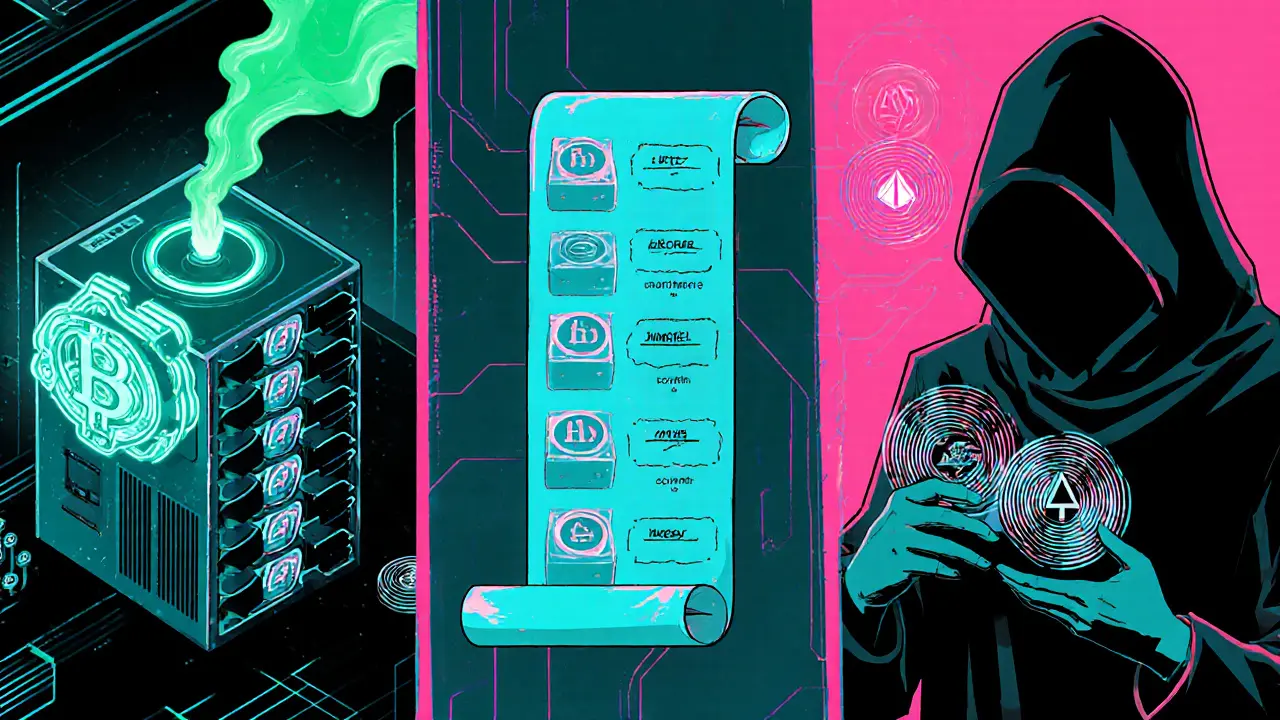
- Mining & validation: Miners pick pending transactions, bundle them into a block, solve the proof‑of‑work puzzle, and add the block to the blockchain.
- Confirmation: Once the block is added, the network reaches consensus. Each additional block after it further secures the transaction.
During this process, the cryptographic wallet acts as your personal bank, storing only the keys, not the coins themselves. The actual coins live on the blockchain.
Why Use Payment Cryptocurrencies Over Traditional Methods?
There are three main selling points:
- Speed across borders: A Bitcoin transaction can settle in under an hour, regardless of where the sender or receiver lives, while a wire transfer might take days.
- Lower fees for high‑value transfers: Moving millions of dollars via a bank can cost a few hundred dollars in fees. Bitcoin’s on‑chain fee (even at peak) is typically under $10 for a comparable amount.
- Censorship resistance: No single entity can freeze or seize your coins without controlling the majority of the network’s hash power.
That said, payment cryptos also face hurdles that keep them from replacing cash entirely.
Limitations and Real‑World Challenges
Volatility is the biggest obstacle. A coffee that costs $3 today could be $7 tomorrow if Bitcoin’s price jumps 30% in a day. Most merchants therefore accept stablecoins or fiat‑backed tokens to hedge that risk.
Merchant adoption is still limited. Only a fraction of online stores list Bitcoin or Litecoin as a checkout option, and point‑of‑sale hardware that reads QR codes for crypto payments is far from ubiquitous.
Technical complexity also scares off everyday users. Managing private keys, backing up seed phrases, and estimating appropriate transaction fees require a learning curve that can be weeks long for a non‑technical person.
Comparison of Popular Payment Cryptocurrencies
| Coin | Supply Limit | Avg. Confirmation Time | Typical Fee (USD) | Privacy Focus |
|---|---|---|---|---|
| Bitcoin (BTC) | 21million | 10min | 2‑5 | Low (transparent) |
| Litecoin (LTC) | 84million | 2.5min | 0.01‑0.05 | Low |
| Monero (XMR) | ~18.4million (tail‑emission) | 2min | 0.05‑0.2 | High (ring signatures, stealth addresses) |
| Dogecoin (DOGE) | No cap (inflationary) | 1min | 0.001‑0.01 | Low |
| Bitcoin Cash (BCH) | 21million | 10min | 0.01‑0.1 | Low |

Adoption Stories: How Real Users Are Using Payment Cryptos
In 2023 a small e‑commerce shop in Berlin started accepting Bitcoin and Litecoin alongside euros. The owner reports that international orders from the US and Japan arrived faster and with fewer charge‑back disputes. However, the shop also notes that when Bitcoin’s price spikes, the accounting team must convert a portion of the received coins to stablecoins to keep revenue predictable.
Another case: a freelance graphic designer in Nairobi uses Monero to receive payments from privacy‑concerned clients in Europe. The anonymity feature lets both parties avoid revealing personal banking details, which is valuable in regions where banking infrastructure is weak.
These anecdotes illustrate the sweet spot of payment cryptos: cross‑border transfers, low fees for high‑value moves, and scenarios where privacy matters. They also highlight why most people still keep traditional money for everyday groceries.
Future Outlook: What Comes Next?
Several trends could push payment cryptos closer to mainstream use:
- Layer‑2 solutions: Protocols like the Lightning Network for Bitcoin promise near‑instant, sub‑cent transactions, making micro‑payments viable.
- Regulatory clarity: Countries that publish clear rules for crypto tax and AML compliance give merchants confidence to integrate crypto checkout.
- Hybrid fintech products: Banks are experimenting with custodial crypto wallets, letting customers spend Bitcoin via debit cards that automatically convert to fiat at the point of sale.
Even with those advances, price volatility and the need for user‑friendly wallets remain big hurdles. Expect payment cryptos to coexist with fiat and stablecoins rather than fully replace them within the next five years.
Quick Checklist for Getting Started
- Choose a reputable cryptographic wallet (hardware wallets like Ledger or software options like Exodus).
- Buy a small amount of a payment crypto (Bitcoin or Litecoin are good entry points) from a regulated exchange.
- Back up your seed phrase securely-offline and in multiple locations.
- Test a low‑value transaction to a friend or a merchant that accepts crypto.
- Track fees and confirmation times; consider using a fee estimator tool.
Frequently Asked Questions
Are payment cryptocurrencies the same as Bitcoin?
Bitcoin is the original and most well‑known payment cryptocurrency, but the category also includes coins like Litecoin, Monero, Dogecoin, and Bitcoin Cash, each with its own design tweaks.
Can I use a payment crypto for everyday purchases?
A growing number of merchants, especially online, accept Bitcoin and Litecoin. For very small purchases, stablecoins or fiat‑backed cards are still more common due to price stability.
Do payment cryptocurrencies guarantee privacy?
Only a few, like Monero or Zcash, are built with strong privacy features. Most, including Bitcoin and Litecoin, are transparent-anyone can see the transaction amounts and addresses.
What’s the biggest risk when using payment cryptos?
Losing your private key means losing the coins forever. In addition, price swings can turn a $100 purchase into a $150 or $50 expense within hours.
How do transaction fees work?
Fees compensate miners for the computational work they do. They fluctuate with network congestion; during peak times Bitcoin fees can rise above $10, while Litecoin or Dogecoin stay under a few cents.


