
Kim Exchange Risk Assessment Calculator
Calculate Your Kim Exchange Suitability
Assess your risk tolerance and potential returns based on your DeFi experience level.
Important Warning:
Kim Exchange lacks transparency, security audits, and public data. Never invest more than you can afford to lose.
Estimated Yield Potential
Complexity Score
Recommended Action
When you hear "Kim v4 crypto exchange," you might expect a polished, widely-used platform like Uniswap or SushiSwap. But here’s the truth: Kim Exchange isn’t a household name yet - and the "v4" label is misleading. There’s no official version 4 release. The platform is simply called Kim Exchange, and it’s a niche decentralized exchange built on the Mode blockchain, serving as a liquidity hub for the Optimism Superchain. If you’re considering trading here, you need to know what’s real, what’s hype, and what’s still missing.
How Kim Exchange Works (Without Order Books)
Most crypto exchanges - even the big ones - use order books. You place a buy order at $2,500, someone else places a sell at $2,490, and the trade happens. Kim Exchange doesn’t do that. Instead, it uses an Automated Market Maker (AMM) model with concentrated liquidity. Think of it like a pool of funds where traders swap tokens directly, and prices adjust automatically based on supply and demand. The difference? Kim focuses on keeping liquidity tightly packed around current market prices. That means less slippage on trades, especially for popular pairs like ETH/USDC or OP/USDT.This isn’t new tech - Uniswap V3 did it first. But Kim adds its own twist: a modular system called xKim plugins. These are like add-ons you can enable to tweak how liquidity works. Want to auto-rebalance your positions? There’s a plugin for that. Need to lock liquidity for longer yields? Another plugin handles it. This flexibility gives advanced users control without needing to code their own smart contracts.
The KIM and xKIM Token Ecosystem
Kim has two native tokens, and they serve very different roles. The first is $KIM. This is your utility token. You use it to provide liquidity to trading pools. When you deposit ETH and USDC into a Kim pool, you get KIM tokens as rewards - and you can stake those KIM to earn more.Staking KIM gives you $xKIM. This is where things get interesting. xKIM isn’t tradeable. You can’t sell it. It’s a governance token that lets you vote on which xKim plugins get funded. The more xKIM you hold, the more influence you have over where the protocol’s rewards go. Want to boost yield for stablecoin pools? Vote for that plugin. Prefer to reward NFT holders? That’s your call.
This system is designed to align incentives. Liquidity providers aren’t just earning fees - they’re shaping the future of the exchange. But here’s the catch: if you’re not actively participating in governance, your xKIM is just sitting there. No passive income unless you vote.
kpNFTs: The 4x Yield Claim
Kim’s biggest marketing hook is kpNFTs - yield-generating NFTs you unlock by staking xKIM. These aren’t just digital art. Each kpNFT boosts the rewards you earn from your liquidity positions. The platform claims users can get up to 4x higher yields by using them.How? It’s not magic. kpNFTs act as multipliers. If you’re earning 10% APY from a liquidity pool, a kpNFT might bump that to 40%. But here’s what no one tells you: those multipliers are tied to specific liquidity pools and plugins. Not all pools support them. And the NFTs themselves have different tiers - some give 1.5x, others 3.5x. You need to check which one you’re getting before you stake.
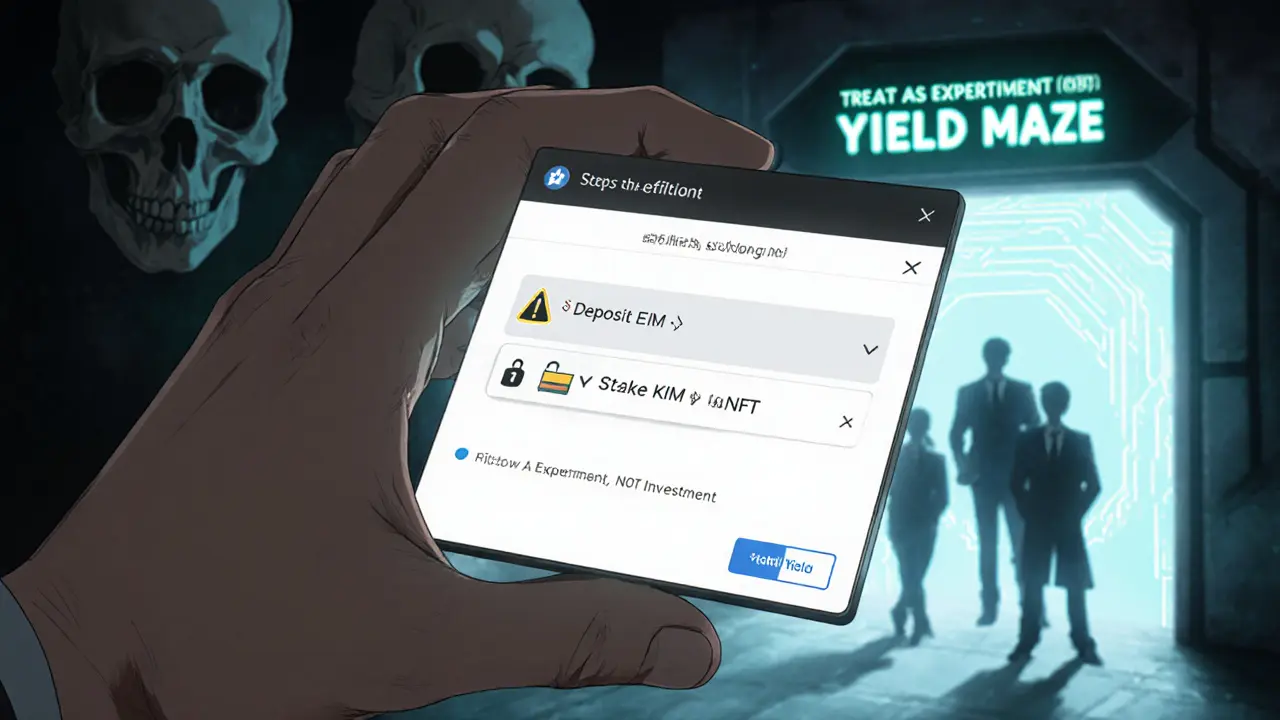
Also, kpNFTs aren’t free. You need xKIM to get them. And xKIM comes from staking KIM. So you’re locking up your capital twice: first to earn KIM, then to earn xKIM, then to unlock the NFT. That’s a lot of steps just to get higher yields. If you’re new to DeFi, this could feel like a maze.

What’s Missing? A Lot.
Here’s the problem with reviewing Kim Exchange right now: there’s almost no public data. You won’t find:- Trading volume numbers
- Total Value Locked (TVL)
- Number of active users
- Fee structure details
- Security audit reports
- Mobile app availability
- Customer support response times
- Regulatory status
Compare that to Uniswap, which publishes weekly TVL and volume stats on its website. Or SushiSwap, which has public dashboards showing every pool’s performance. Kim doesn’t. You’re expected to trust the math - but without transparency, that’s risky.
There are no Reddit threads, no Trustpilot reviews, no YouTube breakdowns from trusted crypto analysts. No one’s saying, "I lost money here," or "This is the best DEX I’ve used." That silence isn’t neutral - it’s a red flag.
Security: MPC and the Unknown
Kim says it uses Multi-Party Computation (MPC) to protect user assets. That’s a real cryptographic technique used by institutions like Coinbase and Ledger to split private keys across multiple servers. It’s harder to hack than a single key. That’s good.But here’s the gap: no one has published a third-party audit of Kim’s MPC implementation. We don’t know if it’s properly configured. We don’t know if there are backdoors. We don’t know if the code has been reviewed by independent security firms. For a DeFi platform handling real money, that’s unacceptable.
And while MPC helps with key security, it doesn’t fix smart contract bugs. If the liquidity pool code has a flaw, your funds could still be drained. We’ve seen this happen on other DEXs - like the $100M exploit on a similar AMM in 2023. Kim hasn’t proven it’s immune.
Who Is Kim Exchange For?
Kim isn’t for beginners. If you’re just trying to swap ETH for USDT, use Uniswap. It’s faster, safer, and you can do it in 30 seconds.Kim is for experienced DeFi users who:
- Understand liquidity provision and impermanent loss
- Want to actively shape a protocol’s development
- Are comfortable with multi-step yield farming
- Have capital to lock up for weeks or months
- Are okay with zero public data and no customer support
If you’re looking for a simple, reliable exchange - walk away. If you’re a DeFi power user who wants to be part of an experimental, community-driven protocol - then Kim might be worth your time. But treat it like a lab experiment, not an investment.
Final Verdict: High Risk, High Reward - But Too Unclear
Kim Exchange has clever tech. The xKim plugins and kpNFTs show real innovation. The tokenomics are thoughtfully designed to reward participation. But innovation doesn’t equal safety or reliability.Without audited code, public metrics, or user feedback, you’re gambling on potential - not performance. There’s no way to know if the 4x yield claim holds up under real market stress. There’s no way to know if the team will abandon the project next month.
If you still want to try it, start small. Deposit only what you can afford to lose. Don’t stake all your KIM. Don’t lock up your entire portfolio in kpNFTs. And keep an eye on the Mode blockchain’s overall health - if Mode slows down or loses support, Kim goes with it.
Right now, Kim Exchange feels like a prototype with promise - not a product ready for mainstream use. Wait for audits. Wait for volume data. Wait for real user reviews. Until then, treat it as a speculative side project - not a core part of your crypto strategy.
Is Kim v4 a real version of the exchange?
No, there is no official "Kim v4" release. The platform is simply called Kim Exchange. The "v4" in search results is likely a misunderstanding or misinformation. The project has not announced any version numbering system, and no public documentation references a version 4 update.
Can I trade any crypto on Kim Exchange?
Kim Exchange supports tokens on the Mode blockchain and the Optimism Superchain. Popular pairs include ETH, USDC, OP, and other Layer 2 assets. But it doesn’t support Bitcoin, Solana, or tokens from other chains. You’ll need to bridge your assets to Mode first, which adds complexity and risk.
Are kpNFTs worth it for beginners?
No. kpNFTs require you to first earn $KIM, stake it for $xKIM, then use xKIM to unlock the NFT. That’s three separate steps with gas fees and locking periods. Beginners often lose money to impermanent loss or forget to vote on plugins, missing out on rewards. Only consider kpNFTs if you’re already active in DeFi and understand yield mechanics.
Is Kim Exchange safe to use?
There’s no public audit of Kim’s smart contracts, and no record of security incidents - but that doesn’t mean it’s safe. Lack of transparency is a major risk. Many DeFi platforms have been hacked despite claiming strong security. Without verified audits, treat Kim as high-risk. Never deposit more than you’re willing to lose.
How do I get started with Kim Exchange?
First, connect a wallet like MetaMask or Rabby that supports the Mode network. Then, bridge ETH or USDC from Ethereum or Optimism to Mode using a trusted bridge like the official Mode Bridge. Once your assets are on Mode, go to the Kim Exchange website, add liquidity to a pool, and stake your KIM to earn xKIM. Always verify the URL - phishing sites are common in DeFi.
Does Kim Exchange have a mobile app?
No, Kim Exchange does not have a dedicated mobile app. You can only access it through a browser on your phone or desktop. This limits convenience and increases the chance of user error when signing transactions on small screens. Always double-check transaction details before confirming.
What’s the difference between KIM and xKIM?
$KIM is a tradeable utility token earned from providing liquidity. You can sell it or use it to stake. $xKIM is a non-transferable governance token you get by staking KIM. It lets you vote on protocol upgrades and plugin rewards, but you can’t sell or trade it. Think of KIM as your entry ticket, and xKIM as your voting card.


