
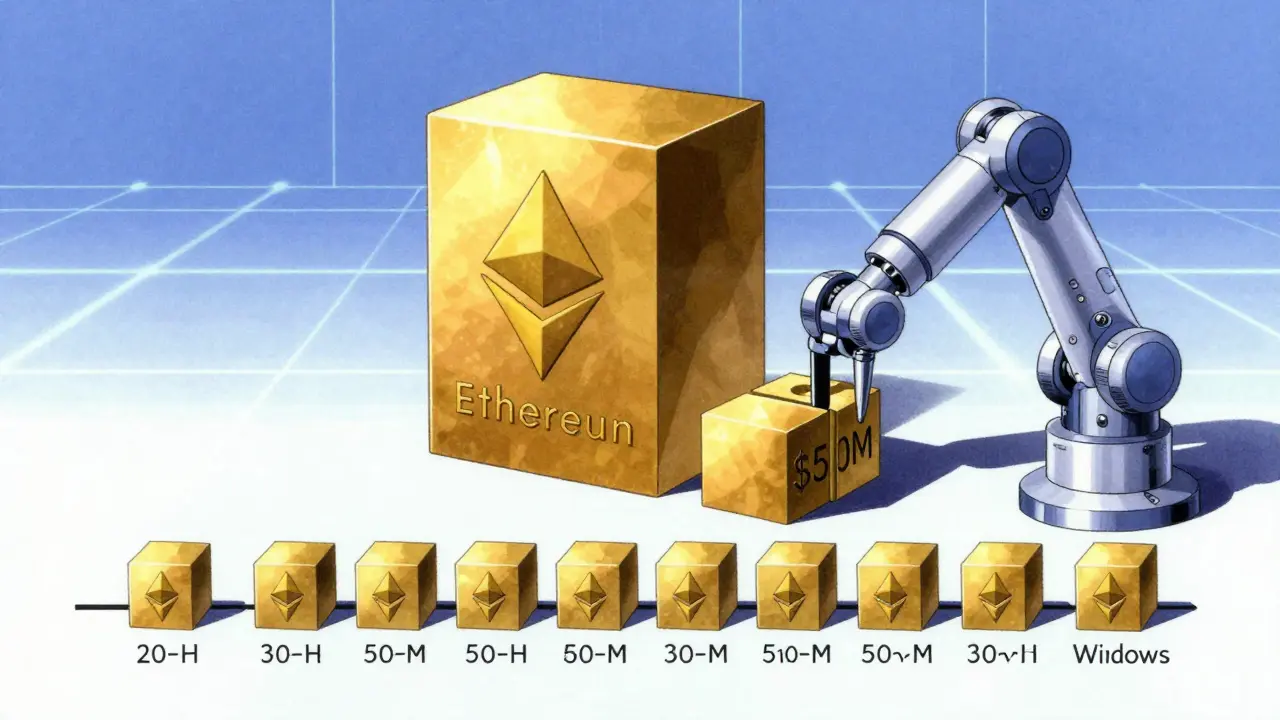
Imagine trying to buy $50 million worth of Ethereum on a standard decentralized exchange. You click "swap," and suddenly the price jumps against you. Slippage eats your profits before the trade even settles. For retail traders buying a few hundred dollars, this is annoying. For institutions moving millions, it’s catastrophic. This is the exact problem Integral SIZE is designed to solve.
Integral SIZE isn't another copycat swap interface for casual users. It is a specialized decentralized exchange (DEX) built exclusively for executing massive cryptocurrency orders on-chain. By using Time-Weighted Average Price (TWAP) methodology, it breaks huge trades into smaller chunks over time to minimize market impact. If you are an institutional trader or a professional managing significant capital, understanding how Integral SIZE works could save you thousands in hidden costs. If you are a beginner looking to buy your first Bitcoin, this platform likely isn't for you.
What Is Integral SIZE and Who Built It?
To understand Integral SIZE, you need to look at its creators. The platform was developed by Integral, a pseudonymous team consisting of mathematicians, financial engineers, and coders. Unlike many DeFi projects launched by anonymous influencers, Integral has a background in traditional finance infrastructure. Their technology reportedly processes over $1 trillion in monthly foreign exchange trading volume, according to CEO Harpal Sandhu. This track record suggests they understand the mechanics of large-scale liquidity better than most crypto-native teams.
Integral SIZE emerged as part of a broader ecosystem that includes Integral FIVE, another DEX focused on highly liquid token pairs like ETH, wBTC, and stablecoins. While FIVE handles general large orders, SIZE specializes specifically in TWAP execution. Think of Integral SIZE as the precision tool in a toolbox where other DEXs are hammers. It operates primarily on the Ethereum blockchain, leveraging its security and widespread adoption while solving one of its biggest pain points: high slippage on large transactions.
How TWAP Execution Minimizes Slippage
The core innovation of Integral SIZE is its reliance on Time-Weighted Average Price (TWAP) algorithms. In simple terms, instead of dumping a large order onto the market all at once, the algorithm slices it up. It executes smaller trades at regular intervals-specifically 30-minute windows in SIZE's case-and calculates the average price across those executions.
Why does this matter? When you execute a massive market order on a standard Automated Market Maker (AMM) like Uniswap, you deplete the immediate liquidity pool. This causes the price to move sharply against you. By spreading the order out over time, Integral SIZE avoids triggering these sharp price movements. The result is a more predictable entry or exit price, often resulting in "price improvement" compared to instant execution.
This approach mirrors strategies used in traditional stock markets for decades. Bringing institutional-grade execution logic to decentralized finance fills a critical gap. Retail DEXs prioritize speed and simplicity. Integral SIZE prioritizes cost efficiency and minimal market disruption for large volumes.
Zero Fees and Cost Efficiency
One of the most striking features of Integral SIZE is its fee structure. According to data from CoinMarketCap, the platform offers zero trading fees for TWAP execution. Compare this to typical DEXs that charge between 0.05% and 0.3% per trade. On a $10 million trade, a 0.3% fee amounts to $30,000. Eliminating that cost directly impacts the bottom line for institutional clients.
However, "zero fees" doesn't mean "free money." The value proposition here is risk management. You are paying with time rather than cash. By accepting a slower execution window (30 minutes), you avoid the hidden cost of slippage, which can easily exceed the savings from zero fees on volatile assets. For traders who don't need instant settlement but do need optimal pricing, this model is incredibly attractive.
Comparison: Integral SIZE vs. Traditional DEXs
| Feature | Integral SIZE | Uniswap / SushiSwap |
|---|---|---|
| Target Audience | Institutional & Professional Traders | Retail & General Users |
| Execution Method | TWAP (Time-Weighted Average Price) | Instant Market Order |
| Trading Fees | 0% for TWAP execution | 0.05% - 0.3% |
| Slippage Protection | High (via time dispersion) | Low (subject to pool depth) |
| Best Use Case | Large orders ($1M+) | Small to medium swaps |
| Accessibility | Specialized/Institutional access | Open to public |
The table above highlights why Integral SIZE occupies a unique niche. It is not competing with Uniswap for the user buying $50 worth of tokens. It is competing for the hedge fund manager moving $5 million. The trade-off is clear: you lose the ability to execute instantly, but you gain significant protection against adverse price movement.
Data Discrepancies and Platform Transparency
If you look at public aggregators like CoinGecko, you might find confusing data regarding Integral SIZE. As of recent reports, the platform lists "0 coins" and "0 trading pairs." This raises eyebrows for anyone expecting a traditional exchange experience. Does this mean the platform is empty?
Not necessarily. This discrepancy likely reflects two factors. First, Integral SIZE may operate through private or whitelisted channels rather than a public-facing UI with open listings. Second, its integration with the broader Integral ecosystem means volume might be reported under different entities or aggregated differently. For instance, the broader Integral ecosystem reported processing $5,985,872.28 in 24-hour volume recently. The lack of public pair listings suggests SIZE functions more as a backend execution engine for specific clients rather than a browse-and-swap storefront.
This opacity is common in institutional fintech but frustrating for researchers. It indicates that SIZE is not a "self-serve" platform for the average crypto enthusiast. Access likely requires credentials, API integration, or direct partnership with Integral.
Integration with PrimeOne and Future Outlook
Integral SIZE does not exist in a vacuum. It is part of a larger push by Integral to bridge traditional finance (TradFi) and decentralized finance (DeFi). A key development in this direction was the launch of PrimeOne on September 30, 2025. PrimeOne is a stablecoin-based crypto prime brokerage built on the Codex Layer-1 EVM blockchain.
PrimeOne provides the custody, margin systems, and real-time settlement infrastructure that institutions demand. Integral SIZE serves as the execution arm within this ecosystem. Together, they offer a comprehensive solution: custody and financing via PrimeOne, and efficient, low-slippage execution via SIZE. This integrated approach addresses the major friction points preventing banks and funds from fully adopting DeFi.
The future trajectory of Integral SIZE depends heavily on institutional adoption trends. As traditional finance continues to explore decentralized infrastructure, the demand for tools that mitigate volatility and slippage will grow. Integral's proven scalability in forex trading positions them well to capture this market. However, regulatory scrutiny around institutional DeFi services remains a variable to watch. Compliance frameworks will determine how widely platforms like SIZE can be adopted by regulated entities.
Who Should Use Integral SIZE?
Let's be direct about who benefits from this platform. If you are a retail trader with less than $100,000 in capital, Integral SIZE is probably not relevant to you. The complexity of TWAP execution and the potential barriers to entry make it impractical for small accounts. Stick to standard DEXs or centralized exchanges where immediacy matters more than micro-optimizing price impact.
However, if you fall into one of these categories, Integral SIZE deserves serious consideration:
- Institutional Investors: Funds moving six-figure or seven-figure sums that cannot afford 1-2% slippage on entries and exits.
- Professional Traders: Individuals managing large portfolios who understand the value of time-dispersed execution.
- Market Makers: Entities needing to rebalance large positions without signaling intent to the broader market.
For these users, the combination of zero fees, TWAP execution, and institutional-grade infrastructure offers a compelling alternative to fragmented manual trading or expensive OTC desks.
Is Integral SIZE available to the general public?
Access to Integral SIZE appears to be restricted or specialized. Unlike retail DEXs that allow anyone to connect a wallet and trade, SIZE seems to target institutional clients. Public data shows limited listing information, suggesting it may require API integration, whitelisting, or professional credentials to use effectively.
What is TWAP execution?
TWAP stands for Time-Weighted Average Price. It is an algorithmic trading strategy that breaks a large order into smaller parts executed over a specified time period. This method helps achieve an average price close to the market average during that period, minimizing the impact of the trade on the asset's price.
Why does Integral SIZE charge zero fees?
Integral SIZE offers zero fees for TWAP execution as a competitive advantage for institutional traders. Since the platform focuses on large-volume trades where slippage is the primary cost driver, eliminating explicit fees makes the service more attractive compared to traditional DEXs that charge 0.05% to 0.3%.
How does Integral SIZE compare to Uniswap?
Uniswap is a general-purpose DEX suitable for retail traders seeking instant swaps. Integral SIZE is a specialized tool for large orders using TWAP algorithms to reduce slippage. Uniswap charges fees and executes immediately; SIZE charges no fees for TWAP but executes over time (e.g., 30-minute intervals).
What is the relationship between Integral SIZE and PrimeOne?
PrimeOne is a prime brokerage platform launched by Integral in late 2025, focusing on custody and margin services. Integral SIZE serves as the execution layer within this ecosystem. Together, they provide a full-stack solution for institutional DeFi trading, combining secure asset holding with efficient order execution.