
Quick Summary: What You Need to Know
- Verify the official source before connecting your wallet.
- Never share your seed phrase or private keys to claim tokens.
- Check the token contract address on a block explorer.
- Be wary of "gas fee" requests sent via Direct Message.
- Use a burner wallet for interacting with new airdrop sites.
Understanding the IMM Airdrop Mechanism
A crypto airdrop is essentially a marketing stunt. A project sends free tokens to a wide range of wallet addresses to create awareness and distribute ownership. For the IMM project, the goal is likely to bootstrap liquidity and encourage users to test their ecosystem. Usually, these rewards are based on specific criteria: maybe you held a certain amount of another coin, interacted with a testnet, or followed them on social media.
However, the lack of widespread, verified documentation for IMM makes this a high-risk scenario. When a project isn't listed on major trackers like CoinMarketCap or CoinGecko, you have to act like a detective. If the only place you've heard about this airdrop is a random Telegram group or a "leaked" link on X (formerly Twitter), your red flags should be waving. Legitimate projects usually have a clear whitepaper and a verified team.
Step-by-Step: How to Safely Check Your Eligibility
If you think you're eligible for the IMM airdrop, don't just click a link and hit "Connect Wallet." Follow this safety-first workflow to protect your assets.
- Find the Official Channel: Look for the project's official website. Check their verified social media accounts. If the link comes from a "support agent" in your DMs, it is 100% a scam.
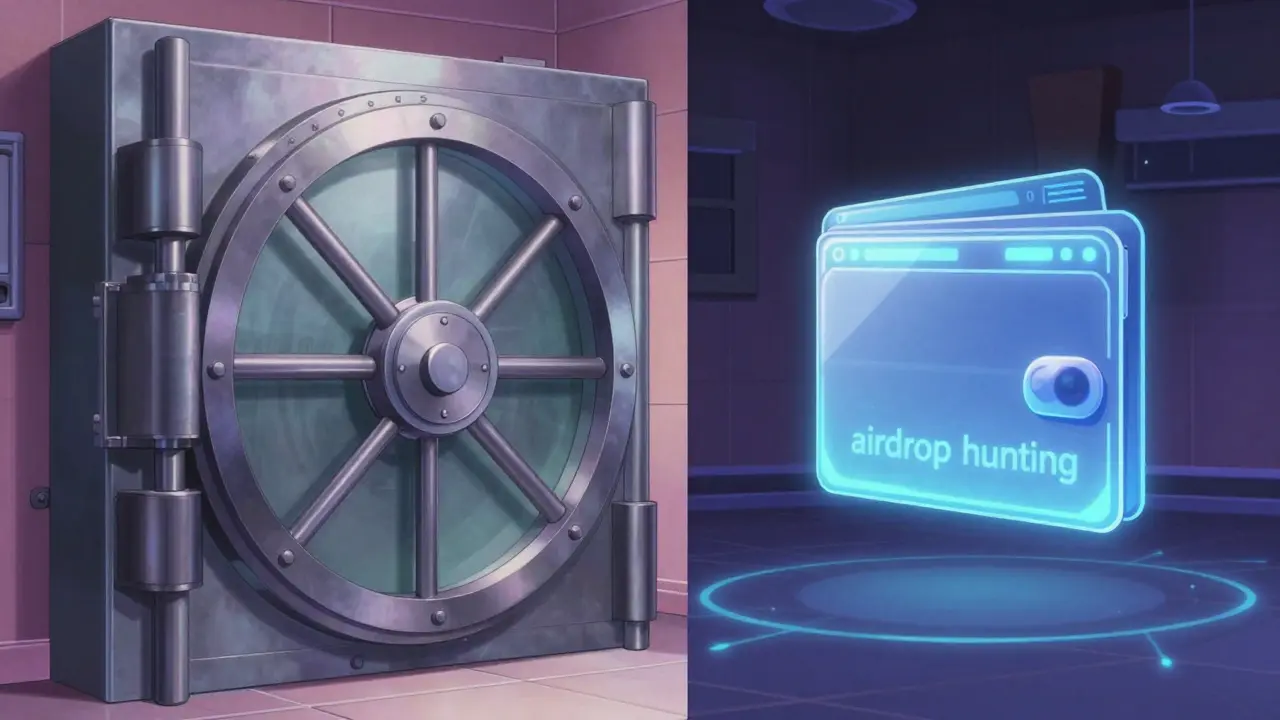
- Use a Burner Wallet: Create a new, empty MetaMask a popular software cryptocurrency wallet used to interact with the Ethereum blockchain and other EVM-compatible networks wallet. Transfer only the minimum amount of gas money (like ETH or BNB) needed to claim the tokens. Never connect your primary "vault" wallet where you keep your long-term holdings.
- Verify the Smart Contract: Before claiming, find the token contract address. Plug it into a block explorer like Etherscan an online tool and blockchain explorer that allows users to search for and analyze transactions on the Ethereum blockchain . If the contract was created two hours ago and has no verified source code, stay away.
- Review the Permissions: When you click "Claim," your wallet will ask you to sign a transaction. Read the prompt. If it asks for "Unlimited Approval" to spend your USDT or USDC, you are being phished. A real airdrop only requires a transaction to receive tokens, not to give the project permission to take your other coins.
Red Flags and Common Airdrop Scams
Scammers are incredibly good at mimicking legitimate projects. They use urgency ("Only 24 hours left!") and greed ("Claim 5000 IMM now!") to bypass your critical thinking. One of the most common traps is the "Verification Fee." A real airdrop will never ask you to send 0.1 ETH to "verify your wallet" before you can receive your tokens. If you have to pay to get "free" money, it isn't free-it's a theft.
Another dangerous tactic is the "Dusting Attack." You might suddenly see a small amount of a random token in your wallet that you never claimed. When you try to swap this token on a decentralized exchange, the smart contract triggers a malicious function that drains your account. If you see unexpected IMM tokens appearing without you taking action, do not interact with them.
| Feature | Legitimate Airdrop | Phishing Scam |
|---|---|---|
| Request for Keys | Never asks for seed phrase | Asks for seed phrase/private key |
| Payment | Free (minus network gas) | Requires "activation fee" or deposit |
| Wallet Access | Specific token minting | Requests "Unlimited Approval" of assets |
| Communication | Official website and verified X/Discord | Random DMs, Telegram bots, or email spam |
The Role of Liquidity and Tokenomics
For a token like IMM to have actual value, it needs a liquidity pool. This is a pile of funds (usually paired with a stablecoin like USDT) that allows people to buy and sell the token. Many airdrops result in "worthless" tokens because the team never adds liquidity to a DEX a decentralized exchange that allows users to trade cryptocurrencies directly without a central authority like Uniswap the largest decentralized trading protocol for Ethereum-based tokens .
If you manage to claim IMM and find that you cannot sell it, or that the price is plummeting the moment you receive it, you've encountered a "pump and dump." In these cases, the airdrop is used to inflate the number of holders, allowing insiders to sell their larger holdings into the hype created by the retail users.
Evaluating Project Credibility
How do you tell if the IMM team is serious? Look at their Whitepaper a document that outlines the goals, technical specifications, and roadmap of a cryptocurrency project . A generic document that uses a lot of buzzwords like "revolutionary," "AI-driven," and "next-generation" without explaining the actual tech is a bad sign. A strong project will explain exactly what problem they are solving and how the token fits into that solution.
Check the community. Are the people in the Discord asking technical questions about the roadmap, or is the chat just filled with people typing "When moon?" and "LFG!" A community built on hype rather than utility usually crashes quickly. Also, check the GitHub a developer platform that hosts project code and tracks changes via version control repository. If the code hasn't been updated in weeks, the project might be abandoned or was never real to begin with.
Is the IMM airdrop free?
Yes, airdrops are intended to be free. However, you will always need to pay a small "gas fee" to the blockchain network (like Ethereum or Solana) to process the transaction. If a site asks you to send tokens to an address to "unlock" your airdrop, it is a scam.
What should I do if I already connected my wallet to a suspicious IMM site?
Immediately move your remaining funds to a brand new wallet. Then, use a tool like Revoke.cash to cancel any token approvals you granted to the suspicious smart contract. This stops the attacker from being able to withdraw your funds even if they have the approval key.
Why can't I see my IMM tokens in my wallet?
Most wallets don't automatically show every token you own. You need to manually "Import Token" by pasting the correct contract address provided by the official project. If the tokens don't appear after adding the correct contract, you may not have been eligible or the distribution hasn't happened yet.
How can I tell if an IMM airdrop link is fake?
Check the URL carefully. Scammers often use typos (e.g., "imn-airdrop.com" instead of "imm-airdrop.com"). Also, check the " padlock" icon in the browser, though keep in mind that many scam sites now use HTTPS to look legitimate. The best way is to cross-reference the link with the project's official X account.
Are airdrops a guaranteed way to make money?
No. Many airdropped tokens never gain value or are eventually deleted. Some may have "vesting periods," meaning you can't sell them all at once. Treat airdrops as a bonus, not a reliable investment strategy.
Next Steps for Airdrop Hunters
If you're looking for more opportunities beyond IMM, start by researching "ecosystem airdrops." This is where a major blockchain (like Solana a high-performance blockchain supporting smart contracts and decentralized apps ) encourages users to try out new apps on its network. These are generally safer because they are backed by a known ecosystem.
For those who are more experienced, consider using a hardware wallet like Ledger a company producing hardware wallets that store cryptocurrency private keys offline for your main assets while using a software wallet for airdrop hunting. This ensures that even if a malicious site compromises your software wallet, your life savings remain safe in cold storage.


