
Imagine holding $10 million worth of Bitcoin is the world's largest cryptocurrency by market capitalization and computational power. You send it to an exchange. Minutes later, you reverse that transaction, keeping both the coins in your wallet and the fiat currency from the sale. This scenario is known as a double-spend, and it requires a specific type of cyber assault called a 51% attack is a theoretical threat where an entity gains control of more than half the network's mining power.. For years, people have asked if this is possible on Bitcoin. The short answer is yes, technically. The real question is: how much would it actually cost?
In mid-2026, the price tag for taking down Bitcoin is not just high-it is astronomical. Estimates range from $5.5 billion to over $20 billion depending on how you pull it off. To put that in perspective, that is more than the GDP of many small nations. It is also far more expensive than any potential payout from stealing transactions. While smaller cryptocurrencies have fallen victim to these attacks repeatedly, Bitcoin’s sheer scale makes it one of the most secure digital assets in existence.
The Mechanics of a 51% Attack
To understand the cost, we first need to look at how Bitcoin stays secure. Bitcoin uses a system called Proof-of-Work (PoW) is a consensus mechanism that requires miners to solve complex mathematical puzzles to validate transactions.. In simple terms, miners compete to add new blocks to the blockchain. The network always accepts the longest valid chain of blocks as the truth. If an attacker controls more than 50% of the total computing power (hashrate), they can mine blocks faster than everyone else combined. They can then secretly build a longer chain that excludes certain transactions, effectively rewriting history.
Currently, Bitcoin’s total network hashrate sits at approximately 150 exahashes per second (EH/s) is the measure of the total computational power dedicated to securing the Bitcoin network.. To guarantee a successful attack, an adversary would need to control an equivalent 150 EH/s. However, because mining is probabilistic, having slightly less than 50% might still allow for shorter-range attacks, but controlling the majority ensures dominance. This massive amount of power does not appear out of thin air; it must be bought or rented.
Buying Your Way In: The Hardware Approach
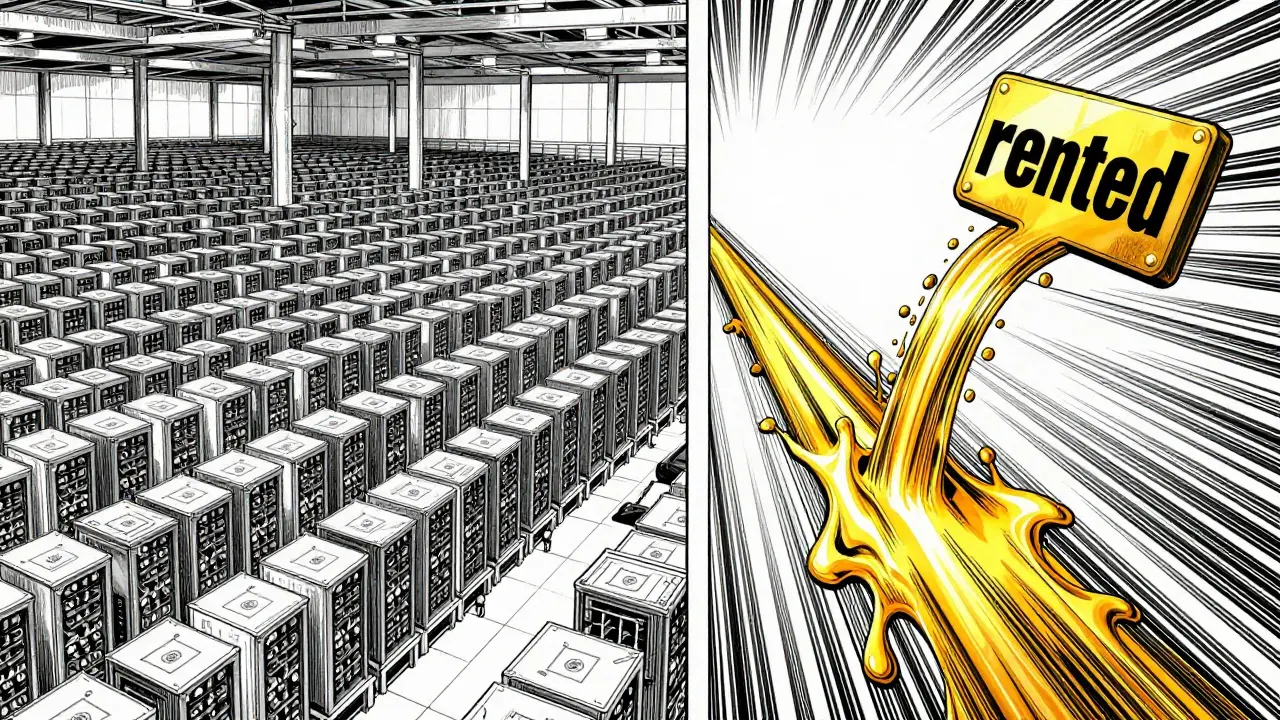
The most straightforward way to gain this power is to buy the physical machines. These are specialized devices called ASICs (Application-Specific Integrated Circuits). Let’s look at the numbers using the Antminer S19 Pro is one of the most efficient ASIC mining units available with 110 TH/s performance. as our benchmark. Each unit delivers about 110 terahashes per second (TH/s) and consumes 3,250 watts of electricity.
To reach the necessary 150 EH/s, you would need roughly 1.364 million of these machines. According to data from Braiins, a leading mining pool operator, purchasing this hardware alone costs around $5.5 billion. But buying them is only step one. You also need:
- Space: Industrial-scale warehouses to house millions of noisy, hot machines.
- Power: Enough electricity to power a small city, which adds millions in monthly operational costs.
- Cooling: Massive infrastructure to prevent the hardware from melting down.
This method is incredibly expensive and slow. By the time you ordered, shipped, and installed 1.3 million miners, the news would likely be all over financial headlines. The market would react, prices might shift, and other miners could adjust their strategies. Plus, once you spend $5.5 billion on hardware, you have a huge asset. Destroying the value of Bitcoin by attacking it would destroy the value of your own investment. This creates a powerful economic deterrent known as opportunity cost.
Renting Power: The Faster, Cheaper Option
Instead of buying hardware, attackers often choose to rent hashrate. This allows them to borrow computing power from existing miners for a set period. Services like NiceHash facilitate this rental market. The cost here fluctuates based on demand, but it is significantly lower than buying hardware outright.
However, even renting is pricey. If the daily cost to rent enough power to challenge Bitcoin runs into the hundreds of millions or billions, the window for profit is tiny. An attacker needs to execute the double-spend, confirm the reversal, and cash out before the rest of the network detects the anomaly and adjusts. Most experts agree that while renting is cheaper than buying, it is still prohibitively expensive for anyone except perhaps state-level actors with unlimited budgets.
| Attack Method | Estimated Cost | Time Required | Risk Level |
|---|---|---|---|
| Physical Hardware Purchase | $5.5 Billion+ | Months to Years | High (Capital Loss) |
| Hashrate Rental | $100M - $500M+ (Daily) | Hours to Days | Medium (Detection Risk) |
| Mining Pool Compromise | Low (Cybersecurity Breach) | Instant | Very High (Legal/Reputational) |
The Synthetic Attack: Hacking Pools Instead of Buying Power
There is a third, more sinister option: synthetic hashrate control. Instead of buying or renting machines, an attacker hacks into major mining pools. Mining pools are groups of miners who combine their power to share rewards. A few large pools control a significant portion of Bitcoin’s hashrate. If an attacker could compromise the software or management systems of several top pools simultaneously, they could redirect that collective power toward an attack without spending billions on hardware.
This method is theoretically much cheaper-essentially the cost of a sophisticated cyber intrusion team. However, it faces massive practical barriers. Major mining pools are distributed globally across different jurisdictions. They employ top-tier cybersecurity firms. Furthermore, if a pool were found to be participating in a 51% attack, it would face immediate legal action, blacklisting, and total loss of reputation. No legitimate business owner would risk their entire company for a one-time illicit gain that destroys the ecosystem they rely on.
Why Smaller Coins Fall Easy
If Bitcoin is so hard to attack, why do we hear about 51% attacks happening regularly? The key difference is scale. Smaller cryptocurrencies, often called altcoins, have much lower hashrates. For example, Ethereum Classic is a legacy blockchain that has suffered multiple 51% attacks due to its lower mining security budget. has been attacked several times. Similarly, Firo is a privacy-focused cryptocurrency that experienced a successful 51% attack in 2020. and Bitcoin SV is a Bitcoin fork that faced three separate 51% attacks in 2021. have all fallen victim.
For these networks, the cost to rent enough hashrate might be only a few thousand or tens of thousands of dollars. An attacker can easily afford this, execute a double-spend against a merchant, and disappear. The lesson here is clear: security in Proof-of-Work networks is directly proportional to the amount of money spent securing it. Bitcoin spends billions annually on electricity and hardware to maintain its security budget, making it orders of magnitude safer than smaller chains.

Economic Deterrents: Why Honest Mining Pays Better
Beyond the upfront cost, there is the issue of opportunity cost. If you somehow acquired 150 EH/s of mining power, what should you do with it? You could try to attack the network, or you could use it to mine Bitcoin honestly.
According to analysis by GoBitcoin.io, an attacker with this level of power could earn approximately 918 BTC per day through legitimate mining. At current market prices, this represents millions of dollars in daily revenue. By launching an attack, you would stop earning this income. Moreover, the attack would likely crash the price of Bitcoin, reducing the value of any BTC you already hold. It is economically irrational to burn your own house down to steal the furniture.
Recent models from the MIT Digital Currency Initiative suggest that 51% attacks are only profitable if the attacker has very low fixed costs. Since most miners have invested heavily in hardware, their break-even point is high. Attacking the network jeopardizes those investments. This alignment of incentives is a core feature of Bitcoin’s design: honesty is the most profitable strategy.
Market Impact and Systemic Risk
A successful 51% attack on Bitcoin would do more than just reverse a few transactions. It would shatter confidence in the entire cryptocurrency industry. Financial institutions, corporations, and governments that have integrated Bitcoin into their balance sheets would panic. We would likely see a massive sell-off, causing the price to plummet. Regulatory bodies might impose harsh bans or restrictions in response.
This systemic risk acts as another layer of defense. Even if a state actor wanted to attack Bitcoin for geopolitical reasons, the collateral damage to global financial markets could be severe. The interconnectedness of modern finance means that destabilizing Bitcoin could have ripple effects that hurt the attacker’s own economy.
Future Outlook: Getting Stronger Every Day
As we move further into 2026, Bitcoin’s security continues to improve. Mining technology becomes more efficient, allowing more hashrate for the same energy cost. More renewable energy sources are being tapped by mining operations, stabilizing costs. The geographic distribution of miners is becoming more diverse, reducing the risk of a single region being shut down by government action.
Industry analysts predict that within the next decade, the cost to attack Bitcoin could rise into the tens of billions, making it virtually impossible for any non-state entity to attempt. Protocol upgrades may also introduce additional safeguards, though the core Proof-of-Work mechanism remains robust. For users, the takeaway is simple: Bitcoin is safe not because it is perfect, but because breaking it is too expensive to be worth the effort.
Can a 51% attack destroy Bitcoin completely?
No. A 51% attack cannot create new coins out of thin air or steal funds from private wallets directly. It can only reverse recent transactions and enable double-spending. Once the attack stops, honest miners will resume building the chain, and the network will recover. However, the loss of trust could cause long-term damage to adoption and price.
Has Bitcoin ever been successfully attacked?
No. Bitcoin has never suffered a successful 51% attack. Its massive hashrate and economic incentives make it too costly to target. Other cryptocurrencies with lower security budgets, such as Ethereum Classic and Firo, have been attacked, highlighting the importance of network scale.
Is it cheaper to rent or buy hashrate for an attack?
Renting is significantly cheaper and faster. Buying the necessary hardware costs billions and takes months to deploy. Renting allows an attacker to access power immediately, but the daily costs are still extremely high, often running into hundreds of millions of dollars, making profitability unlikely.
What happens to my Bitcoin if an attack occurs?
Your coins remain safe in your wallet. A 51% attack does not drain wallets. However, if you are waiting for a transaction confirmation, that transaction could be reversed. Exchanges and merchants typically wait for multiple confirmations (usually 6) to mitigate this risk, making deep-chain reversals nearly impossible even during an attack.
Why don't miners just collude to attack the network?
Miners are incentivized to act honestly. Colluding to attack the network would crash Bitcoin's price, destroying the value of the coins they are trying to mine. Additionally, mining pools are independent businesses competing for hash power; coordinating a global conspiracy among rivals is logistically and legally nearly impossible.


