
For years, criminals and sanctioned entities believed that cryptocurrency offered a shield against law enforcement. They thought the decentralized nature of blockchains meant their money was untraceable, invisible, and safe from international regulations. That belief is now dangerously outdated.
In 2026, authorities have turned the transparency of public ledgers into their greatest weapon. Through blockchain forensics, a specialized investigative discipline that enables agencies to trace, analyze, and attribute transactions on distributed networks, governments can follow digital money trails with precision that traditional banking systems often struggle to match. Whether it's tracking ransomware payments or identifying sanctions evasion by state actors, the tools available today make illicit activity significantly harder to hide.
This isn't just about catching bad guys; it's about reshaping how financial institutions, exchanges, and regulators interact with digital assets. If you are involved in crypto-whether as an investor, a business owner, or a compliance officer-understanding these mechanisms is no longer optional. It is essential for staying on the right side of the law.
The Evolution from Manual Tracking to Automated Intelligence
To understand where we stand today, we need to look back at where blockchain investigation began. In the early days, tracing Bitcoin transactions required immense manual labor. Investigators had to review hundreds of thousands of individual entries line by line, looking for patterns that suggested illicit behavior.
A landmark case that defined this era was the Helix casea major investigation involving Larry Dean Harmon who facilitated laundering over $300 million in proceeds from darknet drug markets. Starting in 2016, investigators tracked Bitcoin moving through the Helix mixing service. They manually followed commission payment trails across the blockchain to identify exchanges and payment processors linked to Harmon. It took years of painstaking work. Harmon eventually pleaded guilty to conspiracy to launder monetary instruments in August 2021 and received a three-year prison sentence in November 2024.
Today, that same level of analysis happens in seconds. Modern platforms use automated pattern recognition and machine learning to flag suspicious clusters of addresses instantly. The shift from human-led auditing to algorithmic surveillance has dramatically increased the speed and accuracy of crypto investigations.
How Blockchain Forensics Platforms Work
At its core, blockchain forensics relies on the fact that most blockchains are public ledgers. Every transaction is recorded permanently. While wallet addresses do not inherently reveal identities, they create a graph of interactions. Forensic firms map these graphs to find connections between anonymous wallets and known entities like exchanges, mixers, or government-sanctioned addresses.
Leading providers such as Elliptica battle-tested blockchain analytics platform used by governments and banks to visualize crypto fund flows and ensure compliance offer comprehensive analytical capabilities. These include cross-chain risk detection, automated anti-money laundering (AML) workflows, and secure integrations for financial institutions. When a user deposits funds into an exchange, the platform checks those funds against a global database of illicit activity. If the coins originated from a hack, a darknet market, or a sanctioned entity, the system flags them immediately.
Another key player, TRM Labsa blockchain intelligence firm specializing in sanctions evasion detection and compliance solutions for crypto businesses, focuses heavily on sanctions policy. They help organizations stay ahead of circumvention techniques by providing real-time monitoring and automated flagging of transactions involving sanctioned jurisdictions.
| Provider | Primary Focus | Key Clients | Notable Feature |
|---|---|---|---|
| Elliptic | Comprehensive AML & Compliance | Governments, Banks, Exchanges | Cross-chain visualization & ecosystem mapping |
| TRM Labs | Sanctions Evasion Detection | Crypto Businesses, Fintech | Real-time screening for sanctioned entities |
| Chainalysis | Law Enforcement Support | FBI, IRS, DOJ | Extensive address labeling database |
Detecting Complex Money Laundering Patterns
Criminals are not standing still. As forensic tools improve, so do the methods used to obscure the origin of funds. One of the biggest challenges for investigators is off-chain laundering, where value moves between different platforms without leaving a direct on-chain trail.
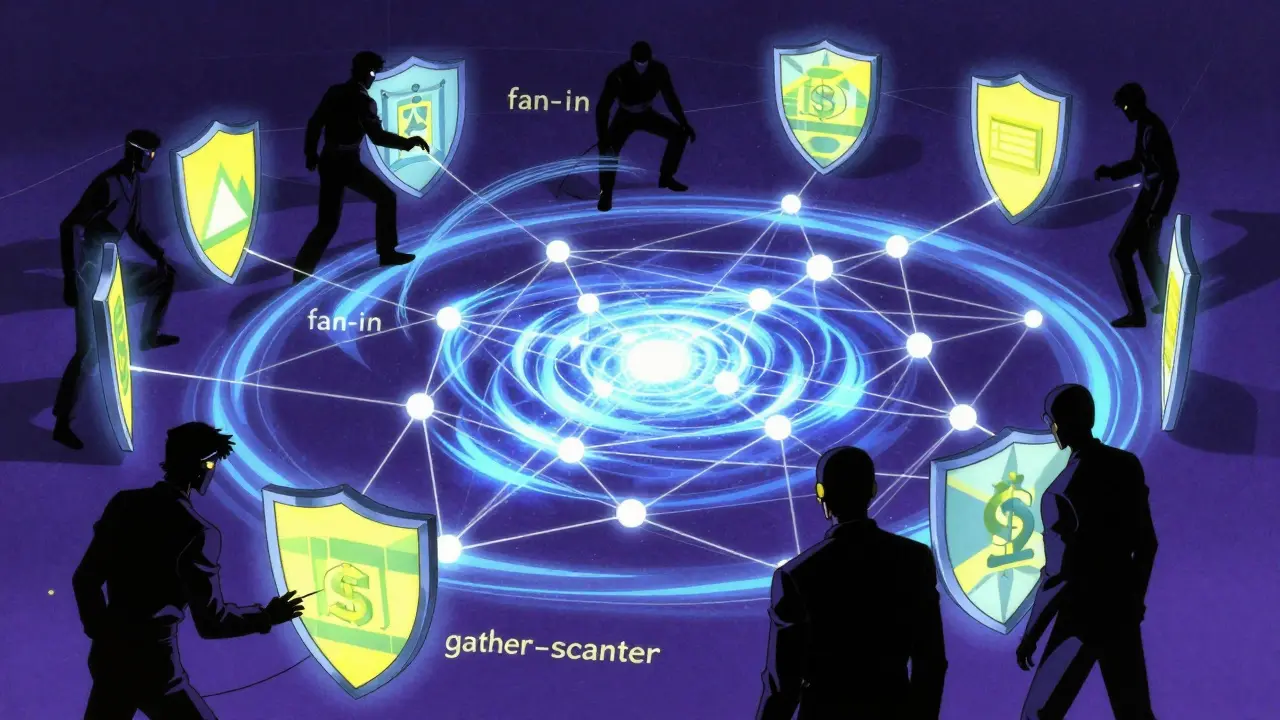
Recent academic advancements have introduced new methodologies to tackle this. For example, the MPOCryptoML methodan end-to-end approach using multi-source Personalized PageRank algorithms to identify multiple laundering patterns in off-chain operations represents a significant leap forward. This system captures hidden and random laundering paths across cross-platform transaction graphs.
It identifies complex formations such as:
- Fan-in/Fan-out: Consolidating funds from many sources into one, then dispersing them again.
- Bipartite structures: Moving funds between two distinct groups of addresses to break links.
- Gather-scatter: Collecting small amounts from numerous wallets before sending large sums elsewhere.
- Stack patterns: Layering transactions to confuse timeline analysis.
Benchmarks show that approaches like MPOCryptoML achieve up to 9.13% improvement in precision and 10.19% in accuracy compared to older baseline systems when tested on real-world datasets from Ethereum fraud detection and other networks. This means fewer false positives and more accurate identification of actual criminal activity.
The Role of Privacy Tools and Mixers
Privacy-enhancing technologies pose a unique challenge. Services like Tornado Casha decentralized mixer that obscures the origins of cryptocurrency transactions, leading to significant regulatory scrutiny and Wasabi Wallet allow users to sever the link between their deposit and withdrawal addresses. For years, these tools were seen as insurmountable barriers for investigators.
However, authorities have adapted. Instead of trying to track the specific coins inside the mixer, they analyze the inputs and outputs. If a known illicit wallet sends funds into Tornado Cash, and a clean-looking wallet withdraws funds shortly after, forensic software assigns a high risk score to that output address. Over time, clusters of addresses associated with privacy tools become tainted.
Moreover, regulatory pressure has forced many centralized exchanges to block withdrawals from known mixer addresses. This creates a bottleneck: if you cannot cash out your mixed coins on a regulated platform, the utility of that privacy is severely limited. This dynamic forces criminals to rely on peer-to-peer trades or decentralized exchanges, which leave their own distinct footprints.
Sanctions Evasion: The New Frontier
Perhaps the most politically sensitive application of blockchain forensics is detecting sanctions evasion. Countries under international sanctions, such as Russia, Iran, and North Korea, have increasingly turned to cryptocurrencies to bypass traditional financial restrictions.
TRM Labs has identified several common techniques used by illicit actors to evade sanctions. While they do not publish detailed manuals to prevent abuse, the general strategies involve:
- Layering through stablecoins: Converting seized assets into USDT or USDC to stabilize value before moving them.
- Using non-KYC exchanges: Trading on platforms that do not require identity verification.
- Cross-chain bridges: Moving assets between different blockchains to complicate tracking.
- DeFi protocols: Using automated market makers to swap tokens without a central intermediary.
Regulatory bodies employ blockchain forensics to monitor systemic risks tied to these flows. They analyze cases of cross-border money laundering and oversee the effectiveness of Virtual Asset Service Provider (VASP) compliance programs. The goal is to coordinate with law enforcement on high-impact investigations that disrupt the financial lifelines of sanctioned regimes.

Who Uses These Tools and Why?
Blockchain forensics is not exclusive to police departments. Its adoption spans three main sectors, each with distinct motivations.
Law Enforcement Agencies use these tools to build evidentiary case files. They need complete on-chain transaction histories to prove beyond reasonable doubt that specific threat actors controlled certain wallets. This is crucial for prosecuting cases in court, where digital evidence must meet strict legal standards.
Cryptocurrency Businesses integrate forensics primarily for screening. Exchanges like Bitget utilize platforms like Elliptic to gain deep insights into transaction monitoring. By visualizing crypto fund flows through wallets, they maintain exchange integrity and avoid hefty fines for facilitating money laundering. If a customer tries to deposit stolen funds, the exchange freezes the account and reports the incident.
Financial Institutions leverage these tools to assess risk. Banks want to know if their corporate clients are engaging in high-risk crypto transactions. They also conduct due diligence when evaluating new fintech partnerships. Understanding exposure to illicit flows, such as ransomware payments, helps protect their reputation and capital.
Collaboration Beyond Finance
The impact of blockchain forensics extends far beyond financial crime. It is being used to combat some of the most serious social issues. The Internet Watch Foundation (IWF), which identifies child sexual abuse imagery on websites, collaborates with Elliptic to disrupt the spread of criminal content.
Many sites hosting illegal material accept cryptocurrency for access fees. By tracking these payments, investigators can identify the operators behind these sites and shut them down. This partnership demonstrates how blockchain intelligence can be applied to protect vulnerable populations, proving that the technology serves broader societal goals.
Challenges and Future Directions
Despite rapid progress, challenges remain. The integration of new blockchain protocols, such as the Internet Computer Protocol (ICP), requires constant updates to forensic frameworks. Institutions must manage and trade emerging digital assets in full compliance with global regulations, which accelerates the need for adaptable tools.
Implementation complexity varies significantly. Enterprise-level deployments require months of configuration and integration work. Organizations need specialized compliance teams trained in both traditional financial crime investigation and technical blockchain analysis. Companies like Elliptic offer tailored training programs to upskill personnel, but the learning curve is steep.
Looking ahead, current developments focus on cross-chain analysis capabilities and automated surveillance analytics. As privacy technologies evolve, so too will the countermeasures. The permanent nature of blockchain records ensures that forensic capabilities will only become more powerful over time. Patterns and relationships become clearer with additional data and improved analysis capabilities.
Can blockchain forensics track transactions on private blockchains?
Generally, no. Blockchain forensics relies on public ledgers where transaction data is visible to anyone. Private or permissioned blockchains restrict access to data, making external analysis impossible without cooperation from the network administrators. However, most illicit activity occurs on public chains like Bitcoin and Ethereum, which are fully transparent.
How effective are mixers like Tornado Cash against modern forensics?
Mixers reduce the effectiveness of direct linking but do not make funds untraceable. Forensic firms analyze input/output correlations and assign risk scores to addresses interacting with mixers. Furthermore, many regulated exchanges now block withdrawals from known mixer addresses, limiting the usability of mixed funds.
What is the role of VASPs in sanctions detection?
Virtual Asset Service Providers (VASPs), such as exchanges and custodians, are responsible for implementing Know Your Customer (KYC) and Anti-Money Laundering (AML) procedures. They use blockchain forensics tools to screen incoming and outgoing transactions against lists of sanctioned entities and illicit addresses, preventing their platforms from being used for evasion.
How long does it take to implement a blockchain forensics solution?
Implementation time varies based on organizational size and requirements. Small businesses might integrate API-based screening within weeks, while enterprise-level deployments requiring custom workflows and extensive historical data analysis can take several months of configuration and team training.
Is blockchain forensics legal in all countries?
The legality depends on local data privacy laws and financial regulations. Most developed nations support the use of blockchain forensics for compliance and law enforcement purposes. However, organizations must ensure their data handling practices comply with regional privacy standards like GDPR in Europe or CCPA in California.