
Remember the last time you tried to swap a token on Ethereum mainnet during a market spike? You likely spent more on gas fees than the trade itself was worth. That frustration is exactly why Layer 2 scaling exists. It isn't just a buzzword; it's the practical fix for a network that was never built to handle billions of users at once. As we move through late 2026, the question isn't whether Layer 2s work-they clearly do-but which ones will dominate your daily crypto experience.
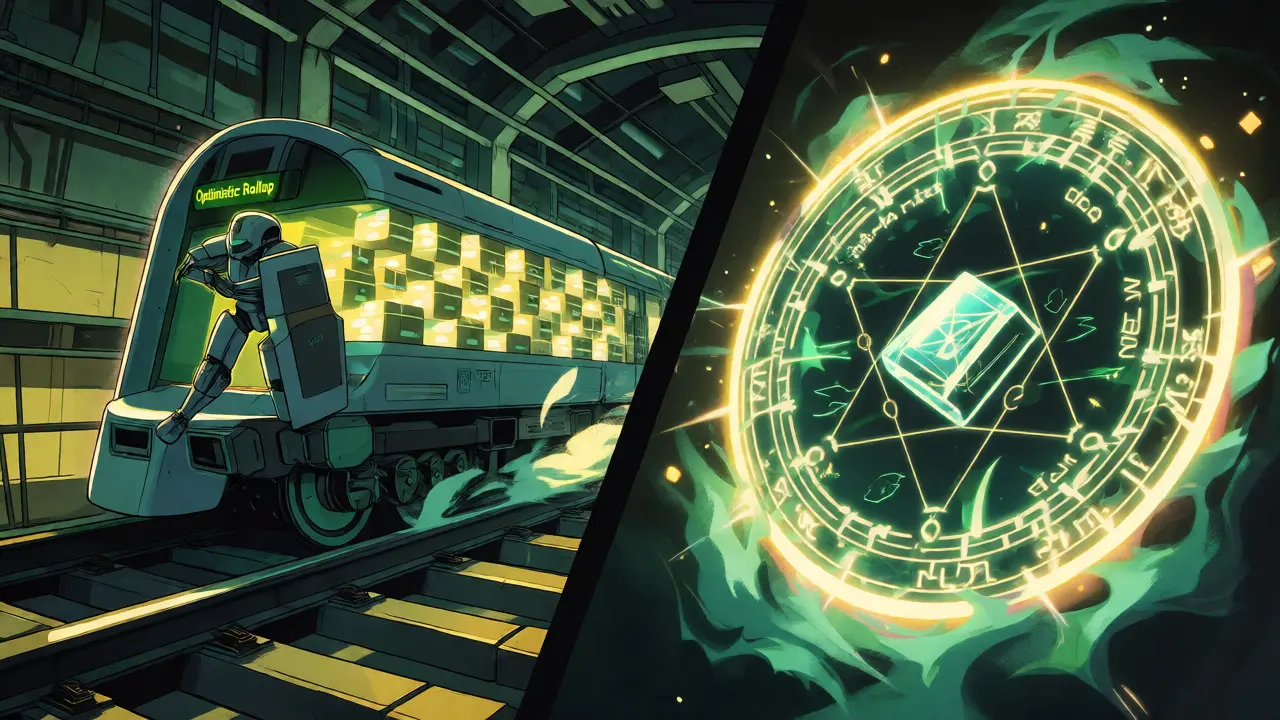
You might think scaling means making the base blockchain faster. But in reality, most modern solutions don't touch the base layer (Layer 1) at all. Instead, they build secondary protocols on top of it. Think of Ethereum as a crowded highway. Layer 1 processes every car individually, checking IDs and tolls. Layer 2 solutions act like express lanes or cargo trains. They bundle thousands of transactions together, process them off-chain, and then submit a single compressed proof back to the main highway. This approach allows networks to hit speeds of 4,000 to 65,000 transactions per second (TPS), compared to Ethereum's native ~15 TPS.
The Two Main Roads: Optimistic vs. ZK Rollups
Not all Layer 2s are created equal. The industry has split into two primary technical camps, each with distinct trade-offs. Understanding these helps you decide where to park your assets or build your dApp.
Optimistic Rollups operate on trust but verify logic. They assume transactions are valid unless proven otherwise within a challenge period (usually seven days). Networks like Arbitrum, Optimism, and Coinbase’s Base fall here. Their biggest strength is compatibility. Because they mimic the Ethereum Virtual Machine (EVM) closely, developers can port existing apps with minimal code changes. For you, this means a smooth user experience with familiar wallets and tools.
On the other side, Zero-Knowledge (ZK) Rollups use complex math to prove validity instantly. No waiting periods, no fraud proofs needed-just cryptographic certainty. Platforms like zkSync and StarkNet lead this charge. While historically harder to develop for, recent upgrades have made them increasingly EVM-compatible. The payoff? Instant finality and better privacy features, crucial for enterprise applications where speed matters more than ease of migration.
| Network | Type | Approx. TPS | Best Use Case | Key Feature |
|---|---|---|---|---|
| Arbitrum | Optimistic | 4,000 | DeFi & Gaming | Largest TVL ($6.2B+) |
| Polygon | Sidechain/L2 Hybrid | 65,000 | NFTs & High-Freq Trading | Highest Throughput |
| Base | Optimistic | 4,000+ | Mainstream Onboarding | Coinbase Integration |
| zkSync Era | ZK-Rollup | 2,000-5,000* | Privacy & Enterprise | Instant Finality |
Why Fees Dropped by 90%
The most tangible benefit for regular users is cost. In early 2021, sending $50 worth of ETH could cost $50 in gas. Today, on networks like Arbitrum or Base, that same transaction costs cents. This isn't magic; it's data compression. By batching thousands of actions into one Ethereum block, the cost per action plummets.
This shift has democratized access. Micro-transactions, which were economically impossible on Layer 1, are now viable. Imagine buying a digital collectible for $1 without paying $10 in fees. Or playing a blockchain game where moving a character across the map doesn't bankrupt you. These scenarios are standard practice now. The reduction in friction has directly fueled the growth of decentralized finance (DeFi) among retail users who previously found Ethereum too expensive to touch.
Institutional Adoption Is Accelerating
It’s not just gamers and traders using these networks. Major financial institutions have started treating Layer 2s as serious infrastructure. Why? Predictability. On Ethereum mainnet, gas prices are volatile. One minute it’s cheap, the next it’s astronomical due to congestion. Layer 2s offer stable, low-cost environments essential for corporate treasury management and tokenized real-world assets (RWAs).
Companies like Coinbase have integrated deeply with their own Layer 2, Base, leveraging its connection to millions of exchange users. Meanwhile, traditional banks exploring tokenized bonds prefer ZK-Rollups for their audit-friendly privacy features. The Total Value Locked (TVL) on Layer 2s has surged, with Arbitrum alone securing over $6 billion in assets. This capital migration signals confidence: big money trusts these rollups to secure its holdings.

The Developer Experience Has Evolved
If you’re a developer, the barrier to entry has lowered significantly. Five years ago, building on a Layer 2 meant wrestling with unfamiliar toolchains. Now, most major L2s support standard Solidity contracts. You write code for Ethereum, deploy it to Arbitrum or Base, and it works. Debugging tools, testing frameworks, and documentation have matured to match mainnet standards.
However, challenges remain. Bridging assets between different Layer 2s can still be clunky. Moving funds from Arbitrum to zkSync often requires routing through Ethereum mainnet, adding time and cost. New interoperability protocols aim to fix this by allowing direct L2-to-L2 transfers, but widespread adoption is still rolling out. For now, sticking to one ecosystem minimizes hassle.
What Comes Next?
The future of Layer 2 scaling points toward consolidation and specialization. We won’t see hundreds of successful L2s survive long-term. Instead, a few winners will dominate specific niches. Arbitrum and Base will likely continue leading in general-purpose DeFi and consumer apps due to their robust ecosystems. Polygon remains the go-to for high-volume gaming and NFT projects needing raw speed. ZK-Rollups will capture the enterprise sector, offering the security guarantees required for regulated industries.
Vitalik Buterin and other core contributors have emphasized that Layer 2s aren't temporary fixes. They are the permanent architecture of scalable blockchains. The goal is a modular system where Ethereum handles security and settlement, while Layer 2s handle execution. This division of labor allows both layers to optimize independently. Expect continued improvements in user experience, such as account abstraction (smart wallets that hide seed phrases) and cheaper bridging, making crypto feel less like tech and more like internet banking.
Is Layer 2 safer than Ethereum mainnet?
Layer 2s inherit security from Ethereum, but they add their own risks. Optimistic Rollups rely on validators to catch fraud, while ZK-Rollups use mathematical proofs. Generally, they are considered safe, but smart contract bugs within the L2 protocol itself are possible. Always check if an L2 has undergone rigorous audits before moving large sums.
Do I need new wallets for Layer 2?
No, you typically use the same wallet address (like MetaMask) for Layer 2 networks. You just need to add the network details to your wallet settings. Your private keys remain the same, so there is no risk of losing access to your mainnet assets when switching to an L2.
Which Layer 2 has the lowest fees?
Fees fluctuate based on network congestion, but generally, ZK-Rollups like zkSync and StarkNet tend to be slightly cheaper than Optimistic Rollups because they don't require storing full transaction data on Ethereum. However, differences are often negligible for average users, usually costing under $0.10 per transaction on any major L2.
Can I lose my funds bridging to Layer 2?
Bridging involves locking tokens on one chain and minting representations on another. Risks include bridge hacks or smart contract errors. To minimize risk, use official bridges provided by the network or reputable third-party aggregators like Li.Fi or Across. Avoid obscure bridges with little liquidity or audit history.
Will Layer 2 replace Ethereum?
No, Layer 2s depend on Ethereum. They settle their state back to the mainnet. Think of Ethereum as the foundation and Layer 2s as the skyscrapers built on top. Without the secure base layer, the upper floors would collapse. They work together, not against each other.