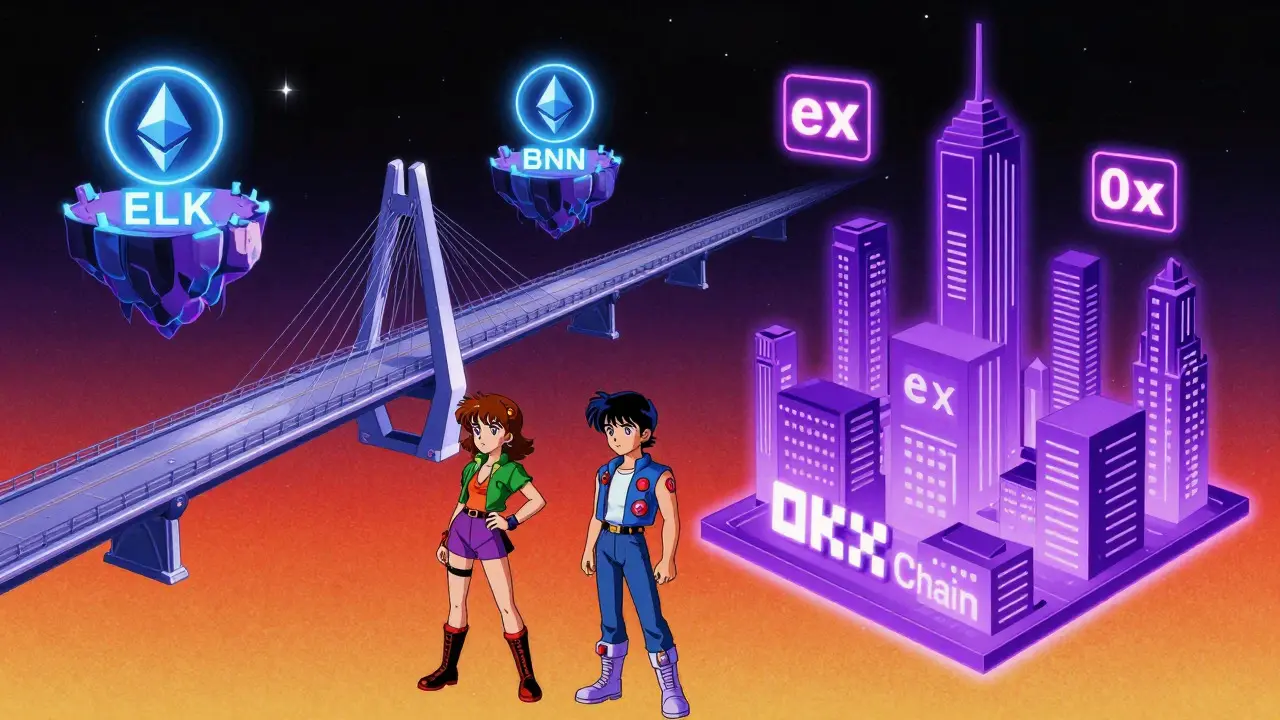
You’ve probably seen the name Elk Finance pop up alongside OKExChain (now known as OKX Chain) and wondered if they are the same thing. Maybe you’re looking for a new place to swap tokens cheaply, or perhaps you’re trying to understand why your wallet is showing different addresses. It’s easy to get tangled up here because both names live in the same ecosystem of decentralized finance (DeFi), but they serve very different purposes.
Here is the short answer: Elk Finance is a decentralized protocol for swapping tokens across different blockchains. OKX Chain is a blockchain network itself, built by the centralized exchange OKX. One is a tool you use on top of networks; the other is the network infrastructure. Mixing them up can lead to sending funds to the wrong address or paying unnecessary fees. Let’s break down exactly what each one does, how they work, and which one actually fits your needs right now.
What Is Elk Finance Really?
Elk Finance is a decentralized cross-chain automated market maker (AMM) that allows users to swap tokens between different blockchain networks without needing a centralized intermediary. Also known as ElkNet, it was designed to solve the fragmentation problem in crypto, where assets are stuck on isolated chains like Ethereum, BNB Chain, or Avalanche.
Think of Elk Finance as a bridge builder. If you have USDT on Ethereum but want to trade it for a token on Fantom, Elk Finance handles the complex routing behind the scenes. It uses its native token, ELK, to govern the protocol and offer incentives. As of late 2025, Elk Finance ranks around #40 in the swap category among decentralized applications. That puts it in the mid-tier-not the giant Uniswap, but certainly not an unknown experiment.
The core value proposition here is "trustless" cross-chain exchange. You don’t need to trust a company with your keys. However, this comes with trade-offs. The liquidity isn’t as deep as on major centralized exchanges, and the user interface can be intimidating if you aren’t comfortable connecting wallets like MetaMask or Trust Wallet. Currently, the ELK token is trading under pressure, sitting below its key moving averages, which suggests the broader market sentiment toward smaller DeFi protocols is cautious.
Understanding OKX Chain (Formerly OKExChain)
Now let’s look at the other side of the equation. OKX Chain is an EVM-compatible public blockchain developed by the OKX exchange, designed for high-performance decentralized applications and low-cost transactions. It was originally launched as OKExChain and rebranded to align with the parent company's global identity.
OKX Chain is not just a swap tool; it is a destination. It is a Layer-1 blockchain, similar to Ethereum or Binance Smart Chain, but optimized for speed and lower gas fees. Its native currency is OKT. What makes OKX Chain unique is its dual-address system. When you create a wallet on OKX Chain, you get two addresses: one starting with "ex" (native) and one starting with "0x" (Ethereum-style). They share the same balance. This is a huge deal for interoperability because it means you can interact with standard Ethereum tools like MetaMask while still enjoying the cheaper costs of the OKX ecosystem.
The chain uses a Delegated Proof-of-Stake (DPoS) consensus mechanism. In simple terms, token holders vote for validators who secure the network. The top 21 validators run the nodes. This structure allows for faster transaction finality compared to pure proof-of-work systems, making it attractive for traders who hate waiting ten minutes for a block confirmation.
Key Differences: Protocol vs. Infrastructure
To truly understand where you stand, you need to see these two entities side-by-side. They are often mentioned together because OKX Chain hosts many DeFi apps, including potentially Elk Finance integrations, but they are distinct layers of the tech stack.
| Feature | Elk Finance | OKX Chain |
|---|---|---|
| Type | Cross-Chain DEX Protocol | Layer-1 Blockchain Network |
| Primary Function | Swapping tokens across multiple chains | Hosting dApps and processing transactions |
| Native Token | ELK | OKT |
| Compatibility | Ethereum, BNB, Avalanche, Fantom, etc. | EVM Compatible (works with MetaMask) |
| Address Format | Standard Wallet Address | Dual: Native (ex...) and EVM (0x...) |
| Governance | DAO via ELK holders | DPoS Validators (Top 21) |
The critical takeaway here is dependency. You might use Elk Finance *on* OKX Chain if you are swapping an asset that lives there. But you can also use Elk Finance on Ethereum. Conversely, OKX Chain exists independently of Elk Finance; it hosts dozens of other games, NFT marketplaces, and lending platforms.
User Experience and Fees: What You Actually Pay
Let’s talk about money, because that’s usually why you clicked this title. How much does it cost to move your assets?
If you are using Elk Finance, you are paying gas fees on the source chain and the destination chain. For example, swapping from Ethereum to BNB Chain involves paying ETH gas for the initial transaction and BNB gas for the withdrawal. During periods of high network congestion, Ethereum gas can spike to $10-$20 per transaction. Elk Finance tries to optimize routes to minimize slippage, but you are still at the mercy of the underlying networks' traffic. The ELK token itself has seen bearish sentiment recently, hovering around $0.037, which doesn’t directly affect your swap fee but impacts the health of the liquidity pools you are trading against.
On OKX Chain, the story is different. Transactions are incredibly cheap, often costing less than $0.01 in OKT. If you are actively trading small amounts or interacting with DeFi apps daily, the savings are massive. However, getting onto OKX Chain usually requires bridging assets from another chain first. This is where the cross-chain bridge comes in. OKX provides a native bridge that connects to Ethereum, Tron, and Algorand. While the bridge is efficient, it adds a step to your workflow. You send ETH to the bridge, wait for confirmation, and receive OKT on the other side.
For beginners, the complexity of managing two different types of addresses on OKX Chain can be a hurdle. Sending OKT from an "ex" address to an "0x" address works fine within the same chain, but sending to the wrong format on a different chain could result in lost funds. Always double-check the address prefix.
Security and Trust Considerations
In crypto, security is never guaranteed, only managed. How do these two compare?
Elk Finance operates as a smart contract protocol. This means once you approve a transaction, it executes automatically. There is no customer support team to call if you make a mistake. The security relies entirely on the code audits and the reputation of the developers. As a mid-tier DEX, it has faced scrutiny but hasn’t had any massive, headline-grabbing hacks recently. However, cross-chain bridges are historically the weakest link in DeFi security. Every time you bridge assets through ElkNet, you are trusting the cryptographic proofs that validate the transfer. It’s "trustless" in theory, but in practice, you are trusting the math and the auditors.
OKX Chain benefits from the backing of OKX, one of the largest centralized exchanges in the world. OKX holds licenses in multiple jurisdictions and adheres to strict KYC (Know Your Customer) and AML (Anti-Money Laundering) standards for its exchange services. While the blockchain itself is permissionless (anyone can join), the ecosystem is heavily influenced by a regulated entity. This brings a layer of stability. The DPoS model means the network is secured by 21 validators. If a majority of these validators collude, the network could theoretically be compromised, but the economic incentives and reputation stakes make this unlikely.
One risk specific to OKX Chain is centralization concerns. Because the top validators are often associated with the OKX brand or its partners, purists argue it lacks the decentralization of Bitcoin or Ethereum. For most users, this is a non-issue-they just want fast, cheap transactions. But if ideological purity matters to you, OKX Chain might feel too corporate.

Who Should Use Which?
Your choice depends entirely on your goal. Are you a trader, a developer, or a casual holder?
- Choose Elk Finance if: You hold assets scattered across multiple chains (like ETH, AVAX, and FTM) and want to consolidate them or swap them without moving everything to a single centralized exchange. It’s ideal for DeFi natives who prefer self-custody and are comfortable with wallet connections.
- Choose OKX Chain if: You want to participate in low-cost DeFi activities, play blockchain games, or mint NFTs without worrying about high gas fees. It’s also great if you already use the OKX exchange and want to keep your assets within that ecosystem for easier management.
- Avoid Both if: You are a complete beginner who prefers the simplicity of buying BTC or ETH on Coinbase and holding it in a hardware wallet. The learning curve for managing cross-chain swaps and dual-address wallets is steep.
For many users, the best approach is hybrid. Keep your long-term holdings on Ethereum or Bitcoin for maximum security. Use OKX Chain for active trading and gaming due to low fees. Use Elk Finance occasionally when you need to move value between unrelated chains that don’t have direct bridges.
Future Outlook and Market Position
Where are these projects heading? The crypto landscape shifts quickly, especially with regulatory pressures mounting in 2026.
OKX Chain is expanding its utility. By supporting EVM compatibility, it attracts developers building on Ethereum to deploy their apps here for lower costs. This creates a network effect: more apps mean more users, which means more demand for OKT. The exchange’s strategic push into Asia and emerging markets gives OKX Chain a strong foothold. However, regulatory crackdowns on centralized exchanges could spill over, affecting the perception of OKX-backed infrastructure.
Elk Finance faces intense competition. Giants like Uniswap are adding cross-chain features, and specialized bridges like Multichain (now Anyswap) dominate the space. To survive, Elk Finance must prove its technology is faster and cheaper than alternatives. The current bearish sentiment on the ELK token reflects investor hesitation. Unless the protocol introduces innovative features or secures major partnerships, it risks becoming irrelevant in the crowded AMM market.
Keep an eye on total value locked (TVL) metrics for both. TVL is a good proxy for user confidence. If TVL on OKX Chain grows while Elk Finance’s stagnates, the trend is clear. Right now, the data suggests OKX Chain has stronger institutional backing and user adoption, while Elk Finance remains a niche tool for advanced DeFi users.
Is Elk Finance safe to use?
Elk Finance is generally considered safe for experienced DeFi users, as it operates via audited smart contracts. However, like all cross-chain protocols, it carries inherent risks related to bridge security and smart contract vulnerabilities. Always start with small amounts to test the process before moving significant capital.
Can I use MetaMask with OKX Chain?
Yes, OKX Chain is fully EVM-compatible. You can add OKX Chain as a custom network in MetaMask using the correct RPC URL. Just remember to switch between the native "ex" address and the "0x" address depending on whether you are interacting with OKX-specific apps or general Ethereum-based dApps.
What is the difference between ELK and OKT tokens?
ELK is the governance token for the Elk Finance protocol, used for voting and incentivizing liquidity providers. OKT is the native utility token of the OKX Chain blockchain, used to pay for transaction fees (gas) and stake for network validation. They serve completely different functions in the ecosystem.
Why are my transactions so expensive on Elk Finance?
Elk Finance facilitates swaps across multiple chains. If you are swapping from Ethereum, you must pay Ethereum gas fees, which can be high during peak times. The cost is not charged by Elk Finance itself but by the underlying blockchain network. To reduce costs, consider swapping during off-peak hours or using lower-cost chains like BNB Chain or OKX Chain as intermediate steps.
Is OKX Chain available in the United States?
Access to OKX services, including the exchange and potentially some blockchain features, may be restricted for users in the United States due to regulatory compliance. Always check the latest terms of service on the official OKX website, as geo-restrictions can change frequently based on legal developments.


