
You might think you can trade Bitcoin on any platform from your phone in Mumbai or Delhi. But if that platform isn't registered with the Financial Intelligence Unit-India (FIU-IND), you could lose access to your funds overnight. It’s not a hypothetical fear. In early 2024, Indian authorities blocked websites and apps for several major international exchanges because they ignored local registration rules. This wasn't about banning cryptocurrency itself; it was about enforcing who gets to handle your money.
The confusion stems from a simple misunderstanding. People hear "ban" and think Bitcoin is illegal. That's wrong. Trading crypto is legal in India. What got shut down were specific platforms that failed to play by India's financial rules. If you're an investor, understanding which exchanges are safe and which are effectively banned is crucial for keeping your portfolio intact. Let's break down exactly what happened, why it matters, and where you should be trading today.
Why Did India Block These Crypto Exchanges?
It all comes down to one agency: the FIU-IND. This body acts as India's central agency for analyzing financial intelligence and combating money laundering. Under the Prevention of Money Laundering Act (PMLA), any entity dealing with virtual digital assets must register with the FIU. Think of it like getting a license to sell alcohol. You can sell beer, but if you don't have the permit, the police will shut your shop.
Several large international exchanges operated in India without this registration. They served millions of Indian users but didn't submit their transaction data to Indian regulators. The government viewed this as a blind spot. If money flows into these platforms from abroad and out to anonymous wallets, how do you track tax evasion or illicit funds? You can't. So, the FIU issued notices. When exchanges ignored them or failed to comply within strict deadlines, the Department of Telecommunications stepped in to block their domains and mobile applications.
This action wasn't random. It followed a pattern of non-compliance. Some exchanges had been operating in a grey area for years, relying on the fact that there was no explicit law banning them. But the lack of a ban didn't mean freedom from regulation. Once the PMLA guidelines were clarified to include crypto exchanges, the grace period ended. The result? A sudden blackout for users of non-compliant platforms.
Which Exchanges Are Currently Blocked or Restricted?
The list of affected platforms has changed over time, but the most prominent cases involve global giants that struggled with local compliance. As of recent updates, names like Binance, KuCoin, and OKX faced significant restrictions. Note that this doesn't always mean a permanent, irreversible ban. Often, it means their websites are inaccessible from Indian IP addresses, and their apps are removed from local app stores until they complete registration.
Let's look at the specifics:
- Binance: The world's largest exchange by volume was temporarily blocked in India. They later paid penalties and worked toward compliance, but their status has fluctuated. Users often face difficulties with INR deposits during these regulatory shifts.
- KuCoin: Another major player that faced blocking orders due to non-registration with the FIU.
- Bybit: Faced similar scrutiny and potential restrictions for failing to meet initial compliance deadlines.
- Other International Platforms: Smaller offshore exchanges often get swept up in these crackdowns if they serve Indian customers without proper documentation.
It's important to distinguish between a total ban and a compliance pause. Many of these exchanges are actively working to register. However, while they are under investigation or pending approval, Indian banks may block transactions to their accounts. This creates a liquidity trap. You might have coins on the platform, but you can't easily move fiat currency in or out.
| Exchange Name | Origin | FIU Registration Status | Operational Status in India |
|---|---|---|---|
| CoinDCX | Domestic | Registered | Fully Operational |
| WazirX | Domestic | Registered | Fully Operational |
| ZebPay | Domestic | Registered | Fully Operational |
| Binance | International | Pending/Under Review* | Restricted/Paused Services |
| KuCoin | International | Pending/Under Review* | Blocked/Restricted |
| OKX | International | Pending/Under Review* | Blocked/Restricted |
*Statuses can change rapidly as exchanges negotiate with regulators. Always check the latest FIU announcements before moving large sums.
The Rise of Domestic Compliant Platforms
When the big international players stumbled, local platforms surged. This wasn't just a technicality; it was a massive shift in market power. CoinDCX reported deposit growth exceeding 2,000% shortly after the foreign exchange blocks began. Why? Because users needed a place to go that wouldn't freeze their bank transfers.
Domestic exchanges like WazirX, ZebPay, and Mudrex were already registered with the FIU. They had built their infrastructure to handle Indian banking rails, UPI payments, and local KYC norms. When the bans hit, these platforms became the default choice for millions of traders.
This migration created a feedback loop. More users meant more liquidity. More liquidity meant better trading pairs and tighter spreads. Suddenly, Indian exchanges weren't just compliant; they were competitive. They offered features tailored to Indian users, such as easy INR withdrawals to local bank accounts and integration with popular payment gateways. For many, the convenience outweighed the desire for the broader asset selection found on some global platforms.
However, this dominance comes with risks. Concentrating your assets on a few domestic platforms means you are exposed to their specific operational risks. Remember the WazirX hack? While it wasn't a regulatory ban, it highlighted that compliance doesn't guarantee security. Diversification remains key, even in a restricted market.

What Happens If You Use a Non-Compliant Exchange?
If you are still using an exchange that isn't registered with the FIU, you are walking a tightrope. The primary risk isn't just losing access to the website. It's financial friction. Banks in India are extremely cautious when dealing with unregistered crypto entities. They view them as high-risk counterparties for money laundering.
Here is what typically happens:
- Bank Transfers Fail: Your attempt to send INR to the exchange via NEFT or RTGS might bounce back. The bank flags the recipient account as suspicious.
- Account Freezes: In severe cases, the bank might temporarily freeze your account pending an investigation into the nature of the transactions.
- No Legal Recourse: If the exchange disappears or refuses to process your withdrawal, you have little protection under Indian consumer laws. Since the exchange isn't recognized as a legitimate financial service provider in India, filing a complaint with local authorities is difficult.
- Tax Complications: Non-compliant exchanges often don't provide the detailed transaction summaries required for Indian tax filings. You end up manually calculating gains, which increases the chance of errors and audits.
There is also the issue of the Enforcement Directorate (ED). The ED investigates money laundering and illegal financial transactions. If they determine that an exchange was facilitating illicit flows, they can attach assets or launch probes that affect users. While individual retail investors are rarely targeted directly, the uncertainty adds stress to your investment strategy.
The Tax Trap: 31% Flat Rate and No Loss Set-Offs
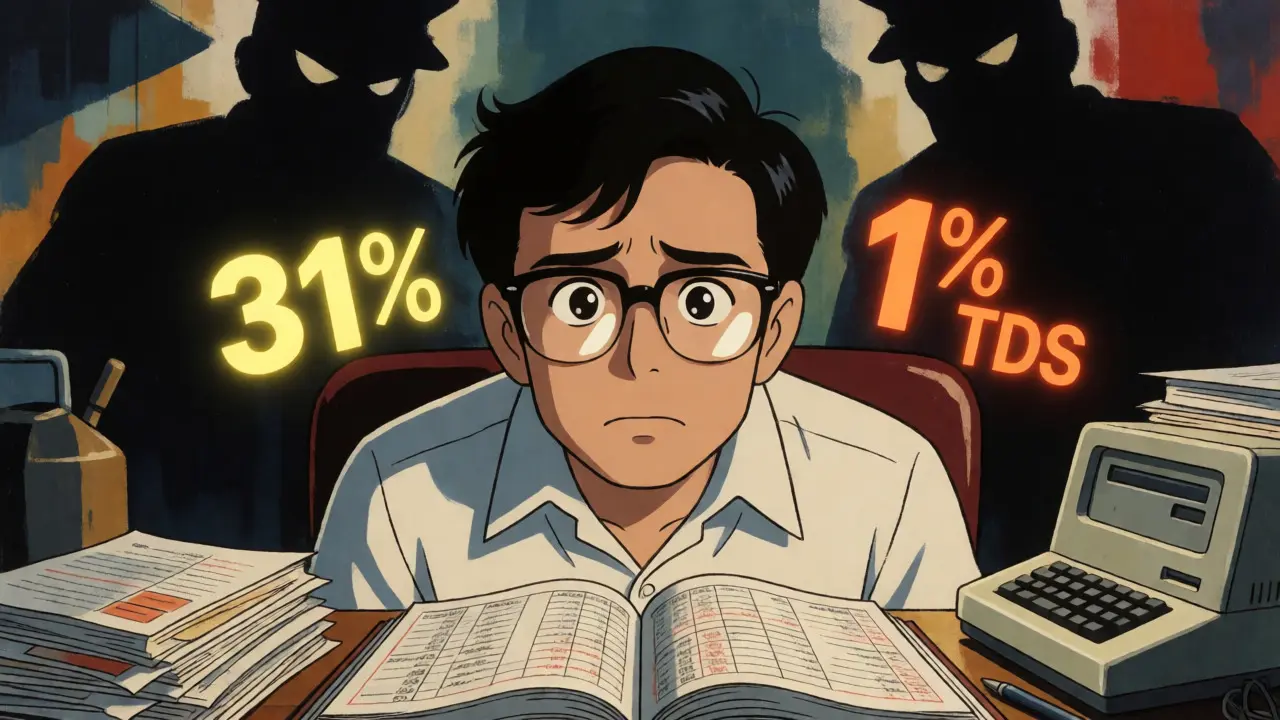
Even if you find a way to trade on a non-banned platform, you cannot escape the taxman. India introduced a harsh tax regime for crypto in April 2022. The rate is a flat 31% on profits, plus applicable cess and surcharge. There are no deductions allowed except for the cost of acquisition.
Worse yet, you cannot offset losses against profits. If you make ₹100 profit on Bitcoin but lose ₹50 on Ethereum, you still pay tax on the full ₹100 gain. This rule applies regardless of whether you trade on a domestic or international exchange. However, compliant exchanges help by generating accurate reports that align with Income Tax Department requirements. Non-compliant ones leave you guessing.
Additionally, a 1% Tax Deducted at Source (TDS) applies to every sale transaction above a certain threshold. This TDS is deducted by the buyer or the exchange. On compliant platforms, this is handled automatically. On others, you might miss it, leading to discrepancies in your Form 26AS and potential notice from the tax department. Penalties for undisclosed transactions can reach up to 60% under Section 158BA(7) of the Income Tax Act.
Is Cryptocurrency Actually Banned in India?
No. This is the most persistent myth. The Supreme Court of India struck down the Reserve Bank of India's 2018 circular that prohibited banks from dealing with crypto entities. That judgment confirmed that holding and trading crypto is legal. The current restrictions are about regulation, not prohibition.
The government wants to bring crypto into the formal economy. They want taxes collected, money laundering prevented, and investors protected. By forcing exchanges to register with the FIU, they create a traceable trail. This approach mirrors what other countries are doing. It’s messy and painful in the short term, but it provides clarity for the long term.
So, if someone tells you crypto is banned in India, correct them. What is banned is unregulated trading venues. The asset class itself remains alive and well, provided you use the right tools.
How to Choose a Safe Exchange Today
If you are setting up a new account or migrating existing funds, follow this checklist to ensure you stay compliant:
- Check FIU Registration: Visit the official FIU-IND website or search for the exchange's name in their list of registered reporting entities. If it's not there, avoid it.
- Verify Banking Partnerships: Ensure the exchange supports seamless INR deposits and withdrawals through reputable Indian banks. Look for mentions of specific banking partners on their site.
- Review Security History: Has the exchange been hacked recently? Did they compensate users fully? Check community forums and news archives.
- Assess Liquidity: Higher volume usually means better prices. Compare order books across a few compliant platforms to see where you get the best fills.
- Look for Tax Support: Does the platform offer exportable transaction history compatible with Indian tax software? This saves hours during filing season.
Don't chase lower fees at the expense of compliance. A 0.1% fee saving isn't worth the risk of having your funds locked for months due to regulatory issues.
Is Binance permanently banned in India?
No, it is not permanently banned. Binance faced temporary restrictions and domain blocks due to non-compliance with FIU-IND registration requirements. They have been working towards full compliance. Users should monitor official announcements for when services resume fully without restrictions.
Can I withdraw my crypto from a banned exchange?
Generally, yes. Most exchanges allow withdrawals even if deposits are paused. However, processing times may be longer, and some platforms might impose additional verification steps. It is advisable to withdraw assets to a personal wallet rather than transferring to another potentially unstable exchange.
Do I need to pay tax on crypto held on a banned exchange?
Yes. Tax liability is based on your ownership and realized gains, not the location of the exchange. Even if the exchange is blocked, you must report your holdings and any profits made during the year in your Indian income tax return.
Are decentralized exchanges (DEXs) banned in India?
DEXs like Uniswap are not explicitly banned, but they operate in a regulatory grey area. Since they don't hold user funds in custody, they aren't traditional exchanges subject to FIU registration in the same way. However, users trading on DEXs still owe taxes and must maintain their own records.
What happens if I ignore the ban and use a blocked exchange?
You risk having your bank transfers rejected or frozen. Additionally, you lose the safety net of local consumer protection laws. If the exchange goes offline or faces further legal action, recovering your funds becomes significantly harder and slower.
