
DCA Risk Calculator
Safe Investment Amount
Based on 2-5% of your portfolio, you should invest:
$0.00
Fee Impact Over 5 Years
At $50/week with 1.5% fees:
Total fees: $0.00 (0.0% of investment)
Diversification Recommendations
Based on your risk profile, consider this allocation:
- Bitcoin: 50%
- Ethereum: 30%
- Altcoins: 20% (3-5 coins)
Tip: Don't include coins without real utility or audited code
Most people start dollar cost averaging (DCA) in crypto thinking it’s a set-it-and-forget-it strategy. Buy $50 of Bitcoin every week. Ignore the noise. Let time do the work. Sounds simple, right? But here’s the truth: DCA mistakes are why so many people end up losing money-even when they’re doing everything "right."
You’re Only Buying One Crypto
The biggest mistake? Putting all your DCA money into Bitcoin or Ethereum alone. You think you’re being smart by sticking to the big names. But crypto isn’t like stocks. One coin can drop 70% in six months and never recover. That’s not speculation-it’s history. In 2021, dozens of altcoins surged 10x. By 2023, 80% of them were down 90%. If you only bought one, you didn’t diversify-you concentrated your risk.DCA isn’t about buying the same thing over and over. It’s about spreading risk across multiple assets with different use cases. Try this: Allocate 50% of your DCA to Bitcoin, 30% to Ethereum, and the remaining 20% across 3-5 other coins like Solana, Polkadot, or Chainlink. Each should have real utility, not just hype. You’re not trying to pick the next Bitcoin. You’re trying to avoid being wiped out if one fails.
You’re Investing More Than You Can Afford to Lose
A UCLA study found that investors who put more than 7.5% of their total portfolio into crypto were far more likely to panic-sell during downturns. Why? Because losing that money would hurt. Real life. Rent. Groceries. Emergency fund.Let’s say you earn $5,000 a month. You’re putting $500 into crypto every week. That’s 40% of your income. If the market crashes 50%, you’ve lost $10,000. Now you’re stressed. You sell. You lock in the loss. And you’re back to square one.
Stick to the rule: If losing your entire crypto investment would make you miss a bill, you’re investing too much. For most people, that’s 2-5% of total savings. Not 20%. Not 50%. Two to five percent. That’s enough to benefit from growth without risking your stability.
You’re Ignoring Trading Fees
You buy $50 of Bitcoin every week. Sounds harmless. But if your exchange charges $1.50 per trade, that’s $78 a year in fees. Over five years? $390. That’s almost 10% of your total investment gone-just in fees.Some platforms charge even more for small purchases. Others hide fees in the spread-the difference between buy and sell price. You think you’re getting $50 worth of Bitcoin. You’re actually getting $48.50. And you don’t see it until you check your transaction history.
Solution? Use a platform with low or zero fees on recurring buys. Binance, Kraken, and Coinbase Pro all offer automated DCA with fees under $1 per trade. Set it up once. Forget it. Let your money work, not your fees.

You’re Chasing the Pump
Bitcoin hits $70,000. Your friend posts a meme: "I made 5x in 3 months!" Suddenly, you feel like you’re falling behind. So you increase your weekly buy from $50 to $200. You’re buying high. You’re not DCAing anymore-you’re gambling.DCA only works if you stick to the plan. Period. Whether the price is $20,000 or $70,000, you buy the same amount. If you increase your buy during a rally, you’re doing the exact opposite of what DCA is meant to do: average down during dips, not up during spikes.
Emotional decisions kill DCA. FOMO, greed, fear-they all make you break the rhythm. The strategy’s power comes from consistency, not timing. If you feel the urge to buy more during a pump, walk away. Wait. Let your automated buy happen. That’s the discipline that separates winners from losers.
You’re Not Adjusting for Market Conditions
Some people treat DCA like a robot. Buy $50 every Monday. No matter what. Even when the whole market is collapsing. Even when 90% of altcoins are dead. Even when Bitcoin has dropped 60% in six months and shows no sign of recovery.That’s not discipline. That’s stupidity.
DCA isn’t about blind repetition. It’s about systematic investing with room for smart adjustments. If the market is in a deep bear phase-say, 12+ months of sustained decline-consider pausing your altcoin buys. Keep investing in Bitcoin and Ethereum. They’re the only ones with real liquidity and adoption. Or, reduce your weekly amount by 30-50%. You’re not quitting. You’re conserving capital.
Conversely, if the market starts recovering after a long slump, you might increase your buys slightly. That’s not market timing. That’s risk management. DCA isn’t rigid. It’s flexible. It’s a framework, not a prison.
You Don’t Have an Exit Plan
Most people have no idea when to sell. They just keep buying. Forever. Even when their portfolio is up 300%. Even when they’ve already doubled their money. They think: "I’ll sell when I’m rich." But "rich" never comes. Then the market crashes. And they lose everything.You need rules. Simple ones.
- If your crypto portfolio hits 15% of your total net worth, stop adding. Rebalance. Take some profits.
- If a coin you bought drops 70% and shows no sign of recovery after 18 months, cut your losses and move on.
- If you’ve held a coin for 5+ years and it’s up 10x, consider selling 25-50% to lock in gains.
DCA is for buying. Not holding forever. You need to think about selling as much as you think about buying. Otherwise, you’re just a walking target for volatility.
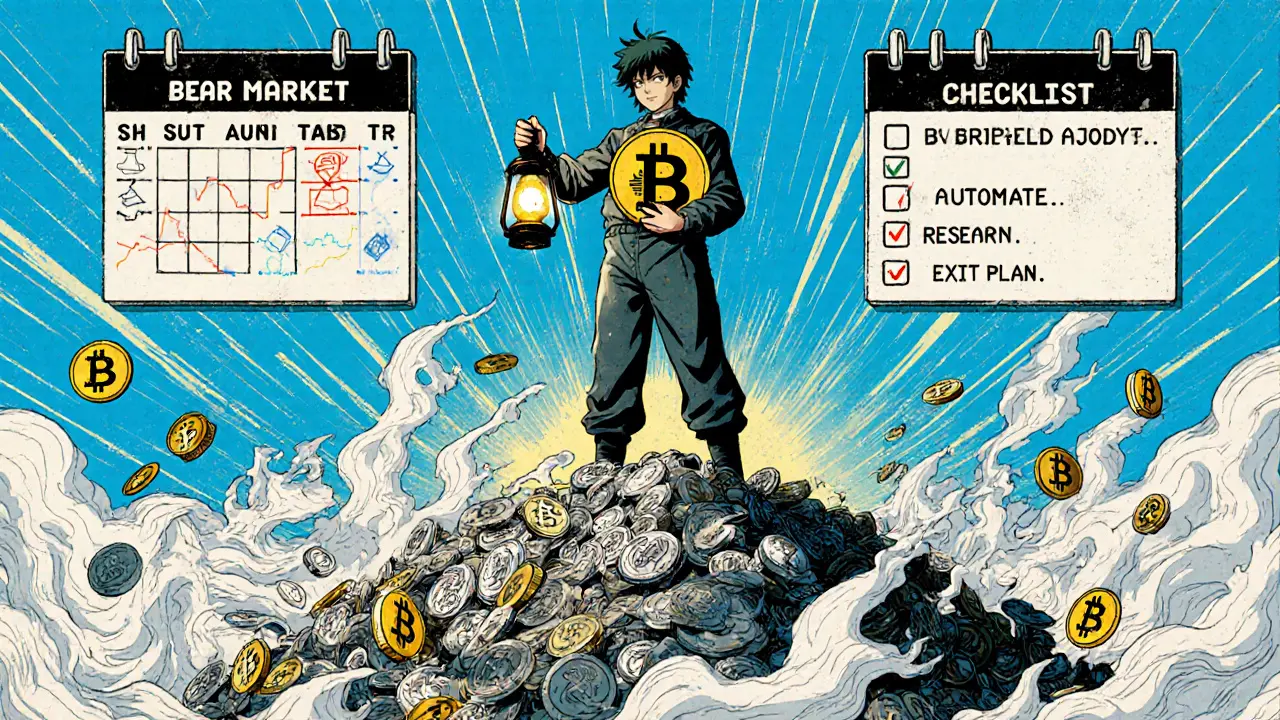
You’re Manually Buying Instead of Automating
You say you’ll buy every Monday. But you forget. Or you’re busy. Or you’re on vacation. So you skip a week. Then two. Then you start doubting the whole strategy.Manual DCA fails. Every time.
Use automation. Set up recurring buys on your exchange. Pick a day. Pick an amount. Set it and forget it. No decisions. No emotions. No excuses. Most platforms let you schedule weekly, biweekly, or monthly buys. That’s all you need.
Pro tip: Schedule your buy for the same day every week. Monday at 9 a.m. New Zealand time. It doesn’t matter if the price is up or down. You’re not trying to time the market. You’re trying to remove timing from the equation.
You’re Not Researching the Coins You Buy
You buy Shiba Inu because Elon tweeted it. You buy a new DeFi token because a YouTube influencer says it’s "the next Ethereum." You don’t check the team. You don’t check the whitepaper. You don’t check if the project even has users.DCA doesn’t make bad investments good. It just spreads the risk. If you keep buying coins with no real value, you’re just losing money slower.
Ask yourself: Does this coin solve a real problem? Is there actual usage? Is the team public and experienced? Is the code open-source? Has it been audited?
If you can’t answer those questions, don’t buy it. Not even $5. DCA isn’t a magic wand. It won’t turn garbage into gold.
You’re Waiting for the "Perfect" Time to Start
"I’ll start DCA when Bitcoin drops below $50,000." "I’ll wait until after the halving." "I need to learn more first."That’s analysis paralysis. And it’s costing you money.
BitPay’s data shows that investors who started DCA in 2020-right before the big rally-ended up with better results than those who waited for "the perfect entry." Why? Because markets don’t wait. Neither should you.
Start now. Even if it’s $20 a week. Even if you’re scared. Even if Bitcoin is at an all-time high. The goal isn’t to catch the bottom. It’s to build a habit. To stay in the game. To let compounding work over years, not days.
The best time to start DCA was yesterday. The second best time? Today.


