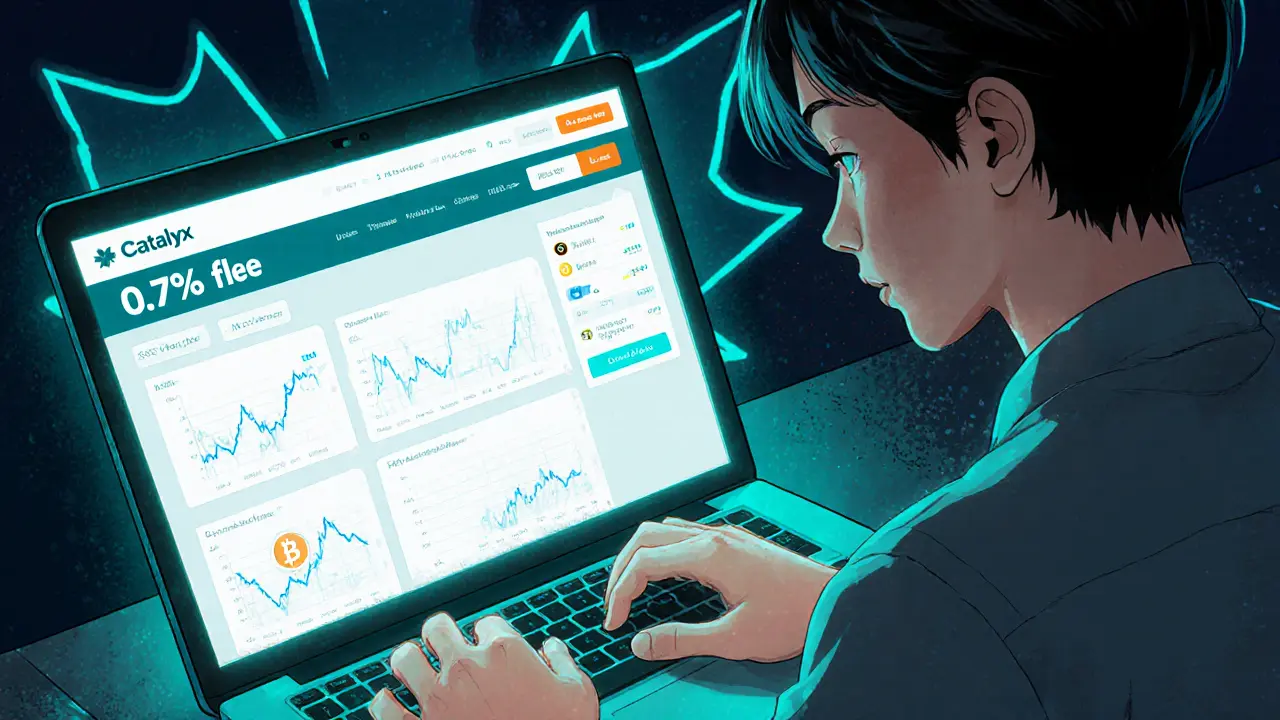
Canadian Crypto Exchange Fee Calculator
Calculate Your Trading Fees
Compare fees across Canadian exchanges based on your trading volume. Note: Catalyx is now closed but included for historical comparison.
Fee Comparison Results
Note: Fees are calculated based on typical fee structures from the article. Actual fees may vary. Catalyx is no longer operational and is included for historical reference only.
Catalyx was a Canadian cryptocurrency exchange that marketed itself as the country’s premier digital‑asset platform before it collapsed in early 2024. Registered with FINTRAC, the platform let users trade fiat for crypto and swap between crypto pairs 24/7. This review walks through how the service worked, what made it attractive, and why it finally fell apart.
What the platform promised
At launch, Catalyx advertised a flat 0.75% trading fee with no hidden spread. The fee applied to both fiat‑to‑crypto and crypto‑to‑crypto trades, so users always knew the exact cost. Around 40 coins were supported, including Bitcoin (BTC), Ethereum (ETH), USDT, ADA, USDC, HBAR, and LTC. The UI showed real‑time price charts, order‑book depth, and a one‑click swap button that many beginners found handy after the initial learning curve.
Technology under the hood
Unlike many exchanges that rely on off‑the‑shelf solutions, Catalyx built its stack from the ground up. The back‑end ran on Elixir with the Phoenix framework, while real‑time communications used SignalR. Data‑intensive tasks-trading history, candlestick charts-were stored in TimescaleDB and PostgreSQL. The platform chose GraphQL as the API layer, which gave developers fast, flexible queries and helped keep latency low.
Growth spurt and user numbers
Early 2021 was a boom period. Catalyx reported a staggering 1,542% quarter‑over‑quarter jump in trading volume for Q12021. In March 2021, daily volume rose from C$14.88million to C$28.44million-a 91% month‑over‑month increase. Deposits surged 163% month‑over‑month, reaching over C$9million, and revenue climbed 76% to C$275,540. The numbers suggested strong market traction, especially for a home‑grown Canadian exchange.
User experience and referral program
First‑time users often described the dashboard as a bit dense, but once they clicked through the tutorials the one‑click swap became intuitive. Catalyx also ran a referral scheme that paid up to 20% of a referee’s fees back to the referrer-no lifetime cap. That incentive helped fuel the rapid user growth, as new traders invited friends to earn extra crypto.

Regulatory backdrop
Operating in Canada meant strict oversight from the Financial Transactions and Reports Analysis Centre of Canada (FINTRAC). Exchanges must file a written undertaking with regulators while their registration applications are reviewed. Catalyx complied initially, but internal controls later turned out to be insufficient, especially around employee access to client wallets.
Legal turmoil and the collapse
The first red flag surfaced in 2019 when CFO Jae Ho Lee allegedly siphoned over C$14million worth of client assets. The Alberta Securities Commission (ASC) issued a Notice of Hearing on July172025, accusing Lee of fraud and the company of breaching its regulatory undertaking. CEO Hyuk Jae Park claimed he learned of the misconduct on November242023 but didn’t report it until a month later, violating the ASC’s expectations.
By December2023, Lee stopped responding to internal requests for wallet access. Park’s lawyers wrote to Lee’s counsel demanding the wallets, but got no reply. Operations halted on December282023, and the exchange entered receivership in January2024. In a sworn affidavit, Park cited a lack of liquidity support from major shareholder Bittrex Global as a factor that made continued operation impossible.
Safety concerns and account freezes
Like any centralized exchange, Catalyx could freeze accounts if it flagged suspicious activity, unusually large deposits, or if authorities requested a freeze. The platform warned users that frozen accounts might never be reopened. Before the legal saga, there was no public evidence of arbitrary freezes, but the later investigations showed that internal risk controls were weak.

How Catalyx stacks up against other Canadian exchanges
| Exchange | Trading fee | Supported assets | Regulatory status (2025) | Current operation |
|---|---|---|---|---|
| Catalyx | 0.75% flat | ~40 (BTC, ETH, USDT, ADA…) | FINTRAC‑registered (now bankrupt) | Closed - receivership |
| Coinbase Canada | 0.5%‑1% tiered | ~100+ | FINTRAC‑registered, active | Operating |
| Kraken Canada | 0.16%‑0.26% tiered | ~150+ | FINTRAC‑registered, active | Operating |
Seeing the fee and asset differences helps you decide whether a platform’s cost structure fits your trading style. Catalyx’s flat fee was simple, but the limited asset list and regulatory fallout hurt its long‑term appeal.
Key takeaways for traders
- Flat fees are easy to understand, but always check whether a platform can sustain operations.
- Strong internal controls are a must. Look for clear separation between employee access and client wallets.
- Regulatory compliance isn’t just paperwork; it signals that an exchange takes user protection seriously.
- Referral programs can boost growth, but they shouldn’t mask underlying risk.
For anyone still hunting a reliable Canadian exchange, the safest bet is to stick with platforms that have survived regulatory scrutiny and maintain transparent custody practices.
Frequently Asked Questions
Is Catalyx still usable in 2025?
No. Catalyx entered receivership in January2024 and its website has been shut down. Users should withdraw any remaining funds from the platform immediately.
What happened to user funds after the bankruptcy?
A court‑appointed receiver is tasked with liquidating assets and attempting to reimburse creditors. In practice, many users have reported only partial recovery, depending on the remaining crypto held in the exchange’s wallets.
How does Catalyx’s fee compare to other Canadian exchanges?
Catalyx charged a flat 0.75% per trade, while Coinbase Canada uses a tiered 0.5%‑1% model and Kraken Canada offers 0.16%‑0.26% based on volume. Flat fees are simple, but tiered fees can be cheaper for high‑volume traders.
What regulatory body oversaw Catalyx?
The exchange was registered with FINTRAC, Canada’s anti‑money‑laundering watchdog. The collapse triggered an investigation by the Alberta Securities Commission.
Should I trust other Canadian exchanges after this scandal?
Look for platforms that have clear custody solutions, regular audits, and a solid compliance track record. Exchanges like Coinbase Canada and Kraken Canada still hold active FINTRAC registration and have survived multiple regulatory reviews.
In short, the Catalyx review shows a mix of innovative tech, aggressive growth, and a painful failure in governance. Use these lessons when picking any exchange-security and compliance matter more than a sleek UI.


