
You have probably heard that blockchain will revolutionize the supply chain. It sounds impressive until you look at your daily operations. You are still dealing with paper bills of lading, delayed customs clearance, and suppliers who refuse to share real-time data. The promise of a "decentralized ledger" feels distant when your biggest headache is a missing signature on a shipping document.
The reality is different from the hype. Blockchain is not a magic wand that fixes broken processes. However, it is a powerful tool for specific problems. If you are moving high-value goods, fighting counterfeits, or drowning in paperwork, blockchain offers concrete benefits. If you are shipping low-cost commodities with simple routes, it might be overkill. This guide cuts through the noise to show you where blockchain actually adds value in logistics today.
How Blockchain Solves Supply Chain Opacity
The core problem in logistics is trust. When a shipment moves from a factory in Vietnam to a warehouse in Germany, it passes through dozens of hands. Each party keeps their own records. When discrepancies arise-and they always do-someone has to spend hours reconciling spreadsheets. Blockchain technology is a decentralized digital ledger that records transactions across multiple computers so that any involved record cannot be altered retroactively without the alteration of all subsequent blocks and the consensus of the network.
In a traditional setup, if a supplier claims they shipped Item A, but the carrier received Item B, you have a dispute. With blockchain, every scan, handoff, and status update is written to a shared, immutable ledger. Once recorded, the data cannot be changed without everyone knowing. This creates a single source of truth. According to Deloitte's 2023 analysis, 68% of supply chain professionals cite lack of transparency as their top operational concern. Blockchain directly addresses this by making the entire journey visible to authorized participants.
Consider a pharmaceutical shipment. Temperature sensitivity is critical. By integrating IoT sensors are connected devices that collect and transmit data such as temperature, humidity, and location in real-time, you can log temperature readings directly onto the blockchain. If the container exceeds safe limits for even an hour, the record is permanent. No one can argue later that the sensor was faulty or the data was lost. This level of verifiable provenance is impossible with standard email updates or PDF reports.
Cutting Through Paperwork and Reducing Errors
Paperwork kills efficiency. A traditional bill of lading requires five to ten days to process, with fourteen or more copies circulating among shippers, carriers, banks, and customs agents. Manual data entry leads to errors. Gartner reported in 2023 that Electronic Data Interchange (EDI) systems suffer from 15-20% error rates due to manual inputs. These errors cause delays, fines, and lost revenue.
Blockchain automates verification. When data is entered once, it propagates to all parties instantly. Platforms like Wave have demonstrated this potential, reducing electronic bill of lading processing time from days to just four hours. More importantly, blockchain reduces documentation errors by approximately 98% through automated validation rules. This isn't just about speed; it's about accuracy. When a smart contract verifies that the cargo matches the invoice, the payment can trigger automatically. No waiting for invoices to arrive, no chasing approvals. This automation is particularly valuable for cross-border trade, where regulatory compliance is strict and costly.
Fighting Counterfeits and Ensuring Provenance
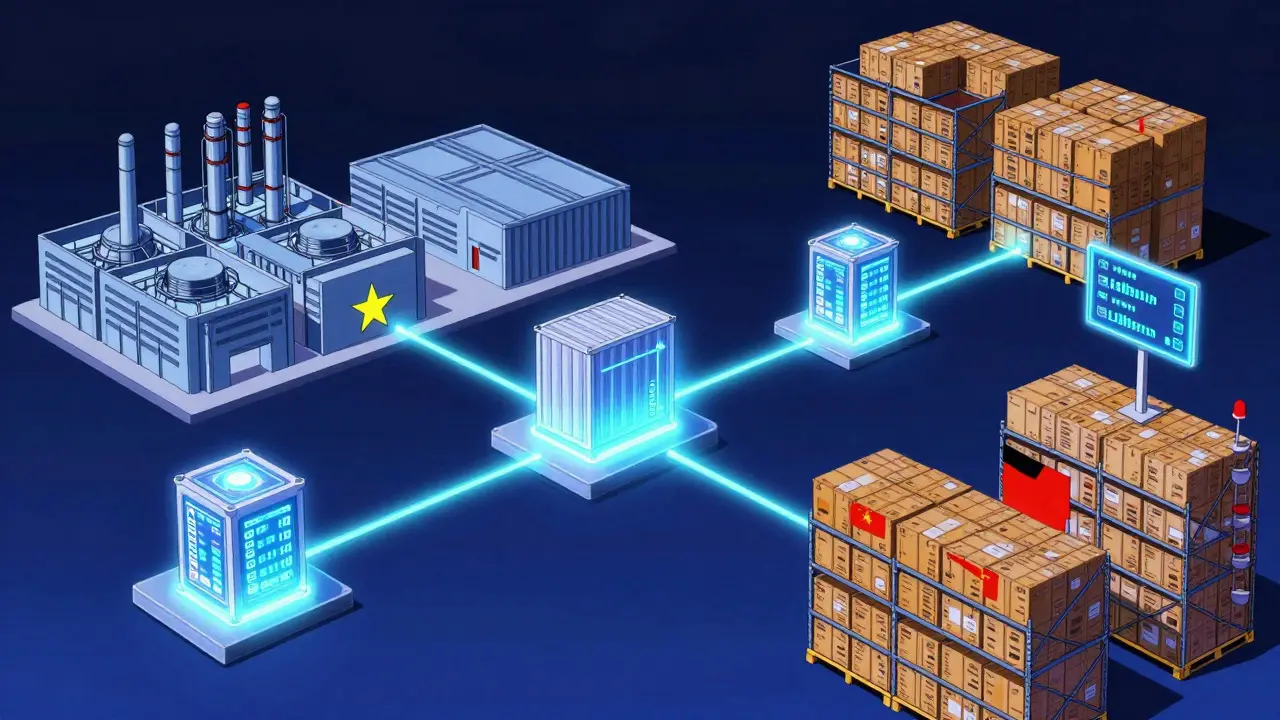
If you sell luxury goods, electronics, or pharmaceuticals, counterfeiting is a existential threat. The OECD estimates counterfeit goods cost the global economy $509 billion annually. In developing countries, WHO data suggests one in ten medicines is fake. Blockchain provides a digital passport for physical products.
Every step of the product's life cycle-from raw material sourcing to final retail-is recorded. Consumers can scan a QR code to see the entire history. For brands, this protects reputation. For regulators, it ensures safety. Walmart’s food traceability initiative showed the power of this approach, achieving product tracing in 2.2 seconds compared to seven days traditionally. While scaling such initiatives faces challenges, the benefit for high-risk industries is clear. You prove authenticity beyond doubt. This builds consumer trust and meets increasingly strict regulations like the EU’s Digital Product Passport.
| Feature | Traditional EDI/Paper | Blockchain Solution |
|---|---|---|
| Data Accuracy | 80-85% (high manual error) | 98%+ (automated verification) |
| Bill of Lading Time | 5-10 days | Hours (e.g., 4 hours) |
| Transparency | Siloed, fragmented views | Shared, real-time ledger |
| Counterfeit Risk | High (easy to forge docs) | Low (immutable records) |
| Dispute Resolution | Slow, evidence-heavy | Fast (single source of truth) |
Smart Contracts: Automating Payments and Compliance
Smart contracts are self-executing contracts with the terms of the agreement between buyer and seller being directly written into lines of code. They run on blockchain platforms like Ethereum or Hyperledger Fabric. In logistics, they automate actions based on predefined conditions.
Imagine a scenario where a shipment arrives at a port. The GPS confirms the location. The IoT sensor confirms the temperature stayed within range. The customs clearance status is updated on the ledger. Instead of waiting for a human to check these boxes and approve payment, the smart contract executes automatically. Funds are released to the carrier. Insurance claims are processed if damage is detected. This reduces reconciliation costs by up to 37%, according to MIT research. It also speeds up dispute resolution by 28%. For businesses, faster cash flow means better liquidity. Fewer disputes mean lower legal costs.
Implementation Challenges and Realistic Expectations
Don’t let the benefits blind you to the hurdles. Blockchain is not easy to implement. The average deployment timeline is 14.7 months. The biggest bottleneck is not technology; it is people. Forming a consortium of partners takes 42% of the total project time. You need your suppliers, carriers, and customers to agree on standards and join the network. If only you use blockchain, its value drops significantly.
Technical skills are scarce. You need developers certified in Hyperledger or Solidity. Consultant rates average $185 per hour. Integration with existing Warehouse Management Systems (WMS) and Transportation Management Systems (TMS) requires robust APIs. Data standardization is another major hurdle. 87% of failed implementations cited incompatible data formats across partners. You must clean your data before putting it on the blockchain. As Dr. Robert Johnson of Stanford warns, "garbage in, garbage out" still applies. If your origin data is wrong, the blockchain just preserves that error immutably.
Costs vary widely. Basic consortium setups start at $50,000. Enterprise-scale deployments with custom smart contracts can exceed $500,000. Only 17% of implementations achieve full ROI within 24 months. Success depends on focusing on specific pain points, not trying to transform your entire enterprise overnight. Start small. Identify one high-friction process, like customs documentation or cold-chain monitoring, and pilot there.
Future Outlook: Integration Over Isolation
The landscape is shifting. By 2026, blockchain is less likely to be a standalone product and more likely to be an embedded layer in broader digital supply networks. DHL predicts that 70% of new logistics platforms will incorporate blockchain elements. The focus is moving toward interoperability. Cross-chain protocols aim to reduce integration costs by 60% by allowing different blockchain networks to communicate.
Artificial Intelligence is merging with blockchain. AI analyzes the vast amounts of verified data on the ledger to predict delays, optimize routes, and manage inventory. DHL’s 2023 pilot reduced inventory errors by 33% using blockchain-verified data for machine learning models. Quantum-resistant cryptography is also becoming a priority, with NIST-standardized algorithms expected late 2025 to protect future data integrity.
Gartner notes that "blockchain will fade as a marketing term by 2027." This is good news. It means the technology is maturing. It will survive only where it solves real business problems. For logistics leaders, the question is no longer "Should we use blockchain?" but "Where does blockchain add measurable value to our specific supply chain?" Focus on transparency, automation, and trust. Ignore the hype. Build solutions that make your operations smoother, faster, and more secure.
Is blockchain suitable for small logistics companies?
For most small companies, joining an existing consortium is better than building your own. The initial investment ($50k-$500k+) and technical complexity are high. Look for industry-specific platforms that allow smaller players to participate. Focus on areas where you face significant friction, such as cross-border documentation or high-value asset tracking. If your shipments are low-value and domestic, the ROI may not justify the cost yet.
How does blockchain differ from a traditional database?
A traditional database is centralized and controlled by one entity. It can be altered or hacked at a single point of failure. Blockchain is decentralized, distributed across many nodes, and immutable. Once data is added, it cannot be changed without consensus from the network. This makes it ideal for environments with multiple untrusted parties who need a shared, tamper-proof record.
What are the biggest risks of implementing blockchain in logistics?
The primary risks are stakeholder alignment and data quality. If your partners don't join the network, the value proposition collapses. Additionally, if input data is inaccurate (garbage in), the blockchain permanently records those errors (garbage out). Other risks include high implementation costs, long deployment times (averaging 14.7 months), and the scarcity of skilled blockchain developers.
Can blockchain replace ERP systems?
No, blockchain complements rather than replaces ERP systems. ERPs manage internal business processes like finance, HR, and inventory. Blockchain manages trust and transparency across external partner networks. Most successful implementations integrate blockchain with existing ERP/WMS/TMS platforms via APIs, using blockchain for cross-organizational data sharing and verification.
Which industries benefit most from blockchain in logistics?
Industries with high regulatory requirements, high counterfeit risks, and complex multi-party collaborations benefit most. This includes pharmaceuticals (drug traceability), luxury goods (authenticity verification), food and beverage (safety and origin tracking), and high-value electronics. Low-volume, high-commodity sectors with simple routing see less immediate value.