
Bitfinex isn’t for beginners. If you’re just starting out with crypto, this isn’t the place to begin.
But if you’ve traded Bitcoin, Ethereum, or altcoins for years-if you know what leverage means, understand order books better than your morning coffee routine, and you’ve lost money on slippage before-then Bitfinex might be the most powerful tool in your arsenal. Founded in 2012, it’s one of the oldest crypto exchanges still running. That alone says something. Most platforms from that era are gone. Bitfinex survived hacks, regulatory crackdowns, and market crashes. It didn’t just survive. It adapted.
Today, it handles around $223 million in trading volume every 24 hours. That’s not Coinbase-level traffic, but it’s more than enough to keep the order books deep and the spreads tight. For large traders, that matters. Slippage doesn’t just eat into profits-it kills them. Bitfinex keeps slippage low because liquidity is thick across major pairs like BTC/USD, ETH/USD, and even niche altcoin pairs nobody else supports.
What you can trade on Bitfinex
Bitfinex lists over 170 cryptocurrencies. That’s not the highest number out there-some exchanges list 300+-but the quality of trading pairs is where it shines. You won’t just find BTC and ETH. You’ll find obscure tokens with low market caps that move fast. Day traders love this. If you’re chasing volatility, Bitfinex gives you more options than most.
Fiat deposits? Yes, but only for five currencies: USD, EUR, GBP, JPY, and CNH. No AUD, no CAD, no NZD. If you’re in New Zealand, like me, you’ll need to use a third-party service to convert your dollars to USD first. That adds a step. And a fee. But once you’re in, the trading engine runs smooth.
Derivatives trading is a big deal here. You can trade perpetual swaps, futures, and options with up to 5x leverage. You need USDT as collateral to open these positions. That’s not unique, but the execution is fast. The platform’s infrastructure was built for professionals. Orders fill in milliseconds. Charts load instantly. No lag. No buffering. That’s rare on crypto exchanges.
Trading tools that actually matter
Bitfinex gives you 12 different timeframes on its charting tool. You can overlay Bollinger Bands, RSI, MACD, and Fibonacci retracements. You can set conditional orders, trailing stops, and OCO (one-cancels-the-other) orders. You can even run automated trading bots through their API. This isn’t a toy. This is a professional terminal.
There’s also a demo account. It never expires. You get $100,000 in fake USDT and can test strategies without risking real money. Most exchanges don’t even offer this. It’s a quiet feature, but if you’re serious about refining your edge, it’s invaluable.
And then there’s margin funding. You can lend your crypto to other traders and earn interest. It’s not high yield-usually between 1% and 5% annually-but it’s passive income with zero risk to your principal. You don’t need to stake. You don’t need to lock anything up. You just leave your coins in your wallet and let others borrow them. It’s a simple way to make your holdings work harder.

Fees are competitive-if you trade a lot
Bitfinex uses a maker-taker model. Makers (those who add liquidity by placing limit orders) pay 0.1% or less. Takers (those who remove liquidity with market orders) pay 0.2%. That’s standard. But here’s the kicker: if you trade over $500,000 in a month, you get a 6% discount on all fees. That’s not a gimmick. That’s a real incentive for high-volume traders.
Withdrawal fees are low too. Bitcoin withdrawals cost 0.0005 BTC. Ethereum is 0.005 ETH. That’s better than most. The only catch? You need to complete full KYC to withdraw fiat. No exceptions. That means uploading ID, proof of address, and sometimes a selfie. It takes a few days. But once approved, withdrawals go through without drama.
Security: Solid, but not perfect
Bitfinex was hacked in 2016. Over 120,000 BTC vanished. It was one of the biggest crypto heists ever. The exchange paid back users over time using its own funds. That’s rare. Most platforms just went silent. Bitfinex didn’t. They rebuilt.
Today, their security score from CertiK is 86.33%. That’s high. Their server infrastructure passed every penetration test. Two-factor authentication is mandatory. Cold storage holds most assets. But here’s the gap: no insurance fund. Unlike Coinbase or Kraken, Bitfinex doesn’t insure customer deposits. If something goes wrong, you’re on your own. That’s a risk you have to accept.
There’s also no FDIC-style protection. If the exchange goes down, your money is gone. That’s the nature of crypto. But for a platform that’s been around this long, the lack of insurance still feels outdated.
Customer support is the weak link
This is where Bitfinex fails most users.
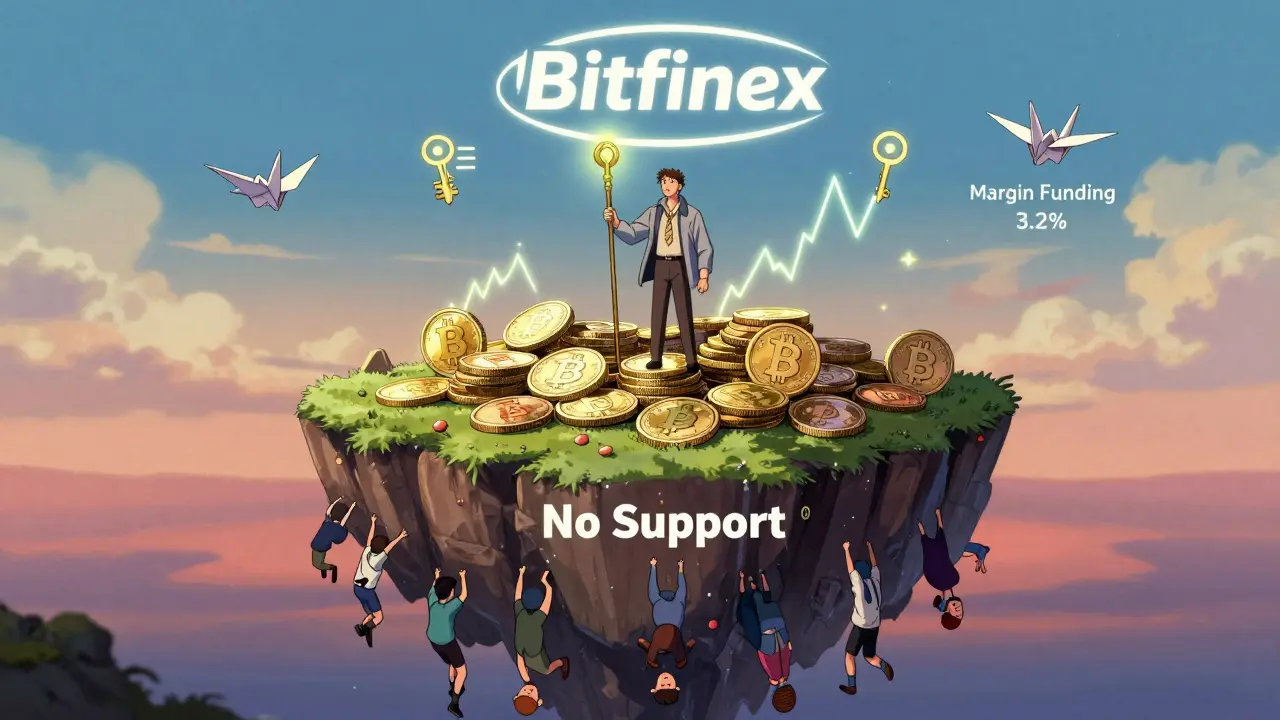
No live chat. No phone number. No Twitter DMs that get replies. Just email. And responses take 12 to 48 hours. If you’re locked out of your account, or your withdrawal is stuck, or you need help with a margin call-you’re waiting. And waiting. And waiting.
There are dozens of Reddit and Trustpilot threads where users say their accounts were frozen without warning. Some were told they needed to deposit more funds to “unfreeze” their accounts. Others reported being asked for additional KYC documents after months of trading. Some got their money back after contacting legal aid. Others didn’t.
It’s not that Bitfinex is a scam. It’s that their support system is broken. They prioritize trading infrastructure over user service. And for experienced traders, that’s acceptable. For everyone else? It’s a nightmare.
Who should use Bitfinex?
If you’re a retail trader who buys Bitcoin once a year and holds it for five years? Skip it. Use Coinbase or Kraken. Their apps are cleaner. Their support is faster. Their learning curve is flat.
If you’re trading 5-10 times a week? You’re in the right place. Bitfinex gives you the tools, the liquidity, and the depth to execute complex strategies. You’ll appreciate the advanced charts, the low fees at high volumes, and the ability to short altcoins with leverage.
If you’re managing a small fund or running automated bots? Bitfinex’s API is one of the most stable in the industry. It’s been battle-tested for over a decade. Developers trust it.
And if you’re outside the U.S., Canada, or Europe? You’re likely one of their core users. The U.S. market is blocked. That’s a big loss, but it also means less regulatory clutter. Bitfinex operates in a gray zone-and it works for those who can tolerate it.
Alternatives to consider
- Kraken: Better support, U.S.-friendly, slightly fewer trading pairs, but still strong on liquidity and security.
- Bybit: Best for derivatives. More leverage options (up to 125x), better UI, faster support.
- OKX: Huge volume, 350+ coins, good mobile app, but regulatory risks in some regions.
- eToro: If you want simplicity and copy-trading, this is your pick. But no real crypto ownership-just CFDs.
None of these match Bitfinex’s depth of features. But they’re easier to use. And that matters if you’re not trading full-time.
Final verdict
Bitfinex is a specialist’s exchange. It’s not designed to be loved. It’s designed to be used. If you’re an experienced trader who needs deep liquidity, advanced order types, and a platform that doesn’t dumb things down-you’ll find everything you need here.
But if you value fast support, a clean interface, or peace of mind? Look elsewhere. Bitfinex won’t hold your hand. It won’t explain things. It won’t apologize for delays. It just executes trades. And for some of us, that’s exactly what we want.
Is Bitfinex safe to use in 2026?
Bitfinex has strong technical security-server hardening, two-factor authentication, and cold storage are all in place. Its CertiK score is high, and it hasn’t had a major breach since 2016. But it doesn’t insure user funds. If the exchange is compromised or shuts down, your crypto isn’t protected. Use it only if you understand and accept that risk.
Can I trade fiat on Bitfinex?
Yes, but only with USD, EUR, GBP, JPY, or CNH. You need to complete full KYC verification first. There’s no direct deposit from NZD, AUD, or CAD. You’ll need to convert your local currency to USD via a third-party service like Wise or Revolut before depositing.
Does Bitfinex have a mobile app?
Yes, Bitfinex has iOS and Android apps. But they’re stripped down. You can check prices, place basic orders, and view your portfolio. Advanced features like margin funding, derivatives trading, and custom charting are only available on the desktop version. Don’t expect the same experience on mobile.
Why is Bitfinex banned in the U.S.?
Bitfinex was blocked in the U.S. after regulatory pressure from the CFTC and SEC. The platform offered derivatives and margin trading without proper licensing. While it’s still accessible to some U.S. users via VPNs, doing so violates their terms of service and could lead to account freezes. It’s not worth the risk.
What’s the minimum deposit on Bitfinex?
There’s no minimum deposit for crypto. You can send any amount. For fiat deposits, the minimum is $100 USD. But if you’re using a third-party converter, your bank or payment processor might have higher minimums.
Does Bitfinex offer staking?
No, Bitfinex doesn’t offer staking. It focuses on trading, not passive income through proof-of-stake. If you want to earn interest on your crypto, you can use margin funding instead-lending your coins to other traders for a small return. It’s not staking, but it’s the closest thing they offer.
How long does KYC take on Bitfinex?
Typically 1 to 5 business days. Some users report faster approvals (under 24 hours), while others wait over a week, especially if documents are unclear or incomplete. Make sure your ID is valid, your proof of address is recent, and your selfie matches your ID exactly.
Can I use Bitfinex for long-term holding?
Technically yes, but it’s not ideal. Bitfinex is built for active trading. The interface is cluttered for simple holding. Plus, keeping large amounts on any exchange carries risk. For long-term storage, move your crypto to a hardware wallet like Ledger or Trezor after buying. Bitfinex is a trading floor, not a vault.


