
When you trade crypto, you might think you’re just buying Bitcoin or selling Ethereum. But behind every click, there’s a system deciding how your trade happens - and that system can make or break your experience. Two main models power most crypto exchanges today: AMM and order book trading. They work in completely different ways, and knowing the difference isn’t just technical - it affects your profits, your risk, and even whether you can trade at all.
How AMM Trading Works: No Buyers, No Sellers, Just Pools
AMM stands for Automated Market Maker. Instead of matching your buy order with someone else’s sell order, AMMs use smart contracts and liquidity pools. Think of it like a vending machine for crypto. You deposit two tokens - say, ETH and USDC - into a pool. The pool holds them in a fixed ratio, like 50/50. When you want to swap ETH for USDC, the algorithm adjusts the ratio automatically. The more ETH you take out, the more expensive each remaining ETH becomes. That’s the core of the constant product formula: x * y = k.
This system never needs a counterparty. There’s no waiting for someone to match your price. You trade instantly, 24/7. That’s why AMMs like Uniswap, SushiSwap, and Curve became so popular. They let anyone trade even obscure tokens with tiny volumes. If no one else is trading a new memecoin, an AMM still lets you buy it - because the pool itself is the counterparty.
Liquidity providers earn fees from every trade. If you put $1,000 into a ETH/USDC pool, you get a share of the 0.3% fee from every swap in that pool. That’s passive income. But there’s a catch: impermanent loss. If the price of ETH swings wildly while your tokens are locked in the pool, you might end up with less value than if you’d just held the tokens in your wallet.
How Order Book Trading Works: Like a Stock Exchange, But on Blockchain
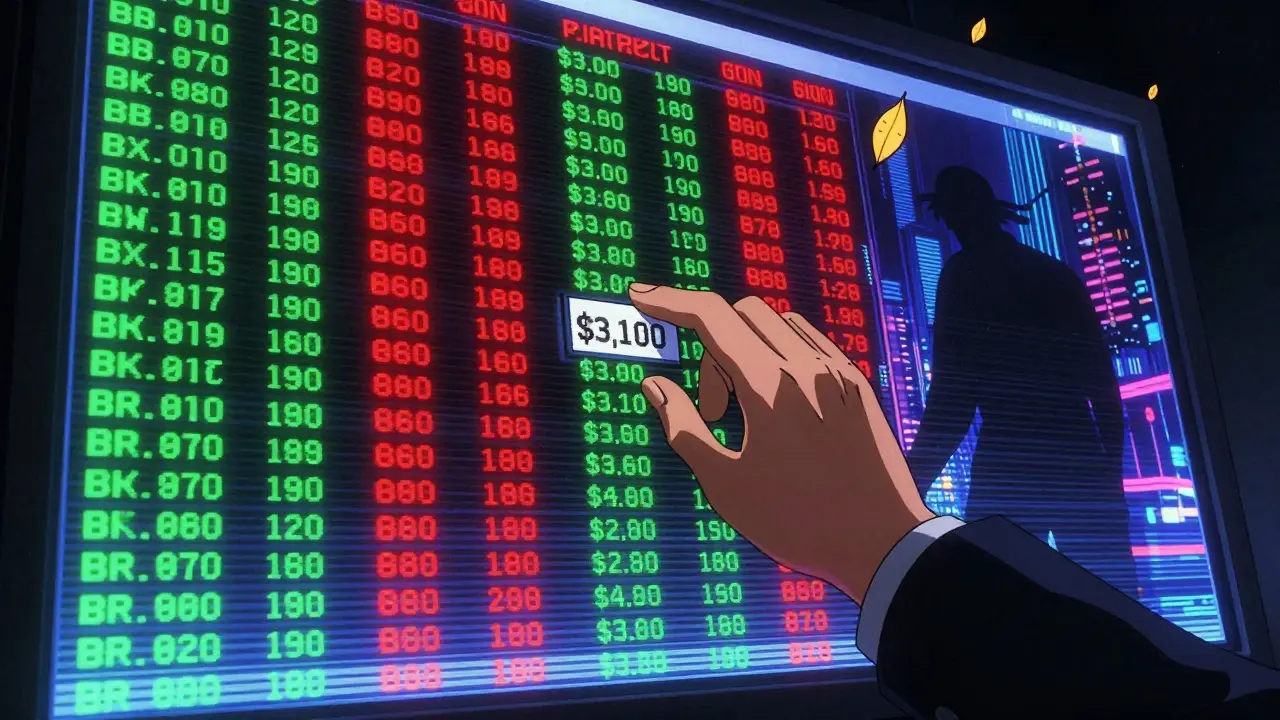
Order book trading is how traditional markets have worked for centuries. Buyers and sellers post their prices. Buy orders (bids) sit on one side. Sell orders (asks) on the other. When a bid matches an ask, the trade executes. It’s transparent. You can see the full depth of the market - how much people are willing to buy at $3,200, $3,195, $3,190, and so on.
Centralized exchanges like Binance and Coinbase use this model. But decentralized exchanges like dYdX do too - even though they’re on-chain. On-chain order books record every order on the blockchain. That means you pay gas fees every time you place or cancel an order. Off-chain order books, like those used by some DEXs, are faster and cheaper because they handle matching off the blockchain, then settle trades on-chain.
The big advantage? Control. You can set limit orders - only buy if it drops to $3,100. You can use stop-losses to automatically sell if it crashes. You can see the spread between the best bid and best ask. Experienced traders love this. It’s precise. You’re not at the mercy of an algorithm.
But here’s the downside: if no one’s trading your token, your order sits there forever. Low liquidity means slow fills. And because all orders are visible, bad actors can spoof - place fake large orders to trick others into thinking there’s demand, then pull them and trade against the panic.
Slippage: The Silent Killer in AMMs
Slippage is when the price you see isn’t the price you get. It’s the #1 complaint about AMMs. Why? Because AMMs calculate price based on pool size. If you try to swap $50,000 worth of a token with a $200,000 liquidity pool, you’re moving the market. The algorithm adjusts the ratio so drastically that you end up paying 10%, 20%, even 50% more than expected.
On an order book, slippage happens too - but only if you’re placing a market order that eats through multiple price levels. With a limit order, you avoid it entirely. You say: “I’ll buy at $3,100 or not at all.” That’s not possible on most AMMs. You get whatever the pool gives you. No exceptions.
That’s why AMMs work best for small trades or highly liquid pairs like ETH/USDC. For large trades, or illiquid tokens, you’re better off on an order book - if one exists.
Transparency and Manipulation: What You Can and Can’t See
Order books give you full visibility. You see every bid and ask. That’s why institutions trust them. But that same transparency makes them vulnerable. Front-running is a real threat. Miners or validators can see your pending order before it’s confirmed. They can jump ahead of you, buy the token you’re about to buy, then sell it back to you at a higher price. This is nearly impossible on AMMs because trades are executed against a pool, not against other users.
On the flip side, AMMs hide the real-time order flow. You can’t see who’s buying or selling. You only see the pool’s total value locked (TVL) and the current price. That’s great for privacy, but bad for strategy. You can’t tell if a big whale is about to dump a token. You’re flying blind.
Who Wins? Traders vs. Liquidity Providers
If you’re a casual trader or new to crypto, AMMs are easier. No need to learn limit orders, time the market, or read depth charts. Just swap. It’s like using a mobile app to pay for coffee - you don’t care how the bank transfer works. You just want it to work.
If you’re a serious trader - day trading, arbitraging, hedging - order books give you the tools. You can set complex strategies, use trailing stops, and manage risk precisely. You’re not just a user. You’re a participant in the market’s price discovery.
Liquidity providers? They’re the hidden winners of AMMs. You don’t need to be a trader to earn. Just deposit tokens. Earn fees. Even if you’re not tech-savvy. That’s why DeFi exploded in 2020. AMMs turned everyday crypto holders into market makers.
Hybrid Models Are Coming
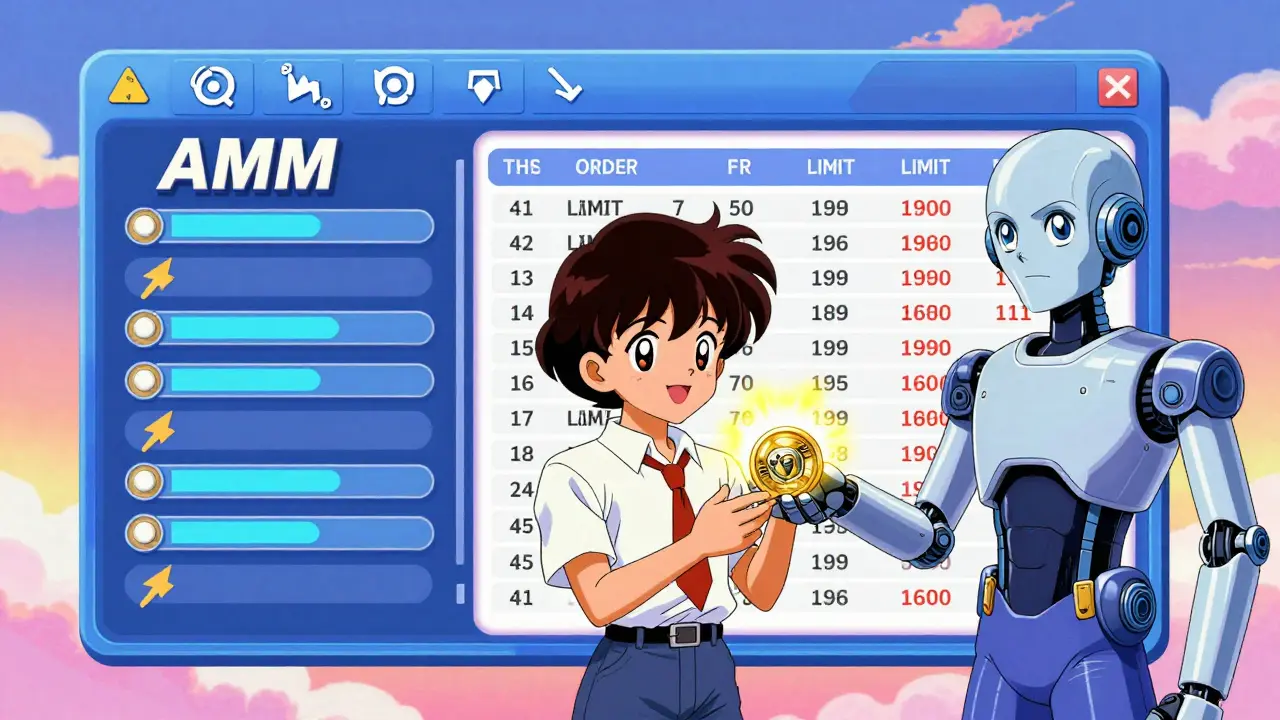
Neither model is perfect. AMMs lack precision. Order books lack liquidity in small markets. That’s why the next wave is hybrid systems.
Some DEXs now combine both. They use AMMs for basic swaps and offer order books for larger trades. Others use off-chain order books with on-chain settlement - fast, cheap, and still decentralized. Layer-2 solutions like StarkNet and Arbitrum are making on-chain order books more viable by slashing gas fees.
Uniswap V3 already lets liquidity providers concentrate their funds within custom price ranges - a move toward order book-like precision. Curve Finance uses a specialized AMM formula for stablecoins that minimizes slippage. These aren’t just tweaks. They’re evolution.
What Should You Use?
Here’s the simple guide:
- Trade small amounts? Use an AMM. It’s fast, simple, and always available.
- Trade large amounts? Check the liquidity pool size first. If it’s under $1M, avoid it. Use an order book exchange instead.
- Want to set your own price? Use an order book. AMMs don’t let you.
- Want to earn passive income? Provide liquidity on an AMM. But know the risks of impermanent loss.
- Trading volatile memecoins? AMM is your only option - unless you find a niche order book DEX.
- Trading BTC, ETH, or major stablecoins? Both work. Order books give you more control. AMMs give you more convenience.
There’s no single “best” model. It depends on what you’re doing, how much you’re trading, and how much control you want.
Can AMMs be used on centralized exchanges?
No, AMMs are a decentralized finance (DeFi) concept. They run on smart contracts on blockchains like Ethereum. Centralized exchanges like Binance or Kraken use order books. You won’t find AMMs on these platforms - they rely on traditional matching engines, not liquidity pools.
Why do AMMs have higher slippage than order books?
AMMs calculate prices based on the ratio of assets in a liquidity pool. When you trade a large amount, you change that ratio significantly, forcing the price to adjust. The smaller the pool, the more the price moves. Order books don’t work this way - they match existing orders. Slippage only happens if your order consumes multiple price levels, which you can avoid with limit orders.
Is Uniswap an AMM or an order book?
Uniswap is an AMM. It uses liquidity pools and algorithmic pricing. It doesn’t display buy and sell orders. All trades happen against the pool, not other users. That’s why it’s the most popular DEX - it solved the problem of low liquidity in decentralized markets.
Can I use limit orders on an AMM?
No, you cannot. AMMs execute trades instantly at the current pool price. There’s no way to set a target price. If you want to buy only if ETH drops to $3,000, you need an order book exchange like dYdX or a centralized platform like Binance.
Are order books safer than AMMs?
Safety depends on what you’re worried about. AMMs protect against front-running because trades aren’t visible before execution. But they expose you to impermanent loss and slippage. Order books give you control and transparency but are vulnerable to spoofing and front-running by miners. Neither is inherently safer - they just have different risks.
Which model is better for beginners?
AMMs are better for beginners. You don’t need to understand bid-ask spreads, order types, or market depth. Just connect your wallet, pick a token pair, and swap. The interface is simple. Order books require learning how to read charts, place limit orders, and interpret liquidity - which can be overwhelming at first.


