
You locked your ETH into a liquidity pool, earned some juicy APY, and felt like a genius. Then April rolled around, and you realized you had no idea how to report those tiny token drops. You’re not alone. Yield farming is the process of lending or staking cryptocurrency in decentralized finance protocols to earn rewards, but it creates a tax nightmare because every single reward counts as a taxable event. The US Internal Revenue Service (IRS) hasn’t issued specific rules just for yield farming yet, so they treat it under general cryptocurrency laws. This means if you don’t track your transactions meticulously, you could face massive penalties or overpay thousands in taxes due to poor record-keeping.
The Core Problem: Every Reward Is a Tax Event
Here’s the harsh reality: in the eyes of the IRS, receiving a yield farming reward is similar to getting paid in cash. When you deposit funds into a protocol like Aave or Compound, you aren’t just sitting idle; you’re providing a service (liquidity) and getting paid for it. That payment-whether it’s interest, transaction fees, or governance tokens-is considered ordinary income at the moment you receive it.
Why does this matter? Because ordinary income is taxed at your marginal tax rate, which can hit 37% for high earners. If you wait until you sell the tokens to report them, you might miss the mark. The value of that token when you received it becomes your cost basis. If you ignore the receipt date and only look at the sale price, you’ll miscalculate your gains. For example, if you earned $100 worth of COMP tokens in January, that’s $100 of income now. If you sell them in December for $500, you have $400 in capital gains. Ignoring the initial $100 means you’d be taxed on the full $500 twice effectively.
Income vs. Capital Gains: Which Rate Applies?
Not all yield farming actions trigger the same tax bill. It boils down to timing and classification. Receiving rewards is almost always treated as ordinary income. Selling those rewards later is where capital gains come into play. But here’s the twist: holding period matters.
- Short-term holdings: If you sell the farmed tokens less than a year after receiving them, any profit above your cost basis is taxed as short-term capital gains. These rates match your ordinary income tax brackets (10%-37%).
- Long-term holdings: Hold those tokens for more than 12 months, and profits qualify for long-term capital gains rates (0%, 15%, or 20%). This can save you significant money, but only if you tracked the original receipt date correctly.
A common mistake is assuming that swapping one token for another within a farm isn’t a taxable event. In many cases, moving assets between pools or claiming rewards involves a swap. Each swap is technically a disposal of the old asset and acquisition of the new one, triggering a calculation of gain or loss. If you’re constantly rebalancing, you’re creating dozens of taxable events without even realizing it.
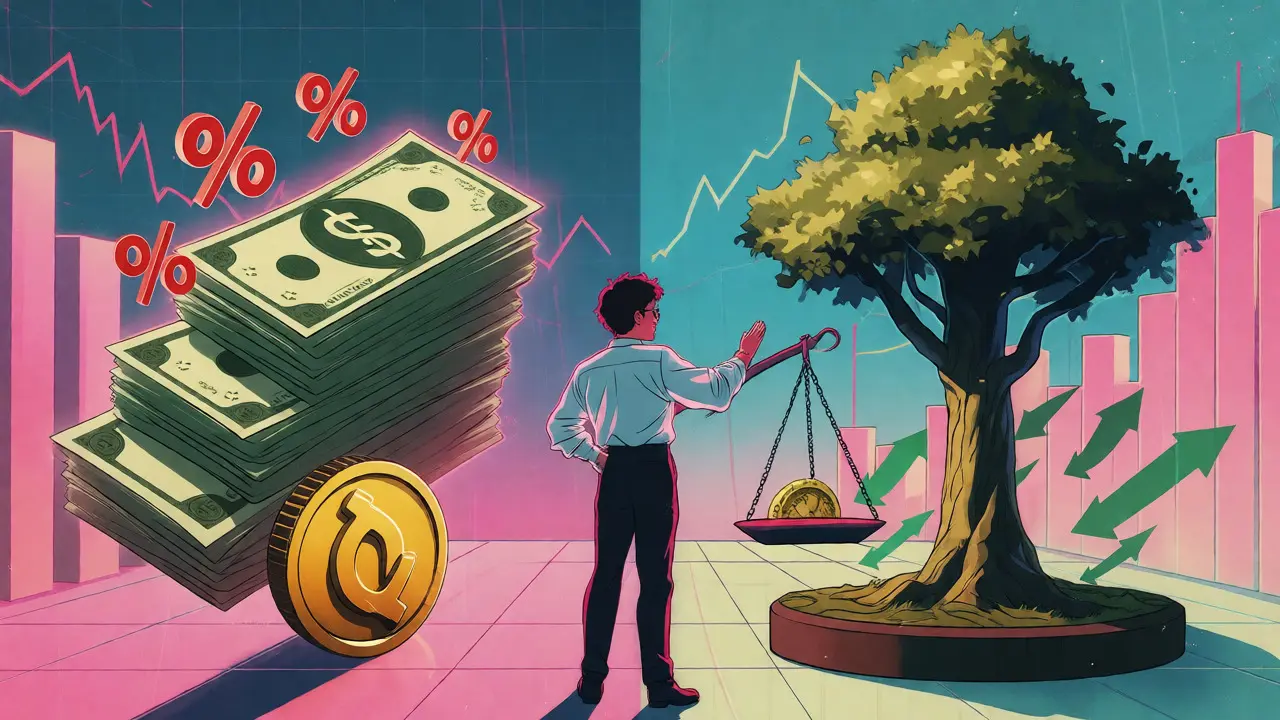
Valuation Challenges with New Tokens
How do you value a brand-new governance token that launched two hours ago? The IRS requires you to use the Fair Market Value (FMV) at the time of receipt. For major coins like Bitcoin or Ethereum, this is easy. For obscure DeFi tokens with low liquidity, it gets messy. Did you use the price from Uniswap? Or did you average prices across three exchanges?
Tax professionals generally recommend using a consistent methodology. If you choose CoinMarketCap’s closing price for that day, stick with it for all similar tokens. Document your source. If the IRS audits you, they won’t care about your philosophy on fair pricing-they want proof. Using tools like Koinly or CoinTracking helps automate this by pulling historical price data linked to blockchain timestamps. Manual entry is prone to error, especially when dealing with hundreds of micro-transactions.
Record-Keeping: Your Best Defense
If you didn’t write it down, it didn’t happen. And if it didn’t happen, you can’t claim deductions or prove your cost basis. Active yield farmers often spend 2-5 hours a week just organizing their logs. What exactly do you need to keep?
| Data Point | Why It Matters | Example Source |
|---|---|---|
| Transaction Hash | Proves the event occurred on-chain. | Etherscan / Block Explorer |
| Timestamp (UTC) | Determines the exact FMV for tax purposes. | Wallet History |
| Token Symbol & Quantity | Identifies what was received or sold. | Protocol Dashboard |
| Fair Market Value (USD) | Calculates the taxable income amount. | CoinGecko / CoinMarketCap |
| Cost Basis | Used to calculate future capital gains. | Calculated from FMV at receipt |
Don’t rely solely on exchange CSV exports. DeFi protocols interact directly with your wallet. You need browser extensions like MetaMask combined with portfolio trackers that sync with multiple chains. If you farm on Polygon, Arbitrum, and Ethereum simultaneously, you need a tool that aggregates these views. Otherwise, you’ll be manually checking block explorers for months during tax season.

Recent Regulatory Shifts and Future Outlook
The landscape is shifting. As of October 2026, the IRS has tightened enforcement on digital assets. The 2025 tax year saw stricter reporting requirements, and the deadline for filing returns for that year passed in April 2026. If you missed quarterly estimated payments for significant yield farming income, you might already owe penalties. The IRS now uses sophisticated analytics to match blockchain addresses with taxpayer identities, making it harder to fly under the radar.
Experts predict specific DeFi guidance will emerge soon, potentially clarifying whether certain liquidity provider (LP) positions are treated as partnerships rather than simple investments. Until then, conservative compliance is key. Treat most rewards as ordinary income upon receipt. It’s better to pay slightly more tax now than to face an audit later with unclear records. Some investors argue that LP tokens represent a share of the pool rather than direct ownership of underlying assets, suggesting non-taxable swaps. However, the IRS hasn’t explicitly blessed this view, so betting against standard interpretation is risky.
Practical Tips for Minimizing Tax Pain
You can’t avoid taxes, but you can manage them. Here are three actionable strategies:
- Harvest Regularly: Don’t let rewards pile up in a volatile token. Claim rewards frequently and convert stable portions to USD or stablecoins if you plan to hold long-term. This locks in your cost basis clearly.
- Use Loss Harvesting: If some farmed tokens dropped in value since receipt, selling them realizes a capital loss. You can use these losses to offset other capital gains or up to $3,000 of ordinary income annually.
- Hire a Crypto-Savvy CPA: General accountants often struggle with DeFi. Find someone who understands smart contracts and wallet interactions. They can help categorize complex transactions and ensure you’re not double-taxed on swaps versus income.
Remember, yield farming is profitable precisely because it’s complex. That complexity extends to taxes. Embrace the administrative burden as part of the cost of doing business in DeFi. With the right tools and mindset, you can turn tax season from a headache into a manageable checklist.
Is yield farming taxed immediately when I receive rewards?
Yes. Under current US tax law, yield farming rewards are generally treated as ordinary income at the time of receipt. You must report the fair market value of the tokens in USD on the day you claimed them. Waiting to sell does not defer the income tax liability.
Do I pay taxes on yield farming if I don't withdraw my funds?
It depends on the action. Simply leaving funds in a pool usually doesn't trigger a tax event. However, if you claim rewards or compound them via a smart contract swap, that is a taxable event. Even if the tokens stay in the wallet, the act of earning and owning them triggers income recognition.
What happens if I lose track of my yield farming transactions?
If you cannot provide a cost basis, the IRS may assume your cost basis is zero. This means the entire sale proceeds are taxed as capital gains, significantly increasing your tax bill. Always export your wallet history and reconcile it with price data before filing.
Are gas fees deductible for yield farming?
Gas fees paid to execute transactions are generally added to the cost basis of the acquired asset or deducted from the proceeds of a sale. They are not typically a separate itemized deduction but reduce your overall taxable gain. Keep records of all gas costs associated with farming activities.
Does the IRS have specific rules for DeFi yield farming?
No, there are no explicit regulations solely for yield farming as of late 2026. The IRS applies existing cryptocurrency guidance, treating rewards as income and swaps as disposals. This lack of specificity creates ambiguity, so following conservative interpretations is recommended.