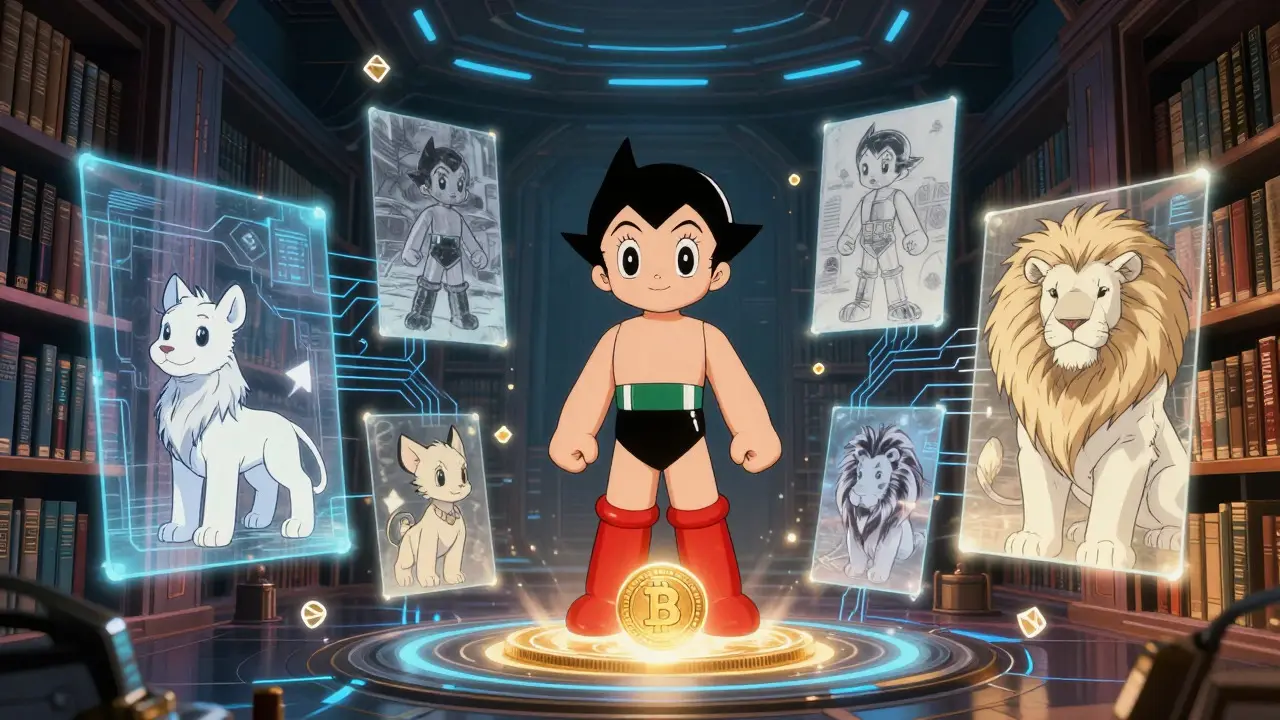
Imagine owning a piece of the creative rights to Astro Boy or Kimba the White Lion, not through a lawyer's office, but via a smart contract on the blockchain. That is the core promise of TCOM Global, a cryptocurrency token designed to manage intellectual property (IP) in the entertainment world. Trading under the ticker TCOM, this asset sits at the intersection of AI, Web3, and classic Japanese anime history. It is not just another meme coin; it attempts to solve a specific problem: how to license, create derivative works from, and distribute value from iconic IP assets transparently.
If you are looking at the charts and seeing a price hovering around $0.008 as of mid-2026, you might wonder what drives its value. The answer lies in its role as the native utility token for a protocol that holds the digital keys to 65 legendary works by Osamu Tezuka, widely revered as the "God of Manga." This article breaks down what TCOM actually does, how its tokenomics work, and whether it fits into your portfolio strategy.
Key Takeaways
- Core Function: TCOM is the utility token for a decentralized IP governance protocol on the BNB Chain, focusing on licensing and monetizing Osamu Tezuka’s works.
- Supply Structure: Fixed maximum supply of 1 billion tokens, with only ~92 million currently circulating (approx. 9.2%), creating potential future inflationary pressure.
- Market Position: A low-cap altcoin with a market cap fluctuating between $0.7M and $6.8M in recent months, indicating high volatility and speculative nature.
- Utility: Used for governance voting, paying for AI-assisted content creation tools, and securing licenses for derivative works within the ecosystem.
What Exactly Is the TCOM Global Protocol?
To understand the coin, you first need to understand the machine it powers. TCOM Global describes itself as the "world’s first decentralized IP governance protocol." In plain English, this means it uses blockchain technology to replace traditional, opaque legal contracts for intellectual property with transparent, on-chain rules.
The protocol is built on the BNB Chain, which provides the underlying infrastructure for fast and cheap transactions. Unlike generic DeFi tokens that focus on lending or staking, TCOM focuses specifically on Intellectual Property Rights. The initial catalog includes 65 classic IPs from Osamu Tezuka. These are not obscure titles; they include foundational works of modern anime like Astro Boy, Kimba the White Lion, and Black Jack.
Here is how the workflow operates:
- Licensing: Creators pay fees in TCOM to access specific IP assets for derivative projects (e.g., fan art, spin-off comics, animated shorts).
- Creation: The platform offers AI-powered tools to help creators generate content based on these licensed characters.
- Voting: The community votes on the best submissions using their TCOM holdings.
- Royalties: Revenue from successful derivative works is distributed back to rights holders and contributors via smart contracts, eliminating middlemen.
Tokenomics: Supply, Circulation, and Value
When analyzing any crypto asset, the numbers tell the story of its scarcity and potential dilution. For TCOM, the data is consistent across major trackers like CoinMarketCap and CoinGecko.
| Metric | Value | Note |
|---|---|---|
| Total Supply | 1,000,000,000 | Fixed cap, no minting beyond this limit |
| Circulating Supply | ~92,000,000 | Approximately 9.2% of total supply |
| Max Supply | 1,000,000,000 | Inflationary until full unlock |
| Current Price (Aug 2026) | ~$0.0084 | High volatility observed |
| Market Cap | ~$770,000 - $1.1M | Varies significantly by date/platform |
| 24-Hour Volume | ~$500,000 - $600,000 | Indicates active but niche trading interest |
How Does TCOM Compare to Other IP Tokens?
While many projects claim to be in the "creator economy," few have secured such a recognizable legacy IP portfolio so early. Most Web3 gaming or metaverse tokens rely on original, unproven characters. TCOM leverages existing cultural capital. The name "Tezuka" carries weight in Asia and among global anime fans, providing a ready-made audience that other generic utility tokens lack. However, TCOM is not without competition. Other platforms use NFTs to represent IP ownership, but they often lack the structured licensing layer that TCOM proposes. TCOM’s differentiator is the combination of AI-Assisted Creation and on-chain royalty splits. It doesn't just let you buy an NFT of Astro Boy; it lets you legally create a new comic featuring Astro Boy, share the revenue, and have the process governed by code rather than a corporate legal department.
Where to Buy and Trade TCOM
Liquidity for TCOM has evolved since its launch on Binance Alpha in August 2025. As of mid-2026, you can find TCOM listed on several centralized exchanges (CEXs) and decentralized exchanges (DEXs).
- Binance Alpha: Where the token launched. Still a primary venue for high-volume trading.
- Bitget: Identified by CoinGecko as one of the most popular venues for buying and trading TCOM due to its user-friendly interface and liquidity depth.
- MEXC: Offers detailed tokenomics tracking and competitive fees for active traders.
- Decentralized Options: Since it is a BEP-20 token on BNB Chain, you can also swap TCOM on DEXs like PancakeSwap, though slippage may be higher during volatile periods.

Risks and Considerations for Investors
No small-cap crypto is free from risk, and TCOM is no exception. Here are the key factors to weigh before entering a position: Volatility: The price has dropped from peaks near $0.07 to current levels around $0.008. This represents a significant drawdown, typical of speculative assets in a cooling market phase. Adoption Uncertainty: While the concept is strong, mass adoption by mainstream creators is still unproven. Will studios and independent artists actually switch to this protocol? The success depends on the quality of the AI tools and the fairness of the governance system. Regulatory Environment: Intellectual property law is complex. Operating IP licensing on a blockchain introduces legal questions regarding jurisdiction and enforcement. Regulatory shifts in regions where Tezuka’s IP is protected could impact the project’s operations. Data Discrepancies: You may notice conflicting market cap figures across different sites (e.g., FXEmpire showing drastically different FDV numbers compared to MEXC). This is common with thinly traded assets. Always cross-reference multiple sources like CoinMarketCap, CoinGecko, and LiveCoinWatch to get a balanced view.
Frequently Asked Questions
Is TCOM a good investment in 2026?
Like all small-cap cryptocurrencies, TCOM is high-risk, high-reward. Its value proposition relies on the successful integration of AI tools and IP licensing on BNB Chain. If the creator ecosystem grows, the low circulating supply could drive prices up. However, if adoption stalls, the remaining 90% of locked tokens could exert downward pressure. It is suitable for investors comfortable with high volatility and thematic bets on the creator economy.
Who created TCOM Global?
Public records do not list specific individual founders by name in mainstream data aggregators. The project is presented as an organized development team behind the tcomglobal.io protocol. The branding focuses heavily on the partnership with Osamu Tezuka’s estate and the technical infrastructure rather than celebrity leadership.
What is the difference between TCOM and an NFT?
An NFT is a non-fungible token representing a unique asset, like a piece of art. TCOM is a fungible utility token used to interact with the platform. You might use TCOM to pay for licensing a character, vote on proposals, or stake for rewards. The IP assets themselves might be represented by NFTs or smart contract entries, but TCOM is the 'fuel' that makes the system run.
Can I earn passive income with TCOM?
Yes, potentially. Depending on the protocol's final implementation details, holding TCOM may grant you a share of revenue from derivative works created in the ecosystem. Additionally, standard DeFi mechanisms like staking or providing liquidity on DEXs may offer yield, though rates vary and should be checked on the official dashboard.
Which blockchain is TCOM built on?
TCOM is built on the BNB Chain. This means it uses the BEP-20 token standard. To hold TCOM in a self-custody wallet, you will need a BNB Chain-compatible wallet like Trust Wallet, MetaMask (configured for BSC), or Rabby.


