Imagine sending money instantly, without paying a single cent in fees, and doing it while laughing at banana puns. That’s the core promise of Banano (BAN). It’s not just another speculative asset trying to ride the next hype wave; it’s a community-driven experiment designed to make cryptocurrency accessible, fun, and technically efficient for everyone from beginners to developers.
If you’ve ever felt intimidated by high gas fees on Ethereum or confused by complex blockchain mechanics, Banano offers a refreshing alternative. But what exactly is this "potassium-rich" currency? Is it just a joke, or does it have real technical substance? Let’s break down how it works, why people use it, and whether it fits into your crypto portfolio.
The Origins: From Nano to Banano
To understand Banano, you first need to know about Nano. Nano is a cryptocurrency known for its speed and zero-fee transactions. In early 2018, a group of pseudonymous developers, often referred to as "CeeFs," decided to fork Nano. They didn’t want to change the underlying tech much; they wanted to change the culture.
Banano launched its mainnet on April 1, 2018, with a simple mission: take Nano’s solid technology and wrap it in a layer of humor, memes, and community engagement. Unlike many projects that launch with an Initial Coin Offering (ICO) to raise millions, Banano had no ICO. There were no venture capitalists holding back 50% of the supply. Instead, the coins were distributed freely through faucets, games, contests, and giveaways. This "fair distribution" model means that anyone can get some BAN without spending money upfront, lowering the barrier to entry significantly.
How It Works: Block-Lattice and ORV
Most cryptocurrencies like Bitcoin use a traditional blockchain where every transaction is added sequentially to a single chain. This creates bottlenecks. Banano, inheriting Nano’s architecture, uses a Block-Lattice (or DAG - Directed Acyclic Graph). Think of it less like a single ledger and more like a series of parallel personal ledgers.
- Account-Chains: Every user has their own chain of blocks. You only update your own chain when you send or receive funds.
- Parallel Processing: Because accounts operate independently, thousands of transactions can happen simultaneously without waiting for the whole network to agree on one global order.
- State Blocks: Transactions are handled via state blocks. When you send BAN, you publish a block debiting your balance. The receiver then publishes a block crediting theirs. These two blocks are linked, completing the transfer.
Consensus is achieved through Open Representative Voting (ORV). Instead of energy-intensive mining, users delegate their voting power to representatives. Representatives don’t earn rewards for voting; they do it voluntarily. If enough voting weight confirms a transaction, it becomes "cemented" and irreversible. This system allows for near-instant settlement times-usually under a second-and zero network fees.

The Supply: Fixed but Distributed
Crypto investors love scarcity, and Banano delivers. The total maximum supply is fixed at approximately 1.9 billion BAN. However, unlike Bitcoin, which releases new coins slowly over decades, Banano’s supply was fully minted at launch. The distribution strategy was unique:
| Category | Approximate Amount (Oct 2026 Data) | Purpose |
|---|---|---|
| Circulating Supply | ~1.62 Billion BAN | Held by users, exchanges, and wallets. |
| Team Funds | ~317 Million BAN | Held for future distributions, events, and ecosystem growth. |
| Burned | ~1.48 Billion BAN | Removed from circulation permanently via burns. |
Note that these numbers shift slightly as team funds are released and more coins are burned during events. The key takeaway is that there is no inflationary pressure from mining rewards. The value depends entirely on demand, utility, and community activity.
Ecosystem: Wallets, Games, and Charity
One of Banano’s biggest selling points is its vibrant ecosystem. Since the coin is free to acquire initially, the community built tools to keep users engaged.
- Kalium Wallet: A popular mobile wallet for iOS and Android. It’s user-friendly and integrates directly with community features.
- Faucets: Websites like BananoFaucet give away small amounts of BAN for free. Great for testing transactions.
- Games & Tipping: Platforms allow users to tip each other for good comments or content. There are also games where you bet BAN or compete for prizes.
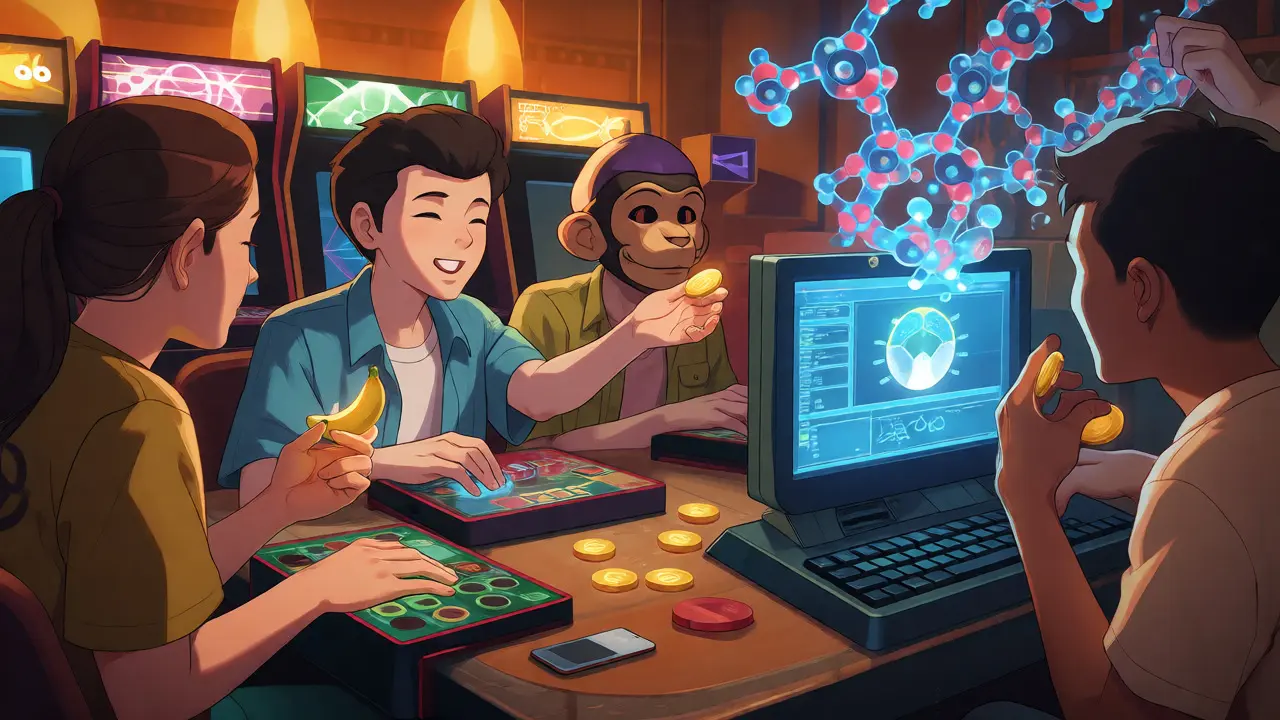
- BananoMiner: A clever twist on mining. Instead of solving useless math problems, users contribute computing power to Folding@Home, a project researching diseases like Alzheimer’s and Cancer. Users earn BAN for donating CPU/GPU cycles.
- MonKeys: Non-fungible tokens (NFTs) unique to the Banano community. These collectibles often grant special access or status within the community.
This gamified approach makes learning about crypto painless. You’re not just staring at charts; you’re playing, tipping, and helping science.
Risks and Realities
Is Banano perfect? No. It’s crucial to look past the memes to see the financial reality.
- Low Market Cap: As of October 2026, Banano’s market cap hovers around $800,000 to $900,000. This makes it extremely volatile. Small trades can move the price significantly.
- Liquidity Issues: You won’t find BAN on major tier-1 exchanges like Coinbase or Binance easily. Most trading happens on smaller platforms or via decentralized exchanges. This can lead to wide bid-ask spreads.
- No Privacy: Like Bitcoin, all transactions are public. Anyone can trace your balance history.
- Concentration Risk: While distribution started fair, large holders (whales) still exist. Team-held funds, if dumped too quickly, could suppress the price.
Furthermore, wrapped versions of BAN exist on other chains like Ethereum or Polygon. Remember, native BAN transfers are feeless, but interacting with wrapped BAN on other networks incurs those networks' gas fees.
Who Should Use Banano?
Banano isn’t necessarily a "get rich quick" investment vehicle. It shines in specific use cases:
- Beginners: It’s the cheapest way to learn how wallets, seeds, and transactions work. Mistakes cost nothing.
- Tippers: Sending micro-payments for online content is seamless.
- Charity Supporters: The community frequently organizes charitable drives, donating BAN to causes.
- Developers: Building apps on a feeless, fast network is attractive for certain dApps.
Is Banano a scam?
No, Banano is not a scam. It is an open-source project with a transparent codebase derived from Nano. However, like any low-cap cryptocurrency, it carries high risk due to volatility and limited liquidity. Always do your own research before investing.
Can I mine Banano?
You cannot mine Banano in the traditional sense (like Bitcoin). Instead, you can earn BAN by contributing computing power to medical research via Folding@Home using the BananoMiner tool. You can also earn it through faucets, games, and community events.
Does Banano have transaction fees?
Native Banano transactions on the main network are completely feeless. However, if you use wrapped BAN on other blockchains (like Ethereum), you will pay that blockchain's gas fees. Also, exchanges may charge withdrawal fees.
Where can I buy Banano?
Banano is available on several smaller exchanges such as Gate.io, CoinEx, and XT.com. You can also trade it peer-to-peer or acquire it for free through community faucets and giveaways.
What is the difference between Banano and Nano?
Technically, they are very similar. Both use block-lattice technology and Open Representative Voting. The main difference is branding and community culture. Banano focuses on memes, humor, and accessibility, while Nano focuses on serious financial adoption. Banano also has a different tokenomics structure with more emphasis on community distribution.