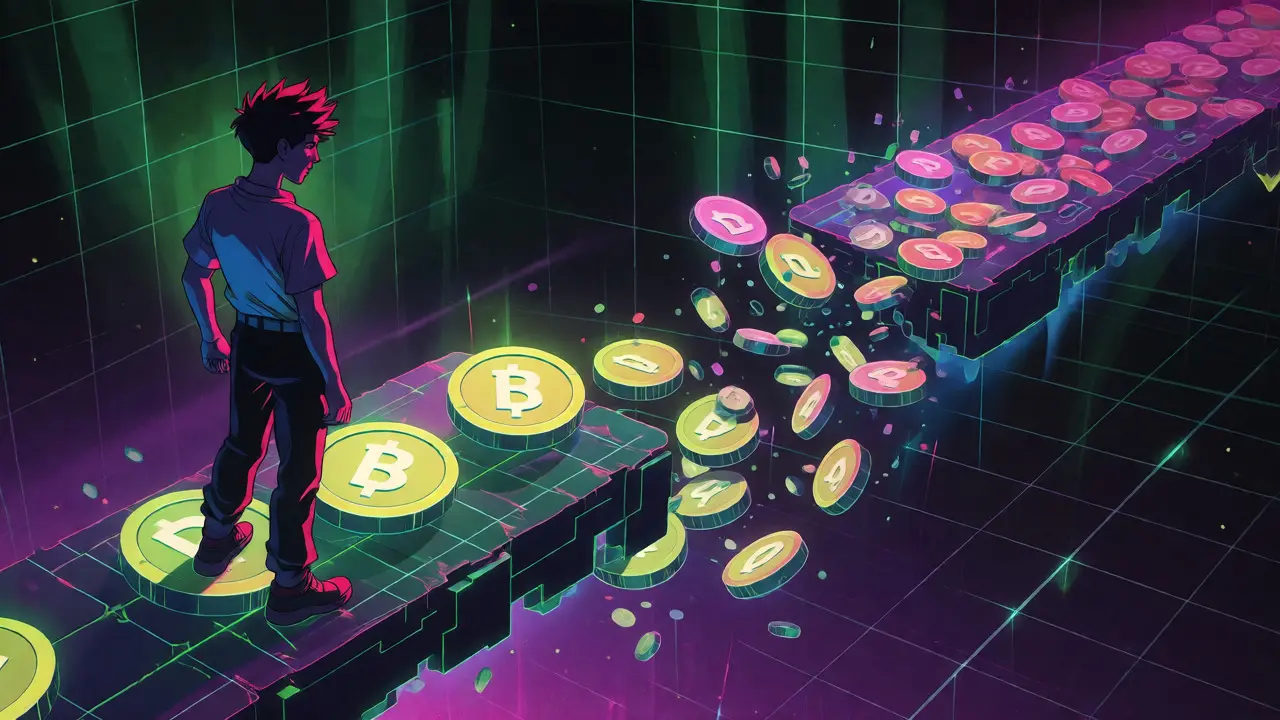
You put your money in a liquidity pool expecting passive income, but three weeks later, you check your balance and it’s lower than when you started. Did you lose money? Maybe not. You might have just experienced impermanent loss, the silent killer of decentralized finance returns that catches even seasoned traders off guard.
Providing liquidity isn’t just about dumping tokens into a smart contract and walking away. It’s an active financial operation. As Michael Moro from SWAAP Finance puts it, treating it like a passive investment is a recipe for underperformance. With over $50 billion locked in these pools across protocols like Uniswap, Curve, and Balancer, the stakes are high. Whether you’re a beginner eyeing stablecoin yields or a pro hunting for 4,000x capital efficiency on Uniswap V3, managing your position correctly is the difference between steady gains and getting rekt by volatility.
The Core Mechanics of LP Positions
At its heart, a liquidity provider (LP) position represents your stake in an automated market maker (AMM). You deposit two or more tokens into a smart contract, usually in equal value ratios (like 50/50), to facilitate trades for others. In return, you earn a slice of the transaction fees-typically 0.3% on volatile pairs on Uniswap.
But here’s the catch: the ratio of tokens in the pool changes constantly as people trade. If one token’s price skyrockets, the pool automatically sells some of that winner and buys more of the loser to maintain balance. This means you end up with less of the appreciating asset and more of the depreciating one compared to simply holding both tokens in your wallet. That gap between your LP value and your "hold" value is impermanent loss. It’s only permanent if you withdraw while the prices remain skewed.
Navigating Concentrated Liquidity vs. Traditional Pools
Not all pools are created equal. The landscape shifted dramatically when Uniswap introduced concentrated liquidity in V3. Unlike traditional pools where your capital is spread across every possible price from zero to infinity, concentrated liquidity lets you choose specific price ranges.
Imagine you think Ethereum will stay between $1,800 and $2,200. You can deploy your capital exclusively within that band. This boosts your capital efficiency massively-up to 4,000 times better than standard pools according to Uniswap’s technical reports. But it comes with a heavy maintenance burden. If ETH breaks out of your range, your position stops earning fees entirely until you rebalance. Data from Gauntlet Network shows that leaving a position out of range for just 30 days can forfeit 65-80% of potential fees.
| Feature | Uniswap V3 | Curve Finance | Balancer |
|---|---|---|---|
| Liquidity Type | Concentrated (Manual Ranges) | Stablecoin Optimized | Multi-Asset Custom Weights |
| Typical APY | 5-15% (Volatile) | 2-4% (Stable) | Variable (Niche Dependent) |
| Impermanent Loss Risk | High (15-25% in volatility) | Low (0.5-1.5%) | Moderate to High |
| Management Effort | High (Active Rebalancing) | Low (Passive) | Moderate |
| Best For | Active Traders & Pros | Conservative Yield Seekers | Diversified Portfolios |
Strategic Position Management
So, how do you actually manage these positions without losing your mind? First, stop guessing. Use tools like Zapper.fi or DefiLlama to monitor real-time metrics. Don’t just look at the headline APY; dig into the trading volume. A pool with high APY but low daily volume ($1 million minimum is a good rule of thumb) might be a trap. Your fees come from volume, not just TVL.
Timing matters too. Gas fees on Ethereum mainnet can swing from $1.50 during quiet hours to $50 during congestion. Adjusting your position costs gas. If you’re making small tweaks, doing them during peak congestion eats into your profits. ChainUp’s analysts recommend batching adjustments or using Layer 2 solutions if available. For those managing larger portfolios, automation is key. Tools like Uniswap’s Position Manager or SWAAP’s Autopilot use algorithms to adjust ranges automatically, reducing management time by up to 60%. Top performers often allocate 15-20 hours a month to this, but automation helps scale beyond what manual monitoring allows.
Diversification is another critical layer. Don’t put all your eggs in one basket-or one protocol. A balanced approach might look like 60% in stablecoin pools on Curve for safety and 40% in volatile pairs on Uniswap for growth. Messari’s analysis showed that diversified LPs suffered 48% lower drawdowns during recent market crashes compared to those concentrated in single assets.

Security and Exit Strategies
DeFi security is non-negotiable. Immunefi reported $2.3 billion in exploits through Q3 2024. Always verify contract addresses through multiple sources. When approving tokens, never give unlimited allowances. Specify the exact amount you’re depositing. This limits the damage if a smart contract gets hacked. Hardware wallets are essential for high-value actions; keeping keys hot for convenience invites risk.
When it’s time to exit, don’t panic sell. Withdraw in tranches, especially during high volatility. Trying to pull everything out at once during a market surge can cause significant slippage. Also, watch out for token imbalance. If you’ve been providing liquidity for a long time, your withdrawal might result in a portfolio heavily weighted toward the underperforming token. Plan for this swap cost before you hit the withdraw button.
Real-World Scenarios and Pitfalls
Let’s look at two contrasting experiences. 'DeFiDegen42' managed an ETH/USDC position on Uniswap V3, actively adjusting ranges during ETF announcement volatility. Result? An 18.7% APY after accounting for fees and impermanent loss. Compare that to 'CryptoNoob1987', who left a LINK/USDC position untouched during a July 2024 surge. They didn’t realize their position was out of range for weeks, resulting in a 32% loss due to missed fees and adverse price movement.
The lesson? Active management pays. Passive holding in concentrated liquidity is dangerous. However, if you prefer a set-and-forget approach, stick to stablecoin pools on Curve. Yes, the returns are lower (2-3%), but the stress is minimal, and impermanent loss is negligible.

Frequently Asked Questions
What is impermanent loss?
Impermanent loss is the temporary reduction in the value of your liquidity provider (LP) position compared to simply holding the underlying tokens. It occurs because the automated market maker rebalances the pool's token ratio as prices change. If one token rises significantly, the pool sells some of it to buy more of the other, meaning you hold less of the winner and more of the loser. The loss becomes permanent only if you withdraw your funds while the prices remain diverged.
How does concentrated liquidity work on Uniswap V3?
Concentrated liquidity allows providers to supply capital within specific price ranges rather than across all possible prices. By narrowing the range where their funds are active, providers increase their share of trading fees within that zone, potentially boosting capital efficiency by up to 4,000x. However, if the market price moves outside the chosen range, the position stops earning fees until it is manually or automatically rebalanced.
Which platforms are best for beginners?
For beginners, Curve Finance is often recommended due to its focus on stablecoin pools, which minimize impermanent loss risk and require less active management. Uniswap is also user-friendly but requires more attention to detail regarding price ranges and fee tiers. Starting with small amounts (0.1-0.5 ETH equivalent) allows new users to learn the mechanics without significant financial exposure.
Do I need to pay gas fees to manage my position?
Yes, interacting with smart contracts for deposits, withdrawals, and rebalancing incurs gas fees. On Ethereum mainnet, these can range from $1.50 to $50 depending on network congestion. Frequent adjustments can erode profits, so many users batch transactions, use Layer 2 networks, or employ automated tools to optimize timing and reduce costs.
How often should I rebalance my position?
Rebalancing frequency depends on your strategy and the asset's volatility. For concentrated liquidity, you may need to adjust whenever the price moves 15-20% outside your range. Some advanced users automate this process to react within 24 hours of significant movements. Stablecoin pools generally require much less frequent intervention, perhaps only quarterly checks unless pegs break.
Next Steps for Liquidity Providers
If you're just starting, open a small position in a USDC/DAI pool on Curve. Monitor it for a month. See how little the value fluctuates. Then, try a small ETH/USDC position on Uniswap V3 with a narrow range. Watch how quickly it goes out of bounds. This hands-on experience teaches you more than any article. Keep records of your entries, exits, and gas costs. Calculate your true net return after all expenses. The goal isn't just high APY; it's sustainable, risk-adjusted yield. Stay curious, stay skeptical, and always double-check those contract addresses.