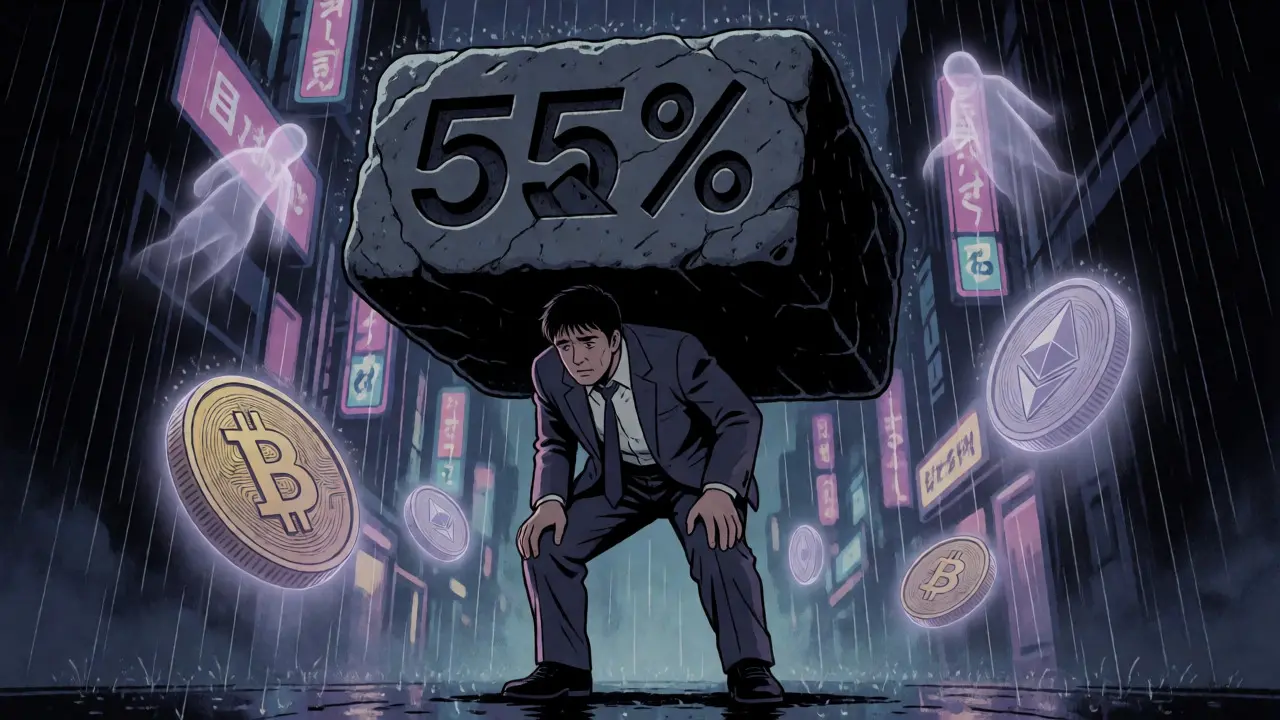
Imagine selling a Bitcoin you held for five years and handing over more than half your profit to the government. For years, this wasn't a hypothetical nightmare for Japanese investors-it was their reality. While stock traders in Tokyo paid a flat 20% on their gains, crypto holders faced a brutal progressive tax scale that could swallow up to 55% of their profits. This disparity didn't just sting; it drove talent and capital out of the country, leaving Japan’s once-thriving digital asset market stagnant while Singapore and South Korea surged ahead.
But the tide is turning. As of late 2024 and into 2025, the Japanese government has signaled a major shift. The ruling Liberal Democratic Party (LDP) announced plans to overhaul the system, aiming to replace the punitive 55% cap with a flat 20% rate, aligning crypto with traditional securities. If these reforms pass parliament as expected by fiscal year 2026, Japan could reclaim its status as a global crypto hub. Here is exactly how the current system works, why it failed, and what the new rules mean for your wallet.
The Current Reality: Why You Paid Up to 55%
To understand the change, you have to look at the old classification. Under the Payment Services Act (PSA), Japan classified cryptocurrency not as currency or financial instruments, but as "miscellaneous income." This technical distinction had massive financial consequences. Unlike stocks, which are taxed under the Financial Instruments and Exchange Act (FIEA) at a fixed rate, crypto gains were added to your total annual income and taxed progressively.
The national income tax rates in Japan range from 5% to 45%. On top of that, you pay a 10% inhabitant tax (split between prefectural and municipal levels). When you stack these together, high earners hit an effective marginal rate of 55%. There was no benefit for holding an asset long-term. Whether you sold after one day or ten years, the taxman took the same cut. This structure discouraged long-term investment and pushed many traders to move their operations offshore to jurisdictions like Portugal or Switzerland, where tax treatment was far more favorable.
| Feature | Current System (Pre-Reform) | Proposed System (Target 2026) | Traditional Stocks (Japan) |
|---|---|---|---|
| Tax Rate Structure | Progressive (5% - 45% + 10% local) | Flat Rate | Flat Rate |
| Maximum Effective Rate | Up to 55% | Approx. 20% | 20.315% |
| Holding Period Benefit | None | None (currently proposed) | None |
| Loss Carry-Forward | Restricted/Complex | 3-Year Provision Expected | Available |
What Triggers a Tax Event?
Many beginners assume they only owe taxes when they cash out to Yen. That’s a dangerous misconception. In Japan, any disposal event triggers a taxable gain. The National Tax Agency (NTA) guidelines are strict about what counts as a disposal:
- Selling for Fiat: Converting BTC, ETH, or altcoins into JPY, USD, etc.
- Crypto-to-Crypto Trades: Swapping Bitcoin for Ethereum is a taxable event. You calculate the gain based on the value of the Bitcoin you gave up versus what you received.
- Spending Crypto: Buying a coffee or a car with Bitcoin counts as selling the Bitcoin at its fair market value at that moment.
- Staking Rewards: Receiving staking rewards is generally treated as miscellaneous income at the time of receipt, adding another layer of complexity to your tax return.
You do not pay tax simply for buying crypto, holding it in a personal wallet, or transferring it between wallets you own. However, tracking every single transaction across multiple exchanges became a compliance nightmare. With the requirement to report gains exceeding 200,000 JPY annually, many casual investors found themselves filing complex returns for relatively small amounts.

The Driving Force Behind Reform
Why change now? Because Japan was losing the race. By 2024, Japan’s share of the global crypto market had dropped to roughly 3.7%, down from over 8% in 2021. Meanwhile, South Korea captured 6.1% of the market, and Singapore continued to attract institutional money with clearer regulatory frameworks. Data from Chainalysis showed a 27% decrease in active Japanese wallet addresses trading on domestic exchanges between 2022 and 2023.
The government realized that taxing innovation at punitive rates stifled growth. Minister of Finance Katsunobu Kato and the Financial Services Agency (FSA) published discussion papers in early 2025 explicitly linking tax modernization to Japan’s goal of becoming a "global hub for digital assets." The logic is simple: if you want Web3 companies to set up shop in Tokyo, you can’t charge them double the tax rate of their competitors in Dubai or New York.
Key Changes in the 2026 Framework
The proposed reform package, which gained momentum following the LDP’s December 2023 announcement, aims to level the playing field. Here is what investors should expect if the legislation passes:
- Flat 20% Tax Rate: The most significant change is moving crypto gains out of "miscellaneous income" and likely treating them similarly to securities. This caps the tax burden at approximately 20%, including resident tax.
- Loss Carry-Forward: One of the biggest pain points for traders was the inability to offset losses against future gains easily. The new framework is expected to introduce a three-year loss carry-forward provision. If you lose money in 2026, you can use those losses to reduce your tax bill in 2027, 2028, or 2029.
- Alignment with Equities: By treating crypto closer to stocks, the administrative burden decreases. Exchanges may provide standardized tax reports similar to those for stock brokers, reducing the need for expensive third-party software for average users.
It is worth noting that while the rate drops, the reporting threshold of 200,000 JPY remains. You still need to keep detailed records. The difference is that the math becomes simpler, and the penalty for success is significantly lower.

Practical Implications for Investors
If you are currently investing in crypto in Japan, or planning to enter the market, here is how you should navigate the transition period leading up to 2026.
For Long-Term Holders: If you have unrealized gains in assets you’ve held for years, consider whether you need to realize them before the new law takes effect. However, since the new rate is lower, there is less urgency to sell before the reform unless you fear political delays. The removal of the "miscellaneous income" label means your gains won’t push you into higher tax brackets for other income sources like salary.
For Active Traders: The introduction of loss carry-forwards is a game-changer. In the past, a bad year meant lost tax benefits. Now, you can smooth out volatility. If you made 5 million JPY in profit in 2025 but lost 2 million in 2026, you can offset the 2026 loss against future gains. Start keeping meticulous records now using tools like Koinly or Freee, as the NTA will still require proof of cost basis.
For Non-Residents: Currently, non-permanent residents face a flat 20% tax on domestic crypto income. The reform might blur the lines, potentially applying the new flat rate to all investors regardless of residency status, simplifying the landscape for expats working in Tokyo.
Remaining Challenges and Risks
Despite the positive outlook, experts urge caution. Dr. Hiroki Takeuchi from the University of Tokyo’s Financial Technology Center notes that while a 20% flat rate brings Japan in line with global standards, it lacks differentiation between short-term and long-term holdings. In the US, holding an asset for over a year reduces the tax rate. In Japan, even under the new proposal, a day trader and a HODLer will likely pay the same percentage. This might still disadvantage passive investors compared to aggressive traders who can leverage frequent turnover strategies.
Furthermore, parliamentary approval is not guaranteed. Regulatory details regarding DeFi interactions, NFTs, and stablecoins remain in flux. The FSA’s April 2025 discussion paper suggests further reviews, meaning definitions of "taxable events" could expand or contract before the final law is written.
When does the new 20% crypto tax rate start in Japan?
The target implementation date is fiscal year 2026. Legislation is expected to pass parliament in Q2 2025, allowing for a transition period before the new rates apply to transactions occurring after April 2026.
Do I still have to file taxes if my crypto gains are under 200,000 JPY?
Generally, no. If your total miscellaneous income (including crypto gains) is below 200,000 JPY per year, you are typically exempt from filing a separate tax return for that income. However, if you have other income sources, you must include it in your main declaration.
Is trading Bitcoin for Ethereum taxable in Japan?
Yes. Any exchange of one cryptocurrency for another is considered a disposal event. You must calculate the gain or loss based on the fair market value of the coin you sold at the time of the trade.
Will the new law allow me to deduct losses from previous years?
The proposed reform includes a three-year loss carry-forward provision. This means losses incurred after the law takes effect can be used to offset gains in the subsequent three years. It is unclear if pre-reform losses will be eligible, so consult a tax professional for specific cases.
How does Japan's new tax rate compare to the USA?
Japan’s proposed flat 20% is lower than the top US ordinary income rate (37%) for short-term gains but higher than the US long-term capital gains rate (up to 20% plus NIIT). However, unlike the US, Japan does not offer a reduced rate for long-term holdings, making it less attractive for buy-and-hold investors compared to Americans.