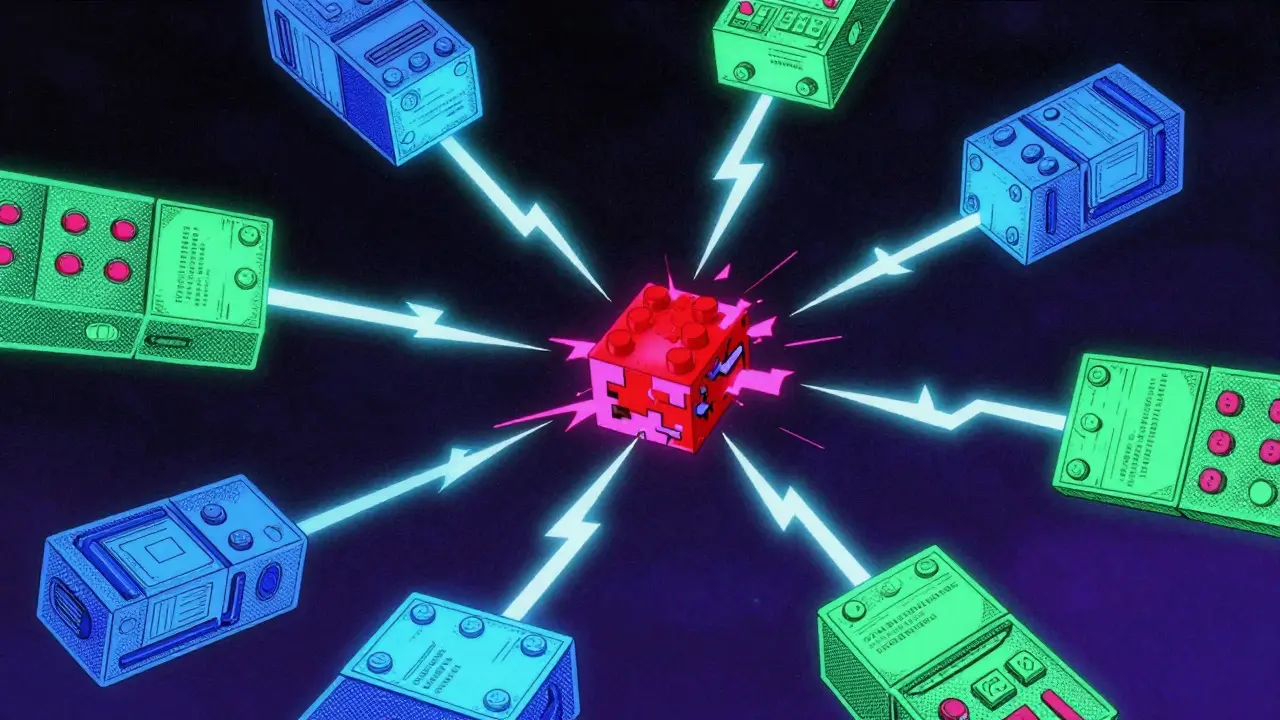
Imagine a single line of code failing in one lending protocol. Within minutes, that error ripples through three stablecoins, breaks two exchange bridges, and freezes billions in user funds. This isn't science fiction; it's the daily reality of composability risks in decentralized finance (DeFi). As blockchain ecosystems grow more modular, the promise of "money legos" comes with a hidden cost: tight coupling between protocols creates pathways for cascading failures, where a localized bug triggers system-wide collapse.
You might wonder why we don't just build stronger individual contracts. The issue isn't weakness in isolation; it's the network effect. When Protocol A relies on Oracle B, which pulls data from Chain C, a glitch in any link breaks the whole chain. This article breaks down how these failures happen, the math behind them, and practical steps to protect your assets before the next domino falls.
Key Takeaways
- Composability risks arise because DeFi protocols are deeply interconnected, meaning one failure can propagate non-linearly across the ecosystem.
- Cascading failures often start with small perturbations like oracle errors or liquidity shortages, amplified by feedback loops and retry mechanisms.
- The Motter-Lai model shows that systems fail disproportionately when high-connectivity nodes (hubs) break, not random ones.
- Prevention requires circuit breakers, capacity overheads, and rigorous change logging rather than just auditing individual smart contracts.
- Resilience means designing for graceful degradation, allowing parts of the system to shut down without taking everything else with them.
How Composability Creates Vulnerability Pathways
In traditional software, modules are often isolated. In DeFi, composability is the core value proposition. You can borrow against ETH, swap it into USDC, stake it in a yield farm, and use the rewards as collateral elsewhere. Each step adds flexibility but also dependency. Smart contracts act as the glue, but they also become the weak links.
When you stack these layers, you create a web of trust assumptions. If the underlying asset price feed (the oracle) lags by even a few seconds during volatility, liquidation bots might over-collateralize positions incorrectly. This doesn't just hurt one user; it drains liquidity from the pool, causing slippage for everyone else. That slippage affects other protocols using the same pool, triggering their own risk parameters. This is the essence of composability risk: the sum of the parts becomes less stable than the parts themselves.
The Mechanics of Cascading Failures
A cascading failure is defined as a process where a localized perturbation triggers a sequence of subsequent failures that propagate through network structures in non-linear manners. It’s not just about one thing breaking; it’s about the *way* it breaks spreading.
Consider the mechanics in distributed systems. Many DeFi applications use retry-on-failure clients. If a transaction times out, the client retries. During a congestion event, this increases load on the network. More load leads to slower processing, which causes more timeouts, leading to even more retries. This positive feedback loop pushes latency past critical thresholds. Once the threshold is breached, services stop responding entirely. The system doesn't just slow down; it dies.
This phenomenon mirrors real-world infrastructure failures. The 2003 Italy blackout didn't start with a massive explosion. It began with minor transmission issues that overloaded adjacent lines. As those lines failed, the load shifted to others until the grid collapsed. Similarly, in DeFi, if a major liquidity provider withdraws funds, the remaining providers face higher volatility. If they panic-sell, prices drop further, triggering more withdrawals. The cascade is self-reinforcing.
Mathematical Models: Predicting the Unpredictable
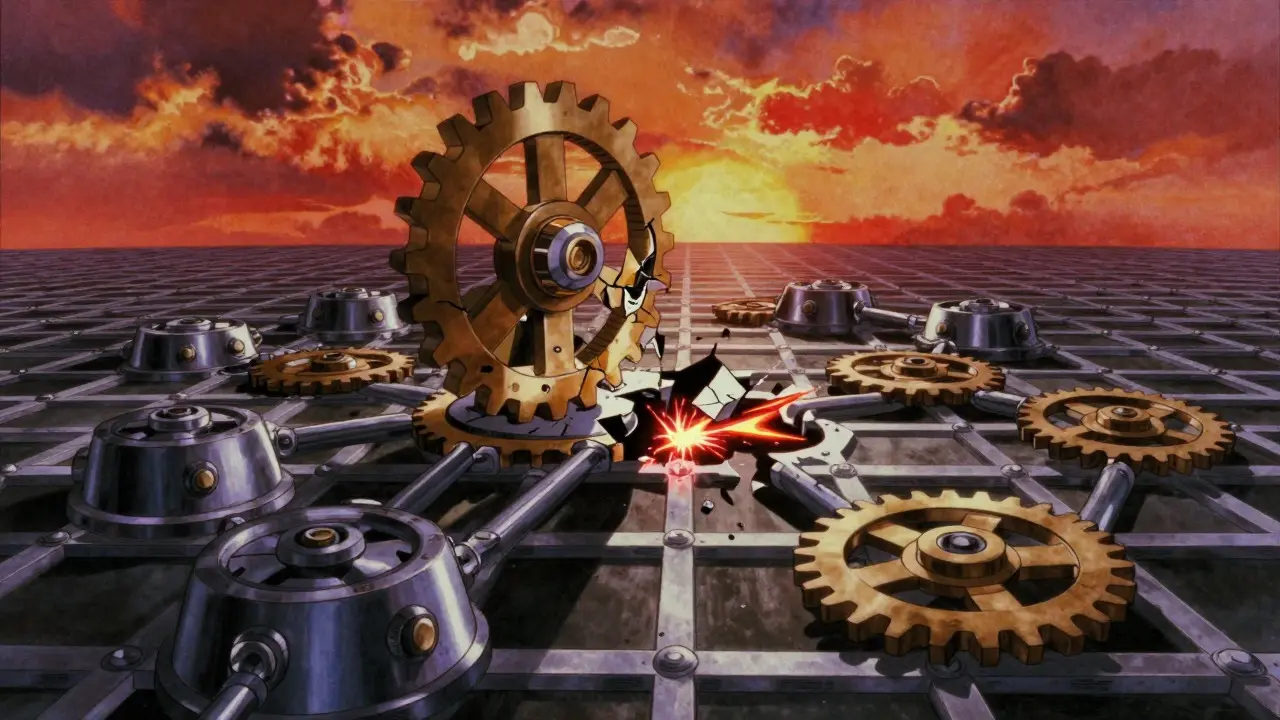
Can we predict these collapses? Researchers use the Motter-Lai model to analyze overload cascading failures. In this model, each node has a maximum capacity. Its initial load is based on its connectivity (betweenness centrality). The maximum capacity is set at the initial load multiplied by (1 + α), where α represents the system's tolerance level.
Here’s the critical insight: random failures rarely cause big problems in robust networks. But if a highly connected node-a hub-fails, the load redistributes to its neighbors. If those neighbors can’t handle the extra weight, they fail too. This shrinks the functional network size rapidly. For heterogeneous networks like DeFi, where some protocols are central (like major DEXs) and others are niche, targeting or accidentally breaking the hubs is the most dangerous scenario.
Extended models show that failure propagation speed increases as system tolerance decreases. In other words, the tighter you run your margins (low α), the faster the cascade spreads. This explains why DeFi protocols operating near their liquidity limits are so vulnerable during market shocks.
Real-World Examples: From Kafka to Crypto
You don't need to look far for examples. In the tech world, Parsely's "Kafkapocalypse" demonstrated how increased load on EC2 nodes running Kafka brokers caused one broker to hit network limits. It became unavailable, forcing load onto other brokers until all failed. This is a pure cascading failure driven by resource exhaustion.
In DeFi, similar patterns emerge. When a bridge contract experiences a reorg (reorganization of blocks), transactions might be reverted. If users or bots assume those transactions succeeded and act on stale state, they execute trades based on incorrect data. This creates arbitrage opportunities that drain liquidity pools. The loss of liquidity then impacts other protocols relying on those pools. The bridge wasn't hacked; it was just inconsistent. Yet, the result was a systemic shock.
Another common trigger is the "Query of Death." A complex query that consumes excessive resources can kill a process. In blockchain terms, a smart contract function that enters an infinite loop or performs heavy computation can block the entire mempool or revert critical transactions. Google's Site Reliability Engineering (SRE) team notes that new rollouts involving binary changes or configuration modifications often alter request profiles, triggering cascades. In DeFi, deploying a new version of a token standard or changing fee structures can have the same effect.
Prevention Strategies: Designing for Resilience
So, how do we stop the dominoes? The answer lies in shifting from "strengthening components" to "designing for absorption." Here are the key strategies:
- Implement Circuit Breakers: These are mechanisms that interrupt failure propagation. If a protocol detects abnormal volatility or liquidity depth drops below a threshold, it pauses operations automatically. This prevents the feedback loop from gaining momentum.
- Maintain Capacity Overhead: Don't run at 100% utilization. Keep safety margins in liquidity and gas limits. If demand spikes, you need buffer space to absorb the shock without breaching thresholds.
- Gradual Rollouts: Never deploy major changes to 100% of users at once. Use feature flags or phased releases. If something goes wrong, you can roll back quickly before the impact scales.
- Change Logging: Maintain detailed logs of all configuration changes and contract deployments. When a cascade starts, knowing what changed 10 minutes ago is crucial for diagnosis and rollback.
- Redundancy and Load Balancing: Avoid single points of failure. If one oracle fails, another should take over seamlessly. Distribute load across multiple validators or liquidity sources.

Comparison: Traditional vs. Composable System Failure Modes
| Attribute | Isolated Systems | Composable DeFi Ecosystems |
|---|---|---|
| Failure Propagation | Localized, contained | Non-linear, cross-protocol |
| Primary Trigger | Hardware fault, single bug | Oracle error, liquidity shift, reorg |
| Recovery Time | Minutes to hours | Hours to days (requires manual intervention) |
| Predictability | High (linear models work) | Low (complex network dynamics) |
| Mitigation Focus | Component redundancy | Systemic resilience, circuit breakers |
Future Trends: AI and Adaptive Response
As complexity grows, static rules aren't enough. Current research focuses on machine learning techniques for real-time monitoring. Imagine a system that detects subtle anomalies in transaction patterns before they become full-blown cascades. Adaptive response mechanisms could automatically adjust parameters, like increasing collateral ratios or pausing specific markets, in real-time.
However, this introduces new risks. If an AI makes a wrong decision during a crisis, it could accelerate the failure. Therefore, human oversight remains critical. The goal is not full automation, but augmented intelligence-tools that help operators make faster, better decisions.
Frequently Asked Questions
What is the main difference between a smart contract bug and a cascading failure?
A smart contract bug is a local error in code logic. A cascading failure is a systemic event where that bug (or another trigger) propagates through interdependencies, affecting multiple unrelated protocols. The bug is the spark; the cascade is the fire.
How can I protect my DeFi investments from composability risks?
Diversify across different chains and protocols. Avoid stacking too many layers of abstraction (e.g., don't use a token that is backed by another volatile token). Monitor liquidity depth and avoid protocols with low tolerance levels (tight margins). Use established oracles and check for circuit breaker implementations.
Does the Motter-Lai model apply directly to blockchain networks?
Yes, conceptually. While originally designed for power grids, the principles of load redistribution and hub vulnerability apply to DeFi. High-connectivity protocols (hubs) pose greater systemic risk if they fail. Understanding your position in the network graph helps assess risk exposure.
Are circuit breakers always effective in preventing cascades?
Not always. They are most effective when triggered early. If a cascade moves faster than the detection mechanism, the breaker may activate too late. Additionally, if all protocols use the same breaker logic, they might all pause simultaneously, creating a liquidity vacuum. Diversified response mechanisms are safer.
What role do oracles play in composability risks?
Oracles are critical single points of failure. Most DeFi protocols rely on a small number of oracle networks. If an oracle provides stale or manipulated data, it affects every protocol using it. This tight coupling makes oracle reliability a top priority for systemic stability.


